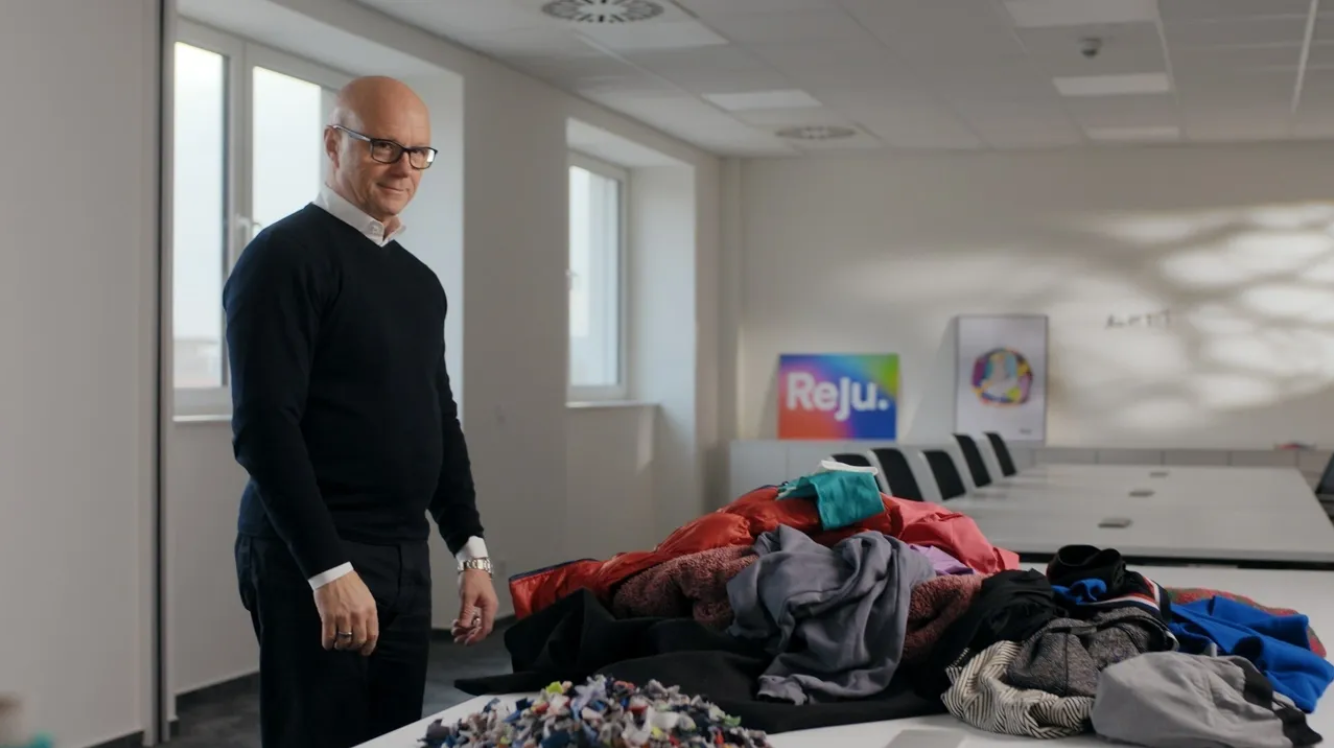
Fashion Redressed, produced by BBC StoryWorks and Global Fashion Agenda, spotlights Reju’s textile regeneration technology and its partnership with Goodwill- offering a new vision for circular fashion and textile waste solutions.
In an industry saturated with sustainability claims, storytelling has become the new battleground for credibility. The latest chapter unfolds through Fashion Redressed- a cinematic series that reframes one of fashion’s most urgent crises not through statistics alone, but through narrative, infrastructure, and human impact.
Premiering globally on a dedicated BBC.com microsite, the series- presented by Global Fashion Agenda and produced by BBC StoryWorks Commercial Productions- positions film as a powerful medium to decode the complexity of textile waste and circularity.
At its center is Reju, a textile-to-textile regeneration company quietly building what could become one of the most critical infrastructures in fashion’s circular future.
When Fashion’s Waste Crisis Becomes a Story Worth Watching
Textile waste is no longer an abstract sustainability issue- it is a visible, growing reality. Each year, millions of tonnes of garments end up in landfills, with polyester- one of fashion’s most widely used fibers- posing a particular challenge due to its synthetic composition.
Rather than presenting solutions in technical isolation, Fashion Redressed translates this complexity into accessible visual storytelling.
Reju’s participation in the series unfolds across two short films. The first dissects the scale of the textile waste problem, focusing on polyester and the science behind regeneration. The second shifts perspective- from technology to collaboration- highlighting the operational ecosystem required to make circularity viable at scale.
This dual narrative reflects a deeper truth: circular fashion is not a single innovation, but a system.
Beyond Recycling: Building a Regeneration Infrastructure
What distinguishes Reju’s approach is its focus on textile-to-textile regeneration- an area often cited as the missing link in fashion’s circular ambitions.
Unlike traditional recycling, which frequently results in downcycling, regeneration aims to restore materials- specifically polyester, back to their original quality, enabling true circularity. It is a process that sits at the intersection of chemistry, engineering, and logistics. But technology alone is not enough.
The films underscore the necessity of partnerships across the value chain- from collection and sorting to processing and reintegration into new products. This is where Reju’s collaboration with Goodwill Industries International becomes particularly significant.
Partnership, Transparency and Fashion’s Circular Future
Goodwill’s experience in collecting, sorting and reselling secondhand goods brings a practical dimension to fashion’s circular ambitions. Its model also connects reuse with employment and community support, showing how environmental goals intersect with social and economic value.
Combining that collection network with Reju’s textile regeneration technology illustrates how different parts of a circular system can work together. Collection, sorting and processing each depend on the others: a promising technology needs reliable material flows, while collected textiles need viable destinations beyond resale.
Reju’s presence in Fashion Redressed offers audiences a closer look at those connections. Film can make complex industrial processes accessible, showing the infrastructure and collaboration behind a sustainability claim. Visibility alone, however, does not establish environmental performance. Meaningful accountability also requires evidence of what a system processes, what it produces and whether it can operate consistently at scale.
For TFI, that is the more valuable conversation. Fashion’s circular future depends on the capacity of companies and organisations to connect their expertise, invest in infrastructure and demonstrate measurable results. The challenge is to turn individual initiatives into reliable systems—and make their progress, limitations and impact clear.