
The Québec brand transforms surplus fabrics into reusable gift wrapping, household textiles and festive decorations, with more than 56,000 metres reportedly recovered since its launch.
At Next Chance, unused fabric becomes the starting point for objects made for everyday living and special occasions. Table linens, reusable gift wrapping and seasonal decorations form part of a growing collection shaped by textiles recovered from designers and manufacturers. Founded in Québec in 2020 by Maude Girard and Gabrielle Huppé, the brand connects an approach to material reuse with the familiar rituals of setting a table, decorating a home and giving a gift.
The founders met through their backgrounds in finance and initially developed the business around reusable fabric wrapping. Their search for materials brought them into contact with the surplus generated by fashion and textile production: offcuts, end-of-line lots and rolls unsuitable for their original purpose. These fabrics became the foundation for a broader range of products, with design decisions responding to what could be recovered.
According to a November 2026 report by La Presse Canadienne, Next Chance has recovered 56,090 metres of fabricsince its founding. The company’s next target is a cumulative 90,000 metres by Earth Day on 22 April 2027. The same report puts its team at 14 full-time and part-time employees, with products distributed through approximately 200 retail locations across Canada.
Designing With What Already Exists
Next Chance sources its textiles primarily from manufacturers and designers in the Greater Montréal area. Its process preserves the existing fabric, which is sorted, allocated to suitable products, cut and sewn. The approach allows the company to retain the material’s construction while finding a different purpose for it.
This changes the relationship between sourcing and design. Rather than selecting a fabric that can be ordered repeatedly, the team works with finite quantities and varying characteristics. A textile’s dimensions, texture and available volume help determine where it belongs within the collection. The resulting colours and patterns depend on the materials entering the workshop.
The company says it also retains remnants generated during its own production, finding further uses for smaller pieces, including filling for Christmas ornaments. Accessories offer another application: its September 2026 hair-accessories launch introduced scrunchies and bows that accommodate smaller fabric scraps.
That relationship between material and product gives the brand room to expand without moving away from its sourcing model. Gift wrapping, tableware and decorative objects require different sizes and types of fabric, creating several possible destinations for the textiles it collects.
The recovered quantities remain company-reported figures. They describe the scale of its material collection, rather than providing a calculation of emissions or water savings. Next Chance’s established work also centres on unused industry surplus; the founders have identified used clothing and household textiles as a future area of development.
From Everyday Tables to Festive Traditions
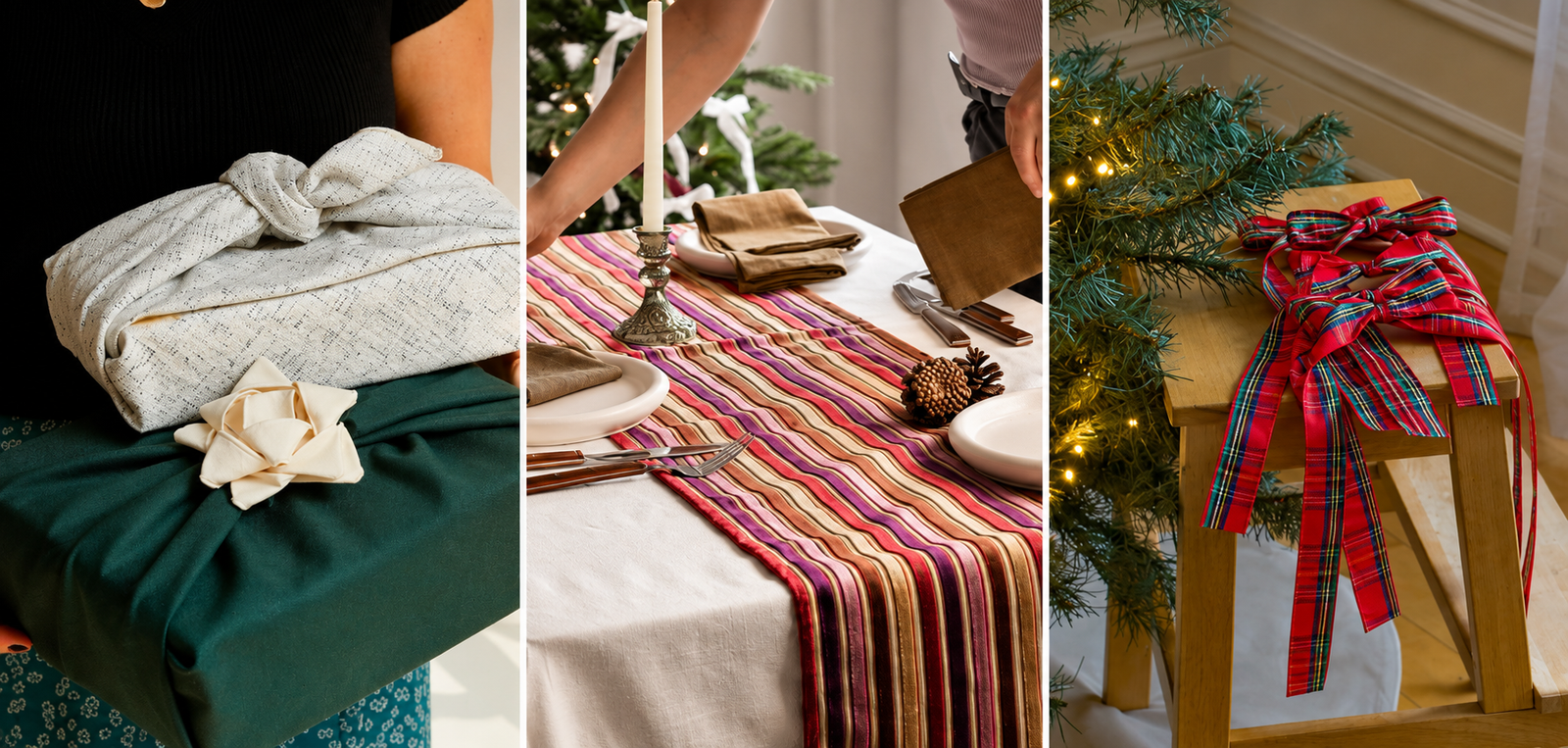
Reusable gift wrapping remains central to the range. Fabric squares presented as furoshiki sit alongside gift bags, bottle bags, decorative bows and wrapping accessories. The fabric becomes part of the gift-giving ritual, with the possibility of being folded, stored and brought out again for another occasion.
The concept has also moved into retail settings. In November 2023, Signé Local announced a holiday collaboration offering Next Chance wrapping at checkout in four Québec stores and online. An earlier partnership with Medicart/Epiderma introduced recovered-textile packaging for online beauty-product orders, illustrating how the same approach could serve both individual customers and businesses.
Within the home, the collection extends to tablecloths, runners and cloth napkins. These pieces broaden the brand’s relevance beyond celebrations, placing recovered fabric within everyday meals as well as larger gatherings. Patterns and colours can be combined with existing crockery and household objects, allowing the same textile to take on different roles throughout the year.
Festive items build on that domestic foundation. The range includes stockings, fabric ornaments, garlands, decorative ribbons, oversized bows and reversible Christmas tree skirts. Corduroy, velvet and patterned textiles bring texture to familiar seasonal forms, while reusable Advent calendars offer an object that can be filled differently each December.
With Christmas approaching, these pieces provide a timely introduction to the brand, but they belong to a wider collection concerned with repeated use. A tablecloth can remain in circulation after the decorations are stored; a fabric bag can return for birthdays or other occasions. Their continued usefulness depends on how they are kept, cared for and incorporated into household routines.
For Next Chance, growth has come through finding more applications for available textiles and building a market for the resulting objects. Its homeware brings that process into a personal setting, where material reuse becomes visible through the things people handle, display and return to over time.
Discover the collection: Next Chance · Instagram: @nextchance.ca