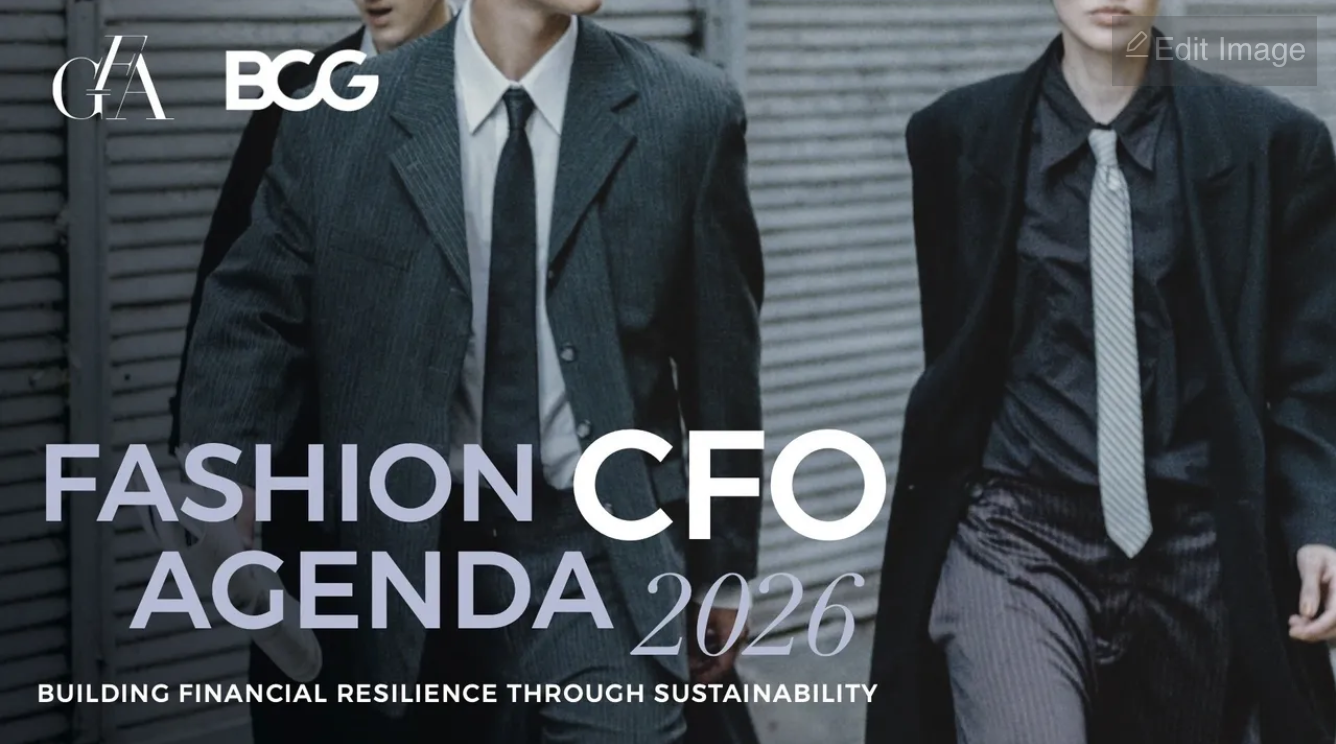
A report from Boston Consulting Group and Global Fashion Agenda examines how sustainability is reshaping fashion’s costs, risks and investment decisions and why finance teams have a central role to play.
Sustainability is becoming a financial question that fashion companies can no longer leave to a single department. Decisions about materials, production and environmental impact increasingly affect operating costs, exposure to regulation and long-term profitability.
The Fashion CFO Agenda 2026, from Boston Consulting Group and Global Fashion Agenda, places those connections at the centre of the finance function. Unveiled at the Global Fashion Summit, the report argues that sustainability needs to be embedded in financial planning, capital allocation and risk management.
The pressures are already tangible. According to the report, climate-related disruptions have contributed to price spikes of up to twice previous levels for raw materials such as cotton and wool. Emerging extended producer responsibility policies could also reduce profits at large fashion companies by approximately 4% by 2030.
Yet the report identifies a disconnect between this growing financial exposure and the attention sustainability receives in executive communications. Mentions in earnings calls have declined since 2022, as AI, trade and market volatility occupy more of the conversation. Environmental risks, however, remain closely connected to those wider business concerns.
You will never be happy if you continue to search for what happiness consists of. You will never live if you are looking for the meaning of life.
From Environmental Commitments to Investment Decisions
The CFO’s involvement changes how sustainability initiatives are assessed, funded and measured. Projects need to be considered through their effects on costs, supply security, regulatory exposure and future revenue, alongside their environmental outcomes.
There is potential for financial gains as well as risk reduction. The report estimates that up to 70% of fashion’s greenhouse gas emissions could be reduced at low cost or with net savings. That finding challenges the assumption that reducing environmental impact invariably requires a substantial financial sacrifice. It does not mean every intervention will pay for itself: companies still need to assess investment requirements, implementation costs and the time needed to realise returns.
A central obstacle is the gap between sustainability commitments and everyday financial decisions. When environmental objectives sit outside budgeting and performance measurement, their costs and benefits can be difficult to evaluate consistently.
The report calls for closer collaboration between finance leaders, chief sustainability officers, supply chain teams and external partners. Finance brings investment discipline and accountability; sustainability and operational teams bring the expertise needed to assess environmental impacts and practical delivery.
CFOs interviewed for the report also identified benefits extending beyond direct savings, including greater operational transparency, stronger brand equity and improved employee engagement. These outcomes may contribute to long-term value, although their financial effects require careful measurement rather than assumption.
For TFI, the significance is the connection between a company’s stated ambitions and the decisions that receive funding. Material choices, supplier relationships and production systems become more likely to change when environmental objectives influence budgets and investment criteria.
That gives finance a greater role without diminishing the contribution of designers, makers or sustainability specialists. Creative and technical ideas still need space to develop. Financial backing helps turn them into practices that can operate across a business.
The report’s broader message is that resilience depends on understanding which investments will leave a company better prepared for changing conditions. For fashion’s CFOs, sustainability is increasingly part of that calculation.
Read the Fashion CFO Agenda 2026 at Global Fashion Agenda.