The Japanese airline’s new upcycling project launches with a five-piece collection that puts surplus seat-cover fabric to work in outerwear and bags.
All Nippon Airways has partnered with Spanish fashion brand ECOALF to turn unused aircraft-seat fabric into jackets and bags, opening a new commercial outlet for textiles made redundant by changes to cabin seating specifications. Launched in Japan on 5 November 2026, the ANA × ECOALF PAX series is the first collection from 2ND RUNWAY, an upcycling project developed by the airline’s maintenance division.
According to Sanyo Shokai, which operates ECOALF in Japan, the collection uses approximately 400 metres of fabric measuring two metres wide — equivalent to seat-cover material for around 200 seats on an ANA Boeing 777. Manufactured as replacement upholstery, the fabric remained unused after seating specifications changed, leaving the airline with stock that could no longer fulfil its intended purpose.
Designing Around the Material
ECOALF selected the upholstery after examining materials stored at ANA’s Haneda Airport maintenance facilities, including engine components, window frames and curtains. The seat-cover fabric offered a particular opportunity: a textile developed to withstand demanding conditions, with properties that could translate into everyday clothing and accessories.
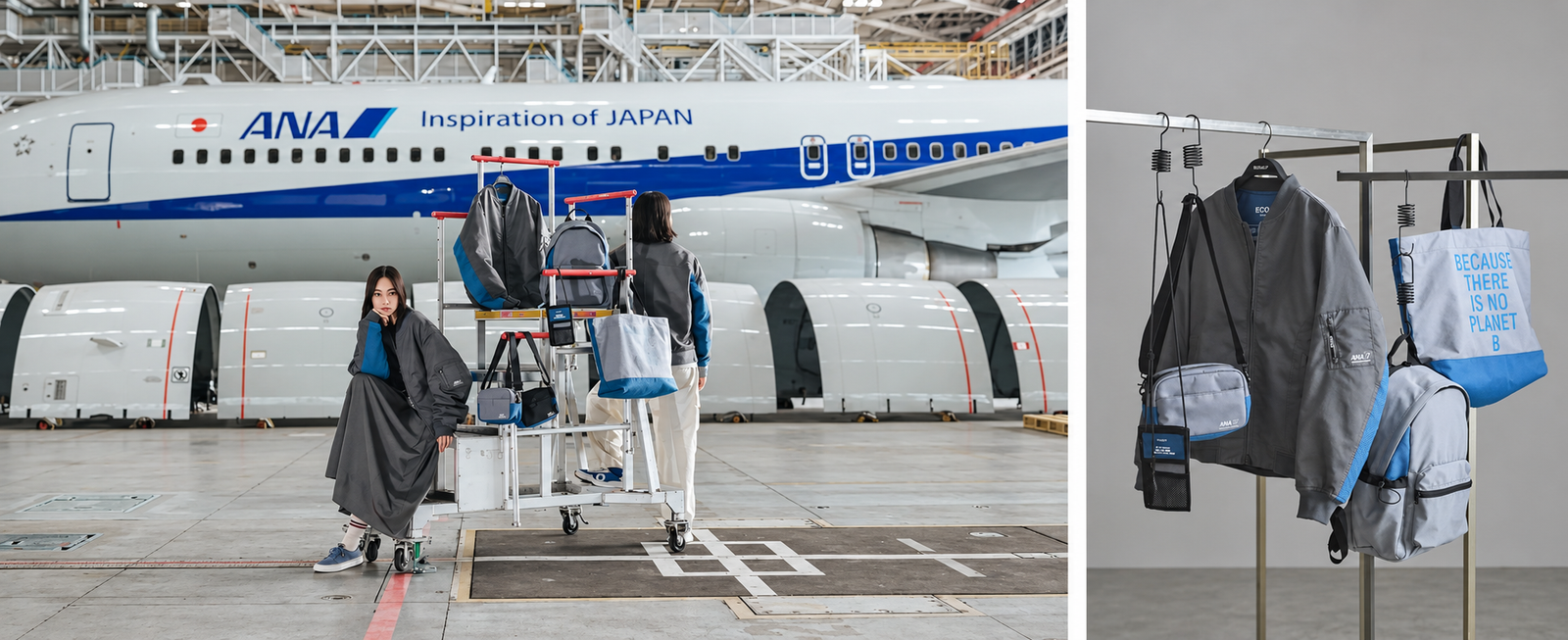
The wool-and-aramid blend was designed with flame resistance, abrasion resistance and passenger comfort in mind. For the collaboration, ECOALF used it in selected sections of a unisex flight jacket, backpack, large tote, shoulder bag and compact crossbody that can also hold a passport. The series takes its name from PAX, the aviation abbreviation for passengers.
A grey-and-blue palette connects the five designs, with the blue upholstery serving as both a visual accent and a functional component. On the backpack, it appears across the back and gussets; on the tote, it is used for the base, gussets and an internal pocket. The flight jacket combines a recycled nylon main shell with upholstery panels beneath the sleeves and on the reverse of the back yoke. Its contrasting aircraft fabric is specified as 85 per cent wool and 15 per cent aramid.
The construction places the surplus textile where its resistance to wear can serve a practical purpose. It also defines the scope of the collaboration’s material reuse: the aircraft fabric forms part of each product, alongside other textiles, rather than accounting for the entire garment or bag.
Reaching Beyond Aviation Collectibles
For ANA, the partnership addresses an audience challenge as well as a material one. The airline has previously developed products from discarded aircraft materials and unused components, but said these tended to appeal primarily to aviation enthusiasts. Working with ECOALF offered a way to introduce those resources to a wider market through fashion and everyday utility.
Developed over approximately 18 months from the initial concept, the collection establishes the approach behind 2ND RUNWAY. Led by the business development team within ANA’s maintenance division, the project aims to give discarded and unused aviation materials new applications in fashion and lifestyle products.
In the announcement, Sanyo Shokai’s ECOALF representative emphasised desirability and practicality as priorities for the collaboration. ANA’s representative similarly highlighted the role of design in presenting familiar aviation materials differently, making their functional qualities relevant beyond their original setting.
Founded in Spain in 2009 and introduced to Japan through Sanyo Shokai in 2020, ECOALF brings an established fashion distribution network to that ambition. The collection is available through seven ECOALF stores in Japan, its Japanese online store and ANA retail channels, including online shopping platforms and the ANA FESTA arrivals gift shop at Haneda Airport.
The collaboration’s significance lies in the relationship between the available stock and the resulting designs. Material developed for aircraft seating has been assigned specific functions in products intended for regular use, giving redundant inventory a route back into commerce. Whether 2ND RUNWAY can sustain that approach across subsequent releases will determine its broader role as an outlet for aviation materials.
The collection is available through seven ECOALF stores in Japan and its Japanese online store, alongside ANA’s retail channels, including its online shopping platforms and the ANA FESTA arrivals gift shop at Haneda Airport. Further collection updates are available on Instagram through @ecoalf_japan and @ana.japan.