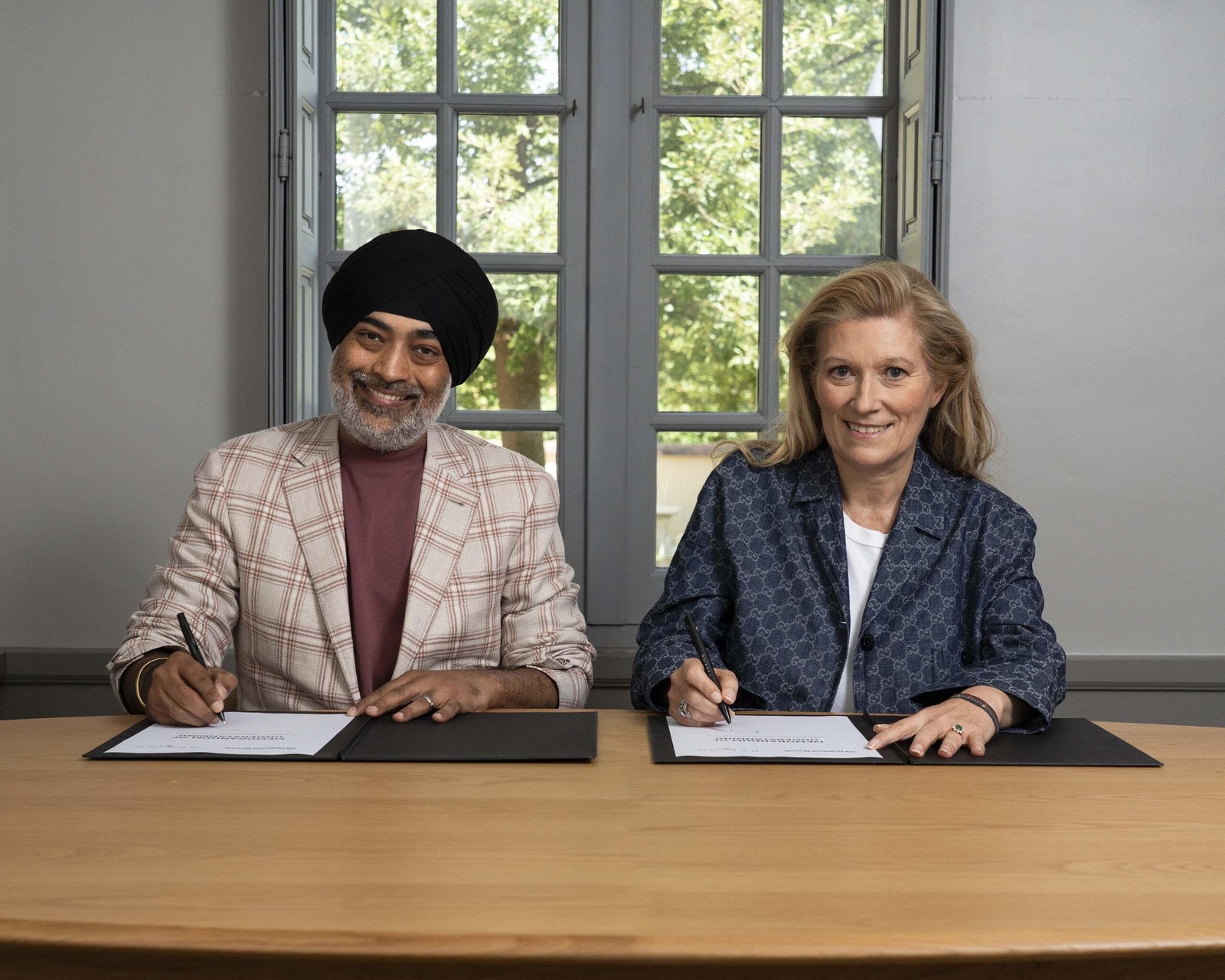
The Kering Generation Award is expanding to India for the first time, as the luxury group partners with Reliance Brands Limited to identify startups developing circular solutions for fashion.
Kering is bringing its Generation Award to India, extending the luxury group’s sustainability innovation programme into one of fashion and luxury’s most significant emerging markets.
The initiative, launched in partnership with Reliance Brands Limited (RBL), will focus on Indian startups developing circular solutions with a direct impact on resource protection. The partnership was formalised at Kering’s headquarters in Paris, where Marie-Claire Daveu, Kering’s Chief Sustainability and Institutional Affairs Officer, and Jaspreet Chandok, Group Vice President of Reliance Brands Limited, signed a memorandum of understanding.
Circular innovation takes centre stage
For its first Indian edition, the award is narrowing its attention to circularity — an increasingly important challenge for an industry seeking to reduce its dependence on virgin resources while reconsidering what happens to materials and products at the end of their first life.
The programme will work with the R|Elan™ Circular Design Challenge, in partnership with the United Nations in India, as its exclusive nominating partner. The collaboration places Indian entrepreneurs working across materials, technology and circular business models within a wider international luxury innovation ecosystem.
It marks the award’s first edition in India, extending a programme that began in China in 2018 and has since expanded internationally.
For Kering, whose portfolio includes Gucci, Saint Laurent, Bottega Veneta, Balenciaga and McQueen, the initiative forms part of a much broader effort to identify technologies capable of reducing fashion’s environmental and social impacts across the value chain — from raw materials and manufacturing to the eventual end of life of products.
From China to India
The Kering Generation Award traces its origins to the luxury group’s work with innovation platforms to identify new materials, processes and technologies.
Kering joined the Plug and Play – Fashion for Good accelerator in 2017 before launching the first Kering Generation Award with Plug and Play China the following year. The programme has since expanded into markets including Japan and Saudi Arabia, alongside a dedicated international initiative for the jewellery sector.
Its scope has evolved with each market. Recent editions have explored subjects ranging from alternative materials and sustainable beauty to water-positive innovation.
India now introduces another dimension: circularity and resource protection.
The expansion is significant not simply because of India’s growing importance to international luxury, but because of the country’s existing ecosystem of designers, material innovators, manufacturers, entrepreneurs and craft traditions.
Expanding the Kering Generation Award to India is a natural and strategic next step in our mission to support visionary impact startups that are shaping the future of luxury.
She described India as both a rapidly growing luxury market and a hub for innovation and entrepreneurship, pointing to the potential for entrepreneurs working across fashion, beauty and innovation to accelerate circular solutions for the industry.
Where luxury and India’s fashion ecosystem meet
Reliance Brands brings another layer to the partnership. Established in 2007, the company has become one of the principal operators connecting international luxury and premium brands with the Indian market. Its portfolio spans brands including Bottega Veneta, Balenciaga, Burberry, Giorgio Armani, Jimmy Choo, Stella McCartney, Tiffany & Co., Valentino, Versace and Zegna, among others.
The company currently operates more than 1,855 points of sale across India and has also invested in Indian designer businesses. That existing network gives the award access to an ecosystem extending beyond an innovation competition itself — connecting emerging ideas with the commercial realities of fashion and luxury.
The future of luxury will be shaped not only by creativity, but by the ability to innovate responsibly.
For Chandok, India’s opportunity lies particularly in the talent already rethinking materials, technologies and circular business models, with the partnership offering those innovators greater international visibility.
The bigger question: can innovation move beyond the pilot stage?
Innovation awards have become increasingly visible across fashion as brands and luxury groups search for alternatives to conventional materials, production systems and linear business models.
The more difficult challenge comes after an award is presented. Moving an experimental material or circular technology from a startup environment into commercial fashion requires investment, infrastructure, reliable supply, technical performance and, crucially, demand from brands prepared to implement it at meaningful scale.
Kering’s wider innovation activity suggests the Group is increasingly looking beyond discovery alone. Over the past decade, it says it has worked with more than 225 startups spanning alternative materials, manufacturing, emerging technologies and circular economy solutions, while developing dedicated innovation laboratories and investment activity around new materials and business models.
That makes the Indian edition worth watching beyond the names ultimately selected. If the programme can connect local innovation with the resources and commercial reach of two major players in luxury and fashion, its impact may ultimately be measured less by the award itself than by what happens to the winning solutions afterwards.
Delhi will host the first Indian awards
The first Kering Generation Award India ceremony is scheduled for October 13, 2026, at the Embassy of France during Fashion Week in Delhi. The event will also form part of the Franco-Indian Year of Innovation, positioning the initiative within a broader exchange between the two countries around technology, creativity and entrepreneurship.
For India’s emerging fashion innovators, the award represents access to an international platform. For Kering, it provides another route into a market increasingly relevant not only as a destination for luxury consumption, but as a potential source of the technologies, materials and circular systems that could influence how luxury is made.
And that distinction may prove important, as fashion’s sustainability conversation shifts from ambition to implementation, the industry’s next significant solutions may not necessarily emerge from its traditional capitals.