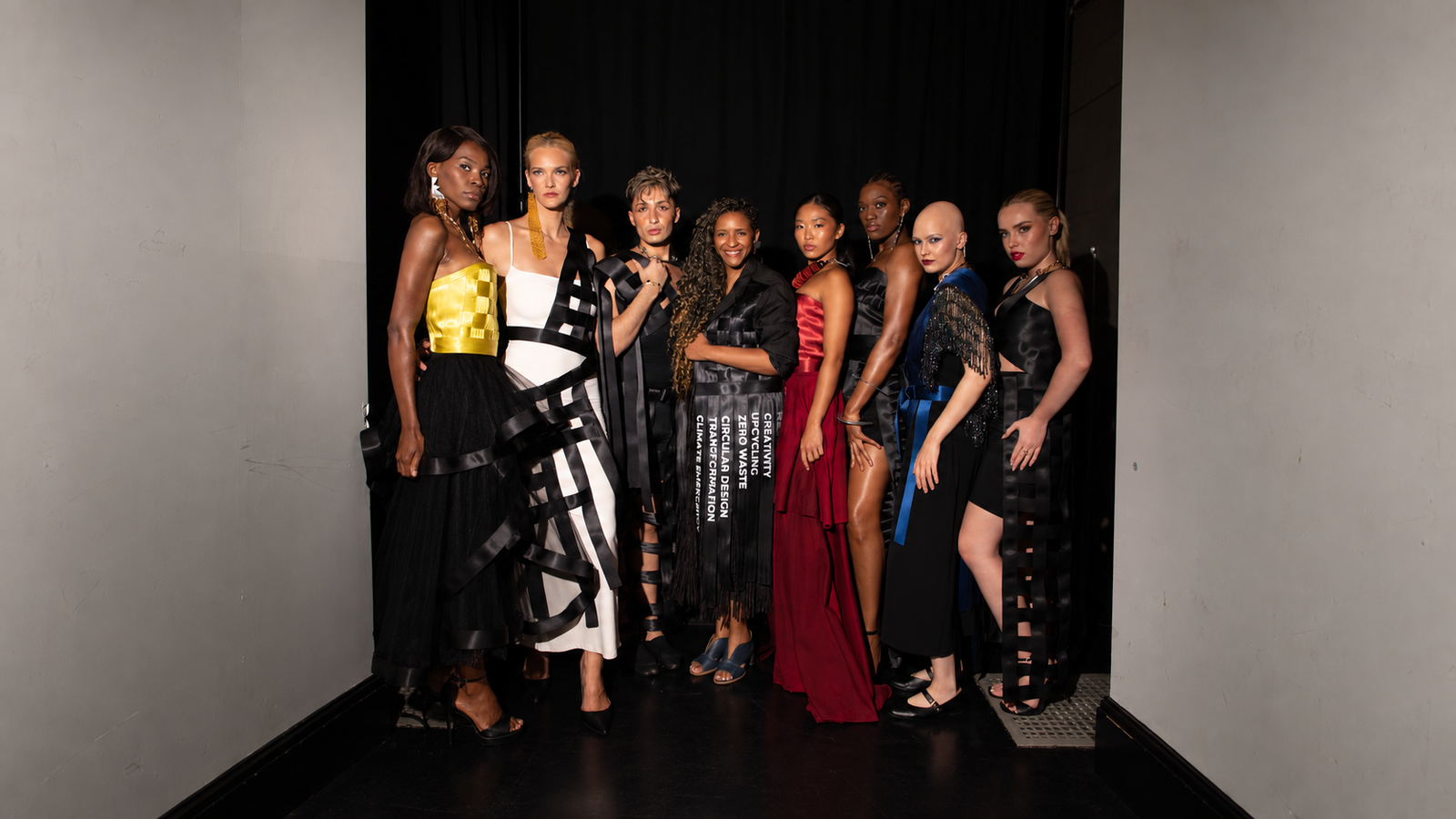
Through Badu Design, the Brazilian designer has transformed industrial waste into fashion, trained thousands of women and carried her ideas from Curitiba to TEDx, climate forums, Harvard, MIT and the runways of New York. Her latest collection, I’M BACK, brings those strands together.
When Ariane Santos presented I’M BACK in New York, she brought more than a collection to the runway. Behind its sculptural forms was a career spanning fashion, social entrepreneurship, environmental advocacy and education and a business founded on the belief that design can change the value assigned to materials, labour and creative knowledge.
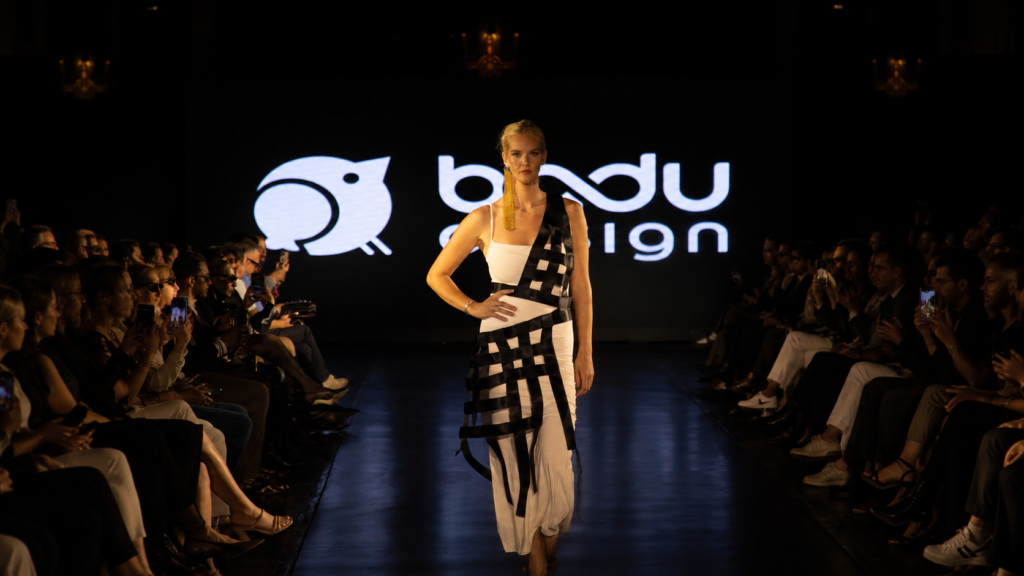
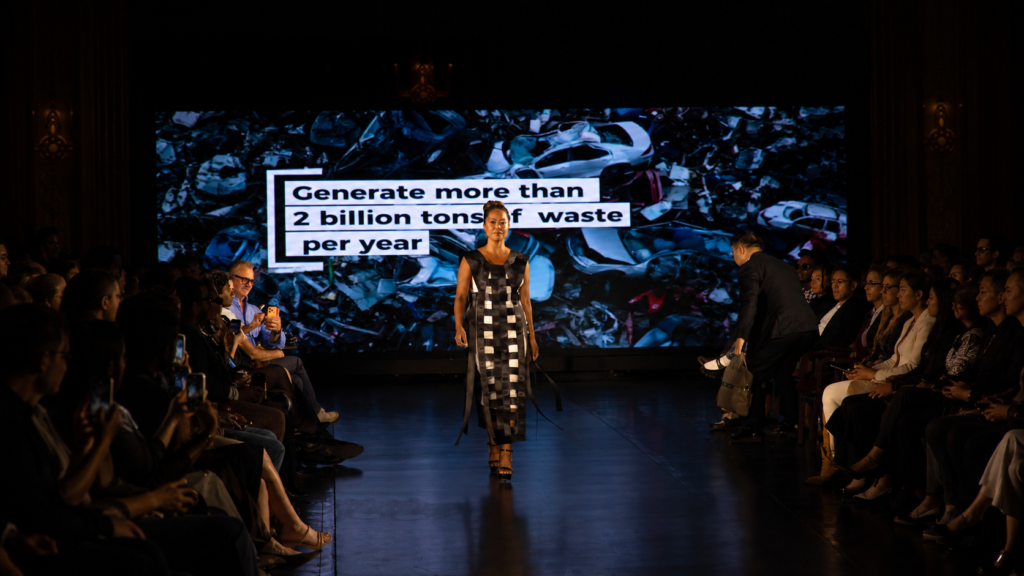
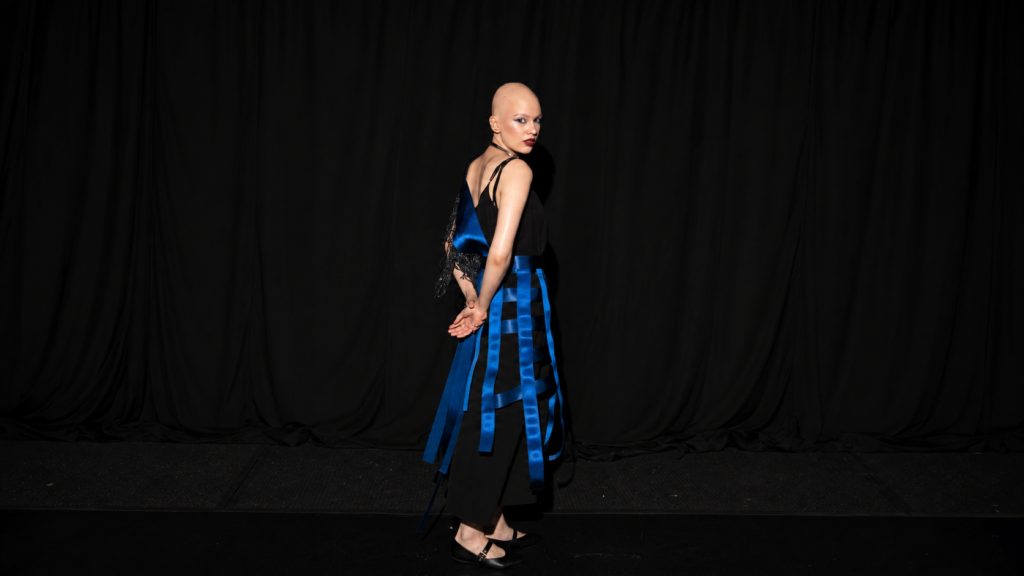
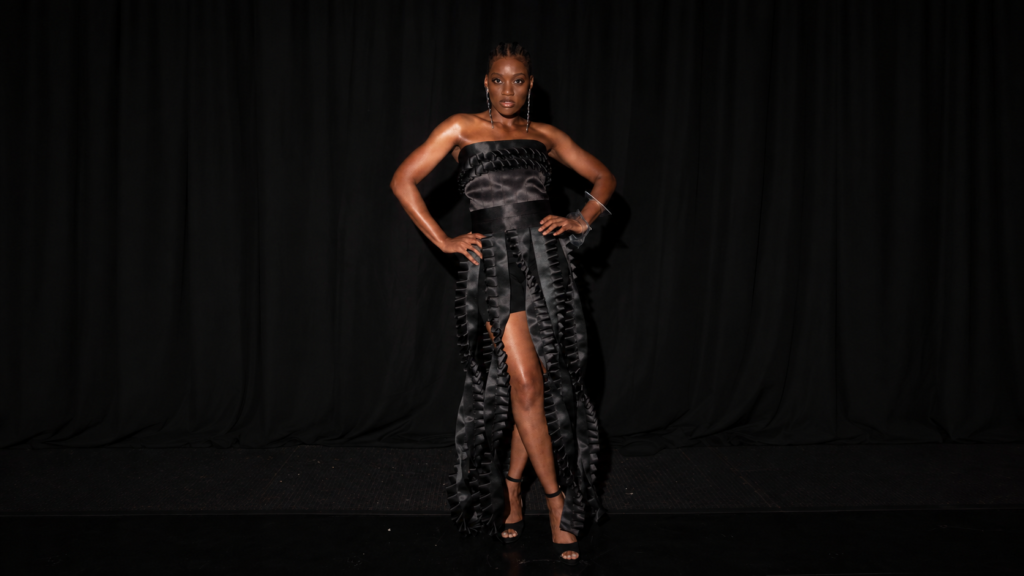
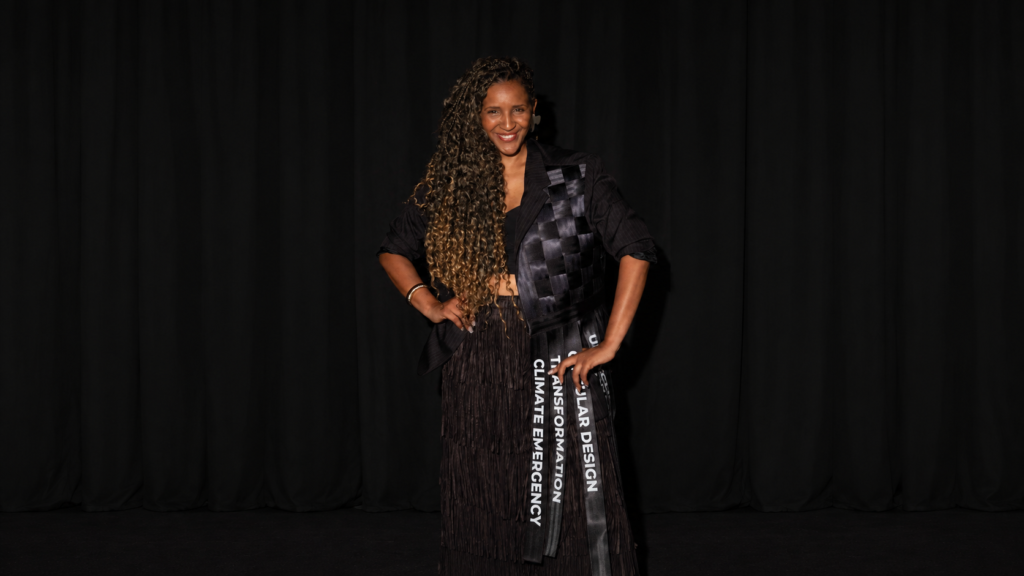
Presented at the Unique Fashion Show during New York Fashion Week on September 13, 2026, I’M BACK transforms discarded automotive seat belts into gender-neutral wearable accessories. Engineered to restrain and protect passengers, the webbing returns in another form: crossing the body, creating volume and turning an industrial component into a contemporary fashion proposition.
The collection is the latest expression of the work Santos has developed over more than a decade through Badu Design. The runway, however, reveals only part of that story.
Santos has spoken at TEDx events, represented her work at the Brazil Conference at Harvard and MIT, participated in Web Summit Lisbon and contributed to climate and circular-economy forums. She received Climate Citizen recognition in 2022 and was named Creative of the Year in Curitiba in 2025. In 2026, she joined Fashion Forward as a Founding Voice.
Across these platforms, Santos has carried a model developed in Brazil: one grounded in industrial waste and built alongside women whose labour and knowledge are often absent from fashion’s dominant narratives.
A business shaped by care
Before founding Badu, Santos worked in the corporate sector and studied business administration at the Federal University of Paraná. Her professional trajectory changed when she left work to care for her grandmother.
Following her grandmother’s death, Santos experienced severe depression. Making became part of the process through which she began rebuilding her life. With R$30, she produced a small group of fabric-covered notebooks and placed them in a local shop. They sold, providing the first commercial foundation for what would become Badu Design.
The company’s name evolved from badulaques, a Portuguese term for small decorative objects, which friends had used to describe Santos’s handmade creations. What began as a modest creative practice gradually became a circular-design business working with discarded textiles and industrial materials.
Care did not remain a detail in the founder’s biography. It influenced the organisation she built.
Some of Badu’s earliest collaborators were women Santos encountered while spending time in hospitals with her grandmother. Many had stepped away from paid employment to care for children, older relatives or other family members. Their circumstances exposed a recurring economic reality: conventional employment rarely accounts for the unpaid care responsibilities carried disproportionately by women.
Badu began offering training in sewing, design, upcycling and entrepreneurship. Its model sought to create routes into the creative economy for women from peripheral communities and favelas, including those who needed paid work to coexist with family responsibilities.
This work later developed through Liga Badu de Empreendedoras and the nonprofit Instituto Liga Badu. The institute expanded the programme beyond product manufacturing, combining technical instruction with circular-design education, entrepreneurship, personal development and opportunities for income generation.
According to current Badu materials, more than 4,000 women across Brazil have participated in training based on Santos’s methodology. The reported figure represents considerable growth from the network of approximately 1,500 women across four Brazilian states cited during Badu’s participation in Web Summit Lisbon in 2024.
The ambition extends beyond the number of participants. Badu positions women as skilled contributors to the circular economy, with the ability to develop products, generate income and apply those skills beyond the company’s own production network.
Changing the terms of waste
Badu’s environmental model was also shaped by an early confrontation with industry. Santos has previously recalled a company delivering boxes of unwanted material to her home without warning. Presented as a donation, the delivery effectively transferred the cost of sorting, storing and transforming the company’s waste to a much smaller organisation.
The incident changed how Badu approached industrial partnerships. Rather than accepting waste as a charitable contribution, the company moved towards shared responsibility. Businesses could supply discarded materials, commission Badu to develop new products and purchase the results for internal use, gifting or resale. Its transformation requires research, design, labour, infrastructure and technical knowledge.
The distinction matters. It recognises that discarded material does not become valuable through intention alone.
Badu has since worked with automotive components, uniforms, hospital textiles, banners, event carpeting and other industrial remnants. One documented partnership demonstrates the model at a measurable scale. Hospital Pequeno Príncipe reported that its collaboration with Badu diverted 1.7 tonnes of textiles from landfill in 2024 and transformed them into 1,520 products.
This combination of material recovery, design services and social impact has taken Badu beyond the conventional profile of a small upcycling label. It offers a practical example of how corporate waste responsibility might support local production and women’s economic participation.
From personal experience to a public voice
As Badu developed, Santos’s personal history and professional practice became the basis of a wider public voice.
In her TEDxBlumenau talk, Como é Sua Relação com o Tempo?—What Is Your Relationship with Time?—she reflected on the pace of corporate life, the interruption created by caregiving and the need to reconsider conventional definitions of productivity.
The talk situated Badu within a larger question: can work be structured around human lives, or must people continue adapting themselves to systems designed without care in mind?
By the time Santos appeared at TEDxBeloHorizonte in 2025, that personal reflection had developed into a broader argument about circular economy and sustainable design. Speaking during an edition focused on climate and the preservation of Brazil’s Cerrado, she addressed fashion’s capacity to reduce waste while expanding opportunity for women experiencing social and economic vulnerability.
The progression between the two stages reflects the evolution of her practice. An intimate examination of time, grief and recovery became a public proposition about resources, industry and economic participation. The personal experience remained present, but it had grown into a framework for questioning larger systems.
Santos has since taken those ideas into entrepreneurship, innovation and climate forums. Her appearances have included Web Summit Rio, Web Summit Lisbon, Expo Favela in France and discussions held in preparation for COP30. During São Paulo Climate Week in 2026, she joined representatives from ELLE Brasil, FARM Rio and the Ellen MacArthur Foundation for a discussion about design, communication and the emerging culture of circular fashion.
Her forthcoming programme at Climate Week NYC extends that presence. From September 20 to 27, Santos is scheduled to participate in activities connected with the UN Global Compact, SDGs in Brazil and Hub Live as the city hosts Climate Week alongside the United Nations General Assembly.
These activities constitute engagement with UN-related climate and sustainable-development networks. They should be distinguished from direct employment or an official role within the United Nations. Their relevance lies in the path they represent: a practice that began with fabric-covered notebooks in Curitiba now contributes to international conversations about circularity, development and climate action.
Recognition without tokenism
In 2024, Santos was selected as one of ten ambassadors for the Brazil Conference, organised by Brazilian students at Harvard and MIT. The appointment gave her an international platform from which to discuss circular design, social impact and women’s entrepreneurship.
The experience also exposed the limits of representation. During the conference, Santos publicly criticised an environment she described as elitist and predominantly white. She questioned forms of inclusion that provide visibility to Black participants without granting them meaningful influence.
Her intervention complicates a familiar narrative about success: the journey from the periphery into prestigious institutions. Access to a room does not necessarily confer authority within it, just as visibility does not automatically redistribute power.
As a Black Brazilian woman who built her business in Curitiba’s periphery, Santos has spoken about the importance of controlling her own narrative. She has cited Chimamanda Ngozi Adichie’s writing as influential in strengthening that sense of authorship.
Within Santos’s practice, representation is connected to material questions. Who is permitted to define innovation? Whose knowledge receives recognition? Who participates in the value generated by fashion, and who is presented merely as evidence of its social conscience?
From circular design to fashion
Fashion has become an increasingly prominent expression of Badu’s work. In September 2024, the brand presented Repense/Rethink at Brazilian Fashion Day at the Consulate General of Brazil in New York. The collection used automotive seat belts to connect material experimentation with climate justice and contemporary Brazilian design.
Badu has also participated in collaborative cultural projects. Santos served as a director of Ritos Periféricos, developed with CUFA, Casa93/Casa Geração and other partners as part of the France–Brazil Season. Inspired by the visual culture of Rio de Janeiro’s Bate-Bola carnival groups, the project brought together fashion, performance, peripheral identity, ancestry and circular-design education.
I’M BACK consolidates these experiences. Its principal material is particularly suited to Santos’s practice. A seat belt is designed for protection, engineered for durability and difficult to return to conventional recycling systems. Badu treats those constraints as the beginning of the creative process.
During the Unique Fashion Show, the collection was presented with recycled-aluminium accessories by Ateliê Xongani, the Brazilian studio led by Ana Paula Xongani. Film shown during the presentation brought Badu’s seamstresses, scrapyards and material processes into the runway narrative, making the system behind the finished image visible.
Before the runway show, Santos introduced the collection through a fashion intervention at Art Meets Fashion at Saphira & Ventura Gallery. Moving the work between gallery and catwalk invited two readings: as material experimentation and as a fashion proposition intended to enter cultural and commercial circulation.
The title I’M BACK carries several meanings. It marks Santos’s return to New York, the return of a discarded material to use and the reappearance of something the prevailing system had already classified as finished.
Designing access
Santos’s achievements form an expansive list: TEDx appearances, climate recognition, participation at Harvard and MIT, international entrepreneurship summits, fashion presentations in New York and Paris, and a growing role in discussions about circular design.
Their cumulative meaning is more consequential than any individual distinction.
Through Badu, Santos argues that environmental innovation cannot be separated from access—to skills, income, authorship, markets and the time required to develop creative potential. Its circularity concerns the movement of materials, but it also asks how opportunity moves through society.
That broader purpose does not diminish the importance of the fashion. It places greater demands on it. The products must carry a convincing design identity while supporting an organisation with environmental, commercial and social responsibilities. International exposure must lead to durable relationships rather than momentary attention. Training must create meaningful possibilities beyond participation figures. Industrial partnerships must recognise design labour rather than treating small creative enterprises as convenient destinations for unwanted materials.
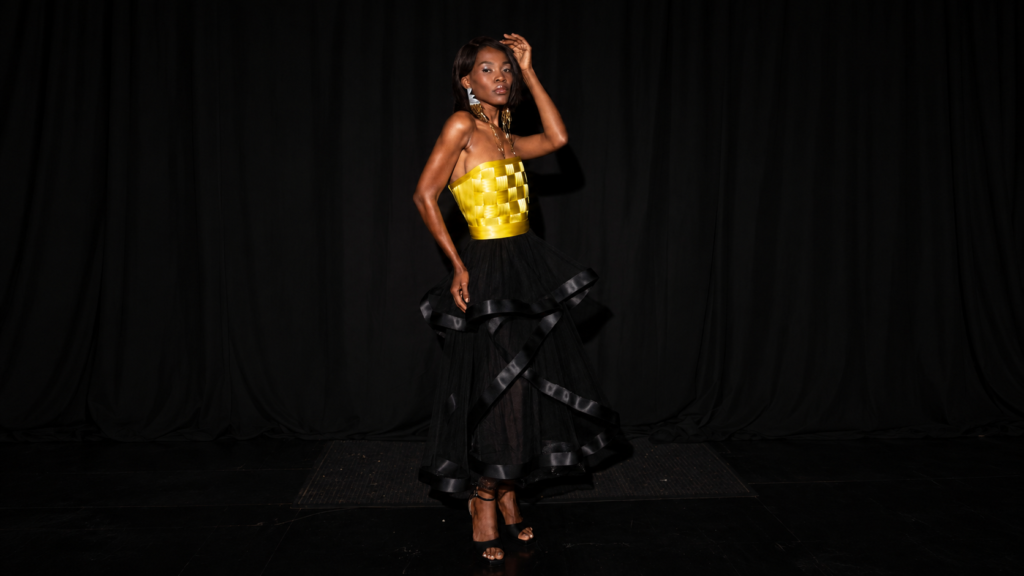
The seat belts in I’M BACK make this philosophy immediately legible. Objects created for one tightly controlled function have been released into another life. Their past remains visible, but it no longer determines what they are permitted to become.
The same principle runs through Santos’s career. From caregiving and personal recovery to women’s education, public advocacy and international fashion, she has built a practice around identifying potential where established systems have failed to recognise it. The runway is the latest platform for that idea. It is neither its beginning nor its final form.
Discover Badu Design: Website: loja.badudesign.com.br | Instagram: @badudesign