
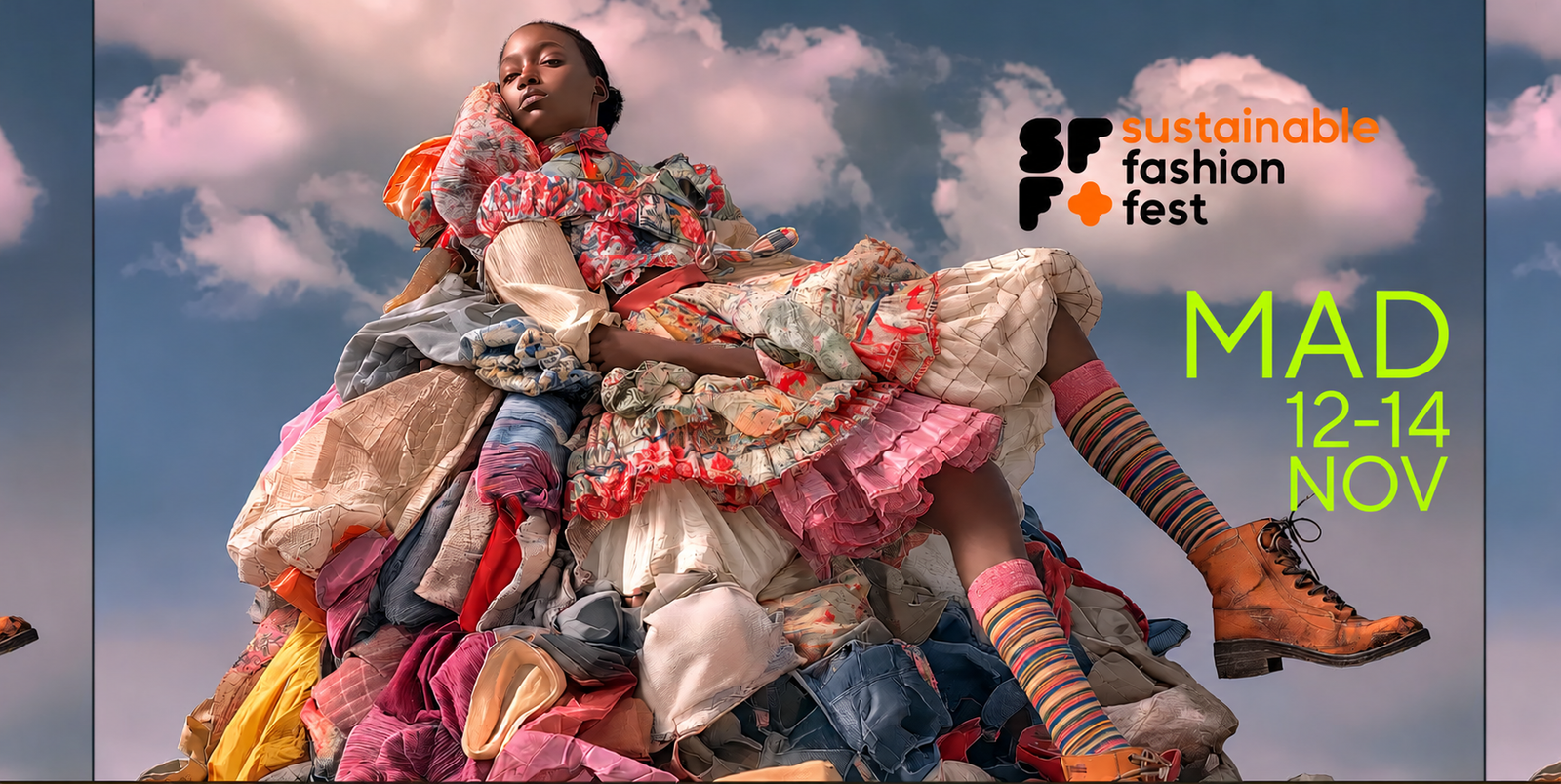
As the festival prepares to return to Madrid from 12 to 14 November, its expansion into digital commerce and international distribution raises a wider question for independent sustainable fashion brands: how can industry visibility become a viable business?
For independent fashion designers, securing a place on an international runway is often easier than building the infrastructure needed to sell beyond it. Production constraints, fragmented distribution networks and the cost of entering new markets remain persistent barriers, particularly for smaller labels seeking to reconcile responsible manufacturing with commercial growth. Sustainable Fashion Fest Madrid is attempting to address that disconnect by extending its activities beyond the event itself.
Returning to the Spanish capital from 12 to 14 November 2026, the festival, founded by Leticia Rufin Alonso, will bring international designers, industry professionals and emerging talent to Próxima Estación for three days of runway presentations, conferences and creative initiatives. This year’s programme spans circular design, textile reuse, inclusive fashion and artificial intelligence, but its most consequential development may be taking place outside the traditional fashion-show format.
Through Sustainable Marketplace and SFF Global Fulfillment & Distribution, the organisation is developing commercial services intended to connect independent brands with buyers and support international market access. The initiatives reflect a shift from providing designers with exposure towards addressing some of the structural challenges that determine whether emerging fashion businesses can grow.
Beyond Runway Visibility: The Business of Sustainable Fashion
Sustainable Marketplace, the festival’s digital commerce initiative, is being developed as a platform where participating brands can establish individual storefronts and reach both consumers and professional buyers. Its online presence already features designer and product listings, although the wider commercial infrastructure remains under development.
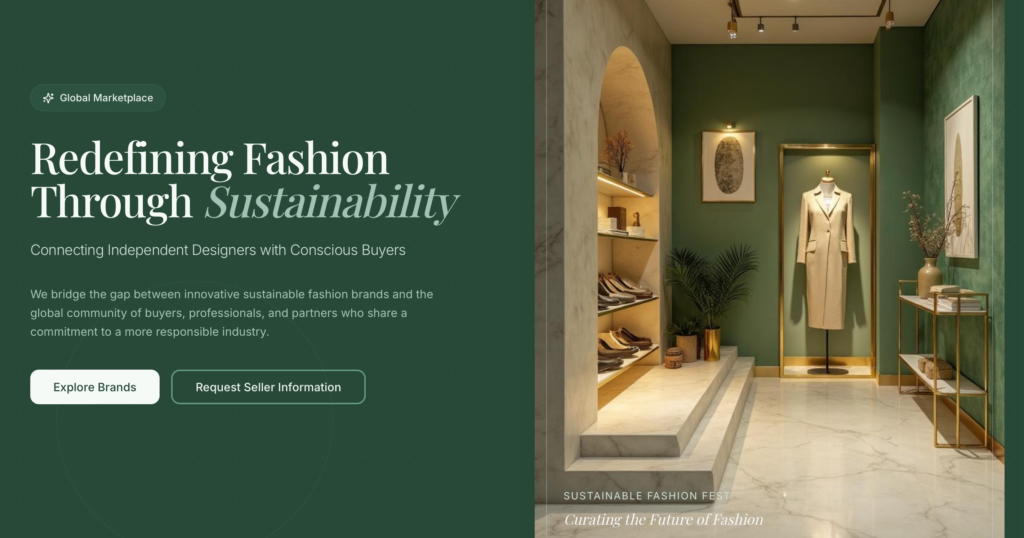
The accompanying SFF Global Fulfillment & Distribution initiative is intended to address another obstacle for international labels: the operational complexity of entering European markets. According to the organisers, the proposed services include warehousing in Spain, order fulfilment, returns management and commercial representation.
For independent designers, these functions can be as important as creative recognition. International expansion requires more than demand for a collection; it depends on inventory management, reliable delivery, customer service and sufficient margins to sustain operations. Shared infrastructure could reduce some of those barriers.
Their development also raises questions about the economics of responsible fashion. Smaller production runs, specialist materials and labour-intensive craftsmanship can limit the ability of independent brands to compete on price and volume. Access to distribution may create new opportunities, but it does not automatically resolve the underlying tensions between growth, production costs and environmental commitments.
These challenges form part of the festival’s professional conference programme. On 13 November, Pilar Prior is scheduled to examine scalable circular business models, while José Carlos Reyes Salvador will discuss Sustainable Marketplace. Rubén González of Humana will address second-hand fashion, drawing attention to the role of clothing collection and reuse within the textile economy.
Other sessions approach sustainability through industry definitions, consumer behaviour and emerging sales models. Pepa González Alonso will examine what sustainability means in contemporary fashion, while Antonio Solé will address the relationship between fast fashion and responsible production. Luis Montalvo’s discussion of live shopping and TikTok Shop will introduce the increasingly influential role of digital commerce in reaching consumers.
The wider conference programme also features Daniel Calderón of Costa Rica Fashion Week, Angie Choroco of MERCATREND, Carla Galindez Blanco, Vinyet Bravo Rojo, Irma Morales Porte, Alfredo Villalba, Enrique Ortiz, Andrés Hoyo and Dani Campoy. Their participation broadens the discussions to include international fashion development, brand growth, conscious fashion, artificial intelligence, digital marketing and the evolving relationship between human creativity and emerging technologies.
Taken together, the programme reflects a central challenge facing the sector: developing business models that can support responsible design without relying exclusively on sustainability as a point of differentiation.
From Textile Waste to Digital Fashion
The festival’s runway programme brings together international labels working across different design disciplines, including brands whose publicly documented practices involve textile reuse, made-to-order production and traditional craftsmanship.
Among the announced participants, ONES has explored garment reconstruction through its reFrame collection, transforming pre-owned denim and knitwear into individual pieces. Portuguese designer Isabel Fernandes incorporates discarded and end-of-cycle textiles into hand-painted garments and textile creations, while Flystyle Tenerife has developed work involving recycled materials and upcycling.
These approaches demonstrate how existing clothing and textile resources can become inputs for new design rather than automatically entering the waste stream. They also reflect the technical and commercial limitations of upcycling: working with irregular quantities of reclaimed material can complicate standardisation, production planning and scalability.
Other participating designers approach garment production through different methods. Melot Atelier emphasises made-to-order clothing and traditional sewing techniques, while Barcelona-based bridal designer Laura Riera has incorporated local manufacturing and natural or organic fabrics into her practice. Flor del Nilo works with artisanal techniques including hand embroidery, crochet and block printing.
Other designers scheduled to present their collections across the three-day runway programme include BBTEILA, KILLALPAQA, INTIARA, Juliette Kanakal, Federica Valentini, TROCHA 1668, CAMJE, Durga, Atelier Vitoria, Jorge Terra, Saró and ADN. Alongside the previously highlighted labels, the lineup brings together designers from different creative backgrounds and fashion disciplines.
The festival will also feature IBEME, whose work addresses inclusive fashion and representation, introducing accessibility and social participation into a programme otherwise largely focused on environmental and commercial questions. Emerging designers will be represented through a UDIT university runway featuring 11 participants.
Textile reconstruction will take a more immediate form through the Hikari Upcycling Challenge, developed with MS–Hikari and involving Humana. Participants will transform existing garments and materials through live design and sewing activities, with a Hikari H8V sewing machine awarded to the winner.
While the competition is a limited intervention within the wider textile system, it provides a practical demonstration of skills that are increasingly relevant to circular design. Extending the life of existing garments requires not only consumer participation but also access to repair, alteration and reconstruction expertise.
The festival’s technology programme will explore a different set of industry changes. A collaboration with Omniverse City and Fuego y Agua will introduce an interactive experience within Fortnite, featuring a virtual recreation of the festival environment. The project is intended to offer participating brands an additional setting for presentation, storytelling and audience engagement.
Artificial intelligence will also feature across the conference programme. Manuel Sanchez is scheduled to discuss applications of AI in textile design and production, while Javier Furones and other speakers will examine its influence on creative processes and fashion communication. European AI Fashion Week is included in the programme for 14 November, extending the discussion into digital fashion experimentation.
The growing use of AI and virtual environments presents both opportunities and unresolved questions for the industry. Digital tools may support more efficient design development, production planning and communication, but their environmental benefits depend on implementation and resource consumption.
Alongside the conferences and runway presentations, the festival’s programme includes professional networking, evening activities and a Madrid fashion bus tour, designed to extend interactions between designers, industry participants and visitors beyond the main venue.
For Sustainable Fashion Fest, the move into commerce and distribution is arguably more significant than the addition of another runway or digital experience. Fashion events can generate publicity and professional connections, but the commercial value of that exposure is difficult to assess without examining what happens to participating businesses afterwards.
Sustainable Marketplace and SFF Global Fulfillment & Distribution represent an attempt to address that gap. Their success will depend on whether the services become operationally effective, attract sustained participation and generate meaningful business for the designers they are intended to support.
Equally important is the credibility of the festival’s sustainability positioning. As responsible fashion becomes an increasingly broad category encompassing recycled materials, artisanal production, circular business models and social inclusion, transparent criteria are necessary to distinguish demonstrable practices from general commitments, and the November edition will provide a platform for these conversations.
Sustainable Fashion Fest Madrid 2026
Dates: 12–14 November 2026
Venue: Próxima Estación, Madrid, Spain
Official website: sustainablefashionfest.com
Sustainable Marketplace: sustainablemarket.es
Tickets and registration: Sustainable Fashion Fest Madrid 2026 – Eventbrite