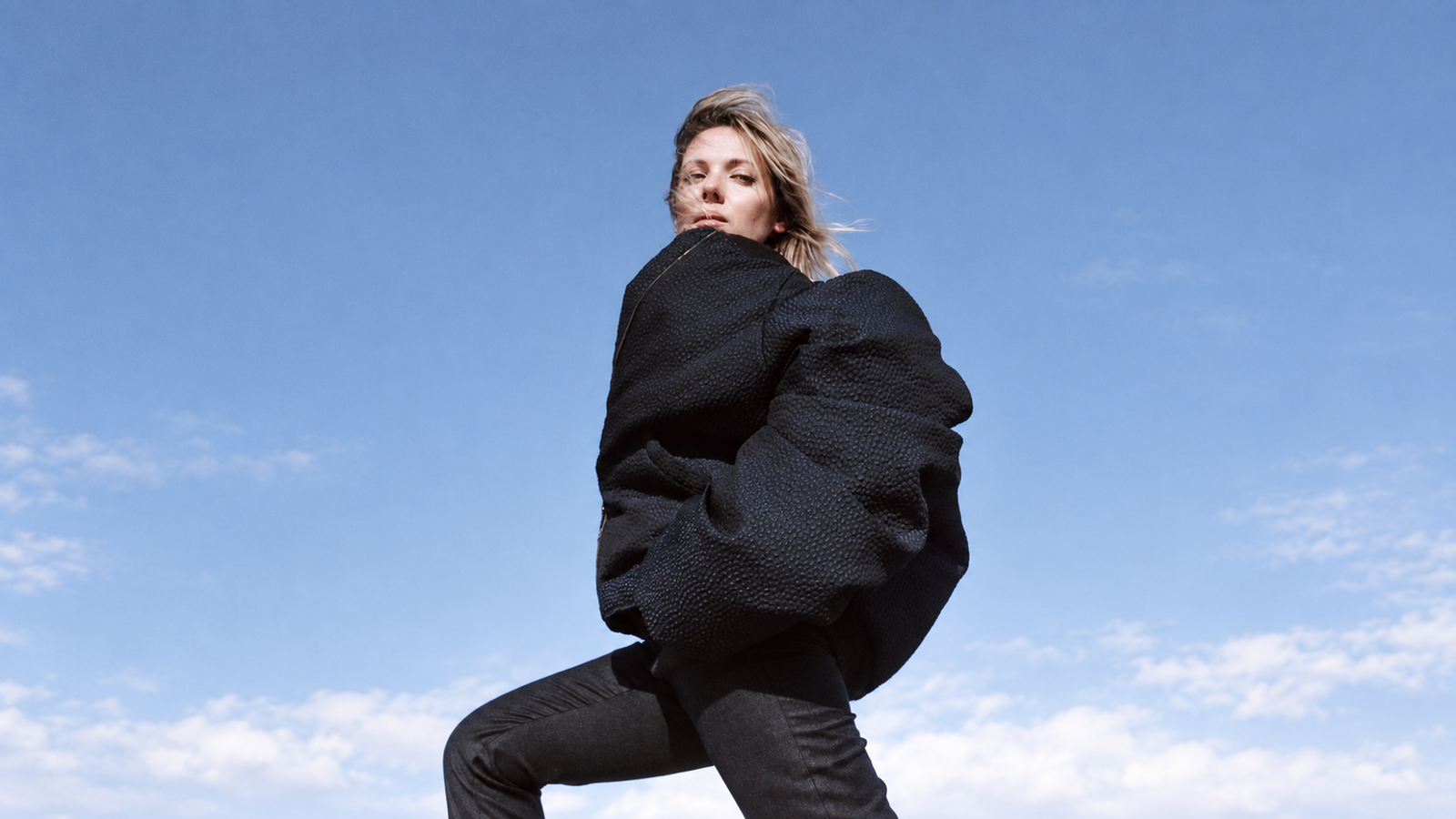
The Paris-based multidisciplinary artist discusses the development of an independent practice, the influence of architectural thinking and why launching a label is not her immediate priority.
For Vita Stepanchuk, the decision to study fashion followed years spent examining how other people design. A journalist whose work brought her into close contact with architects and interior designers, she arrived at IFA in Paris with an established professional perspective and a longstanding ambition to make clothes.
Her practice has since expanded into drawing, ceramics, sculpture and murals. Fashion remains central, but her project, Fort N5, is developing within a broader artistic enquiry rather than following a conventional brand-launch trajectory. Her immediate priorities are technical proficiency, experimentation and a considered approach to production.
Speaking about the professional experience behind her practice, the limits of external validation and the relationship she hopes to establish between an object and its audience.
That distinction is important to understanding her work. Stepanchuk is interested in architectural silhouettes and the expressive potential of clothing, but she also questions the rationale for producing more of it. Working with deadstock and surplus fabrics offers one possible approach: allowing available materials to change a design rather than treating consistency as a prerequisite for production.
“I value my experience in its own right. It shapes how I approach a subject and how long I am prepared to investigate it.”
— Vita Stepanchuk
You pursued journalism before formally studying fashion. How has that professional background shaped your approach to design?
Journalism established the research discipline that underpins my work. It taught me to observe closely, listen and question an initial interpretation. Those skills remain relevant when I develop an idea, even though the outcome is now visual or material rather than written.
My interest in fashion began before school, but my parents raised practical concerns about employment and the possibility of building a career outside the major fashion centres. A literature teacher had encouraged my writing, and journalism offered a credible professional direction that also interested me creatively.
I value that experience in its own right. It shaped how I approach a subject and how long I am prepared to investigate it. In design, I rarely begin with appearance alone. There is usually a question, an idea or an emotional state that I want to articulate. The challenge is to find a form that communicates it.
What did your exposure to architecture contribute to that process?
Working on “Dachny Otvet” gave me sustained access to designers and architects and the thinking behind their decisions. I became attentive to proportion, volume, materials and the organisation of space.
Architecture helped me understand that form influences perception. The same applies to clothing: construction changes how we perceive the body and how the body occupies space.
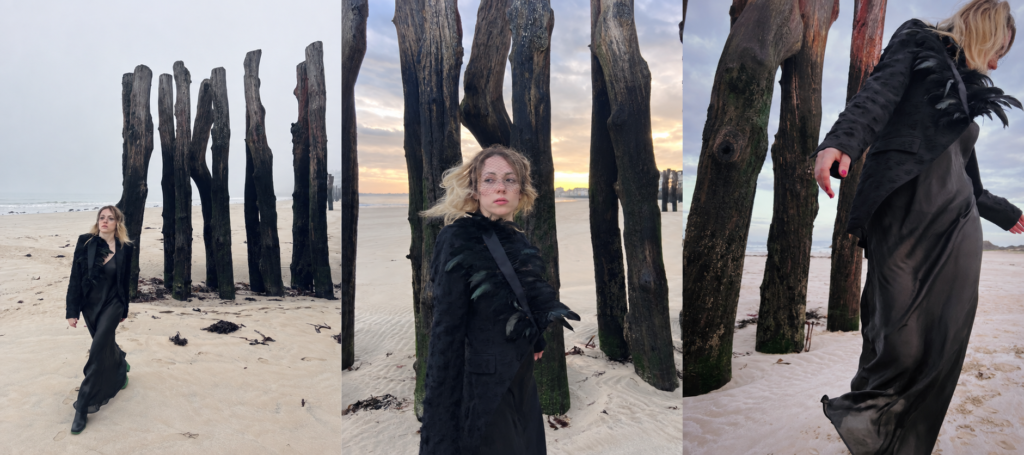
When designing, I consider tension, negative space and movement alongside the silhouette. Those concerns are central to Fort N5, particularly the architectural volumes and unusual constructions I am developing.
The experience also broadened my understanding of education. Much of what informs my work was acquired before I entered a fashion classroom. Journalism developed my capacity for enquiry; architectural reporting gave me a vocabulary of form. Both remain integral to my practice.
How did studying in Paris change the scope of your ambitions?
I arrived intending to pursue fashion, which had been an ambition since childhood. I did not anticipate that drawing would become an independent part of my practice.
A teacher recognised something in my sketches and encouraged me to develop it. As I spent more time drawing, I became interested in the image itself and the possibilities it offered beyond communicating a garment.
There was an artistic tradition in my family. My grandfather was self-taught and painted throughout his life, sometimes exchanging paintings for goods or services during the difficult post-war years. My mother also draws beautifully, although neither pursued art professionally.
Still, I would not explain my practice solely through that history. The important development was recognising that I could pursue ideas across different disciplines. Fashion remains central, but it no longer defines the full extent of what I want to explore.
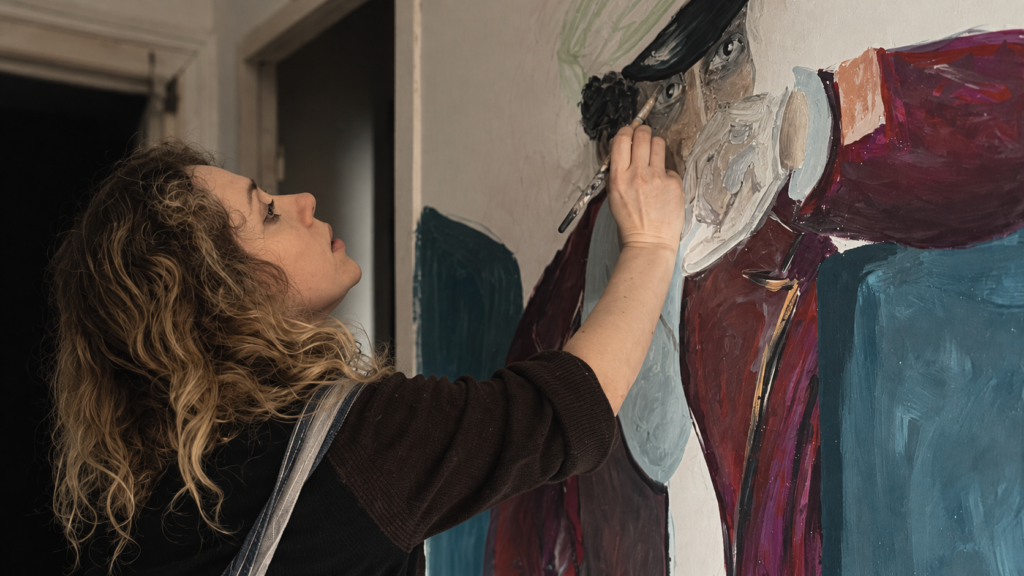
Your mural work in Cassis introduced another relationship between art and architecture. What did that project reveal?
The project brought together artists to transform former railway drivers’ rooms at the station into an art-focused guesthouse, while preserving the character of the building. I created several murals there.
The owner asked me to include his father’s name on a train driver’s identification tag depicted in the work. That request gave the image a significance I had not anticipated. It became a tribute connected to his own history.
The experience made the relationship between art and memory tangible. A work can acquire meaning through someone else’s experience, beyond the circumstances in which it was made. That was particularly important to me: understanding that my involvement as the artist was only one part of the work’s emotional significance.
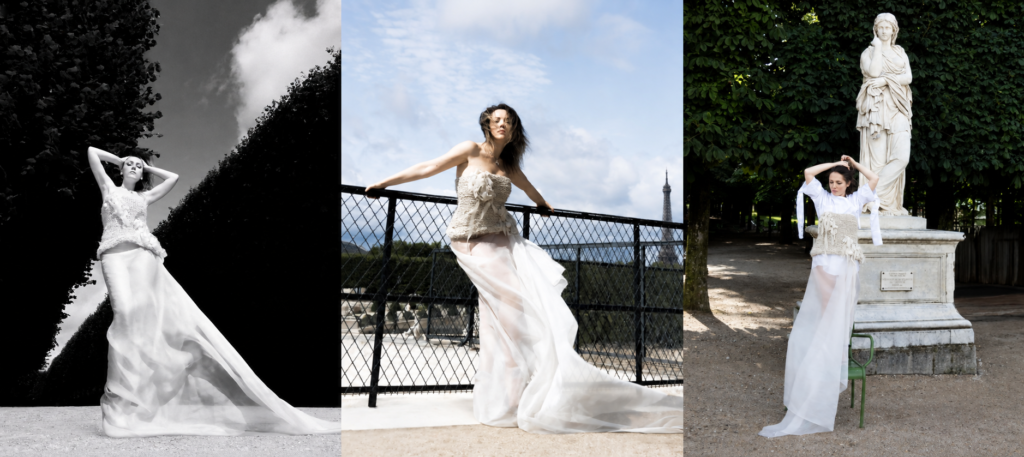
What connects your work in clothing, ceramics and sculpture?
A sustained interest in materials and craftsmanship. I work with knitting, embroidery, beads, textile dyeing and other forms of transformation. Ceramics entered the practice through an invitation to experiment, and I became absorbed in the process.
Across these disciplines, I am interested in how an idea acquires a physical presence. Making is essential to that experience. I value the direct involvement of the hands and the concentration required to bring something into being.
I do not see these activities as separate identities that need to be reconciled. Drawing, painting, textiles, objects and performance offer different means of addressing related questions. Maintaining that range allows the practice to develop without requiring every idea to become a garment.
Your exhibition and performance in Paris examined the boundary between fashion and art. What is the significance of that distinction for you?
I am interested in whether an everyday garment can also be experienced as a work of art. Can clothing communicate an idea beyond its function as a product?
That question informs the relationship I would like to establish with an audience. Someone may respond to a designer’s perspective because it expresses something about who they are or who they want to become. The garment then belongs to a broader experience involving images, ideas and atmosphere.
Status will continue to influence fashion consumption. I do not expect that to disappear. But I would like meaning to play a more substantial role in the decision to acquire something. Independent designers can offer a distinct point of view, and that is what interests me: the connection with a particular vision, as well as the object itself.
How do you assess external recognition without allowing it to dictate the work?
Recognition has been valuable. Presenting at Unique Fashion Foundation was encouraging, and many opportunities have developed through recommendations from people who encountered my work. Those responses helped establish confidence in the direction I was taking.
The difficulty arises when approval becomes a condition of making. If I anticipate what an audience will like, I can begin repeating familiar ideas because their reception appears more certain.
For a long time, external validation was closely tied to my assessment of the work’s value. That relationship has changed. I increasingly believe the process must have value before the work is shown.
I still care about whether it communicates. But the motivation to make it needs to come from an interest strong enough to exist independently of its reception.
“I increasingly believe the process must have value before the work is shown.”
— Vita Stepanchuk
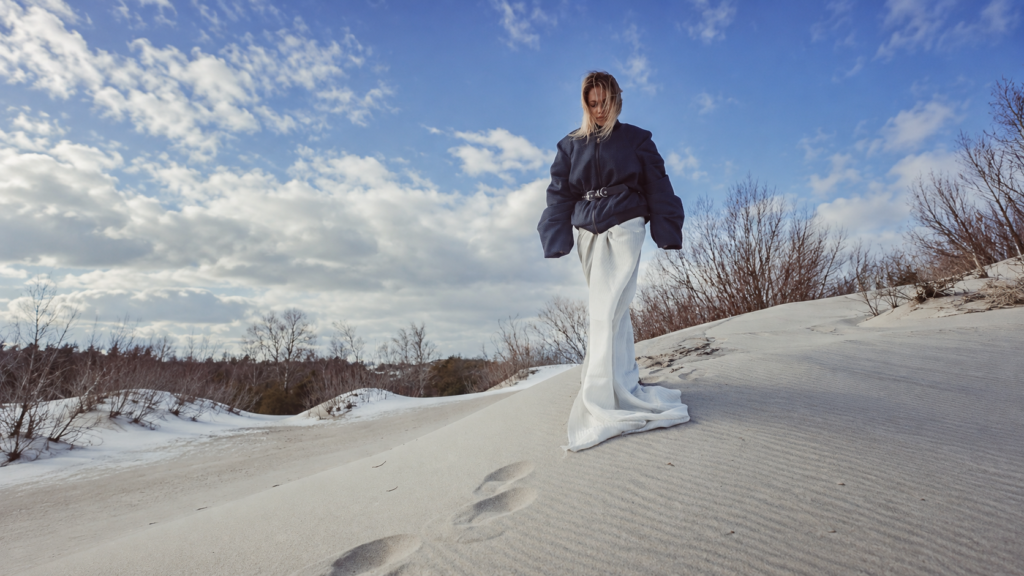
Why have you chosen to develop Fort N5 gradually rather than move directly towards launching a label?
Establishing a brand is not an objective in itself. I want to develop the technical knowledge and skills necessary to realise my ideas properly. My studies are intensive, and I have deliberately made that education a priority.
Fort N5 is developing alongside this process. It brings together my interest in architectural form, the relationship between clothing and the body, and the question of how the work should be produced.
I do not want the decision to launch a label to precede a clear understanding of the practice behind it. For now, developing that understanding and the means to express it is the more important work.
You have questioned whether fashion needs to produce so much in the first place. What does sustainability mean within your practice?
For me, sustainability begins with the decision to produce. Before discussing fabrics, we have to ask whether another garment needs to exist and what justifies making it. The industry’s reliance on increasing volume is part of the problem; changing materials alone does not address that.
This influences how I am developing Fort N5. I do not want to establish a label whose purpose is simply to introduce more products. I want the work to express a distinct perspective and give people a reason to choose a piece beyond its logo or status.
My ambition is to work as much as possible with existing resources and remain directly involved in making. Working with my own hands and through local production would allow me to keep design and its execution closely connected.
How do deadstock fabrics and upcycling influence the clothes themselves?
I use deadstock and leftover fabrics, including materials no longer needed for their original purpose. I am also exploring upcycling as a way to reconsider what those materials can become. It is part of my approach, but I do not want it to become a gimmick or the sole identity of the project.
What interests me is how the material can change a design. I might develop a silhouette in a fabric available today, then return to it six months later with something entirely different. Its texture, weight and character change; even its proportions may need to evolve.
That gives a silhouette the possibility of several distinct expressions, rather than fixing it as a product to be reproduced indefinitely. I want each piece to retain a trace of the material’s previous life and the process through which it was transformed.
“I want each piece to retain a trace of the material’s previous life and the process through which it was transformed.”
— Vita Stepanchuk
What remains essential as your practice becomes more defined?
The freedom to experiment before evaluating an idea through its commercial potential or likely reception.
As a child, I combined clothes from my mother’s wardrobe with my own without considering whether they belonged together. That was my first experience of creating through clothing, although I understood it simply as play.
Professional knowledge matters, but I want to preserve that willingness to make unexpected connections. The artists and designers I find most compelling have developed a recognisable language and atmosphere without losing their capacity for invention.
That is the ambition for my practice: to develop a distinct perspective while remaining open to where the work might lead.
Follow Vita Stepanchuk on Instagram: @oh.la.vita.
* This interview has been edited and condensed for length and clarity.