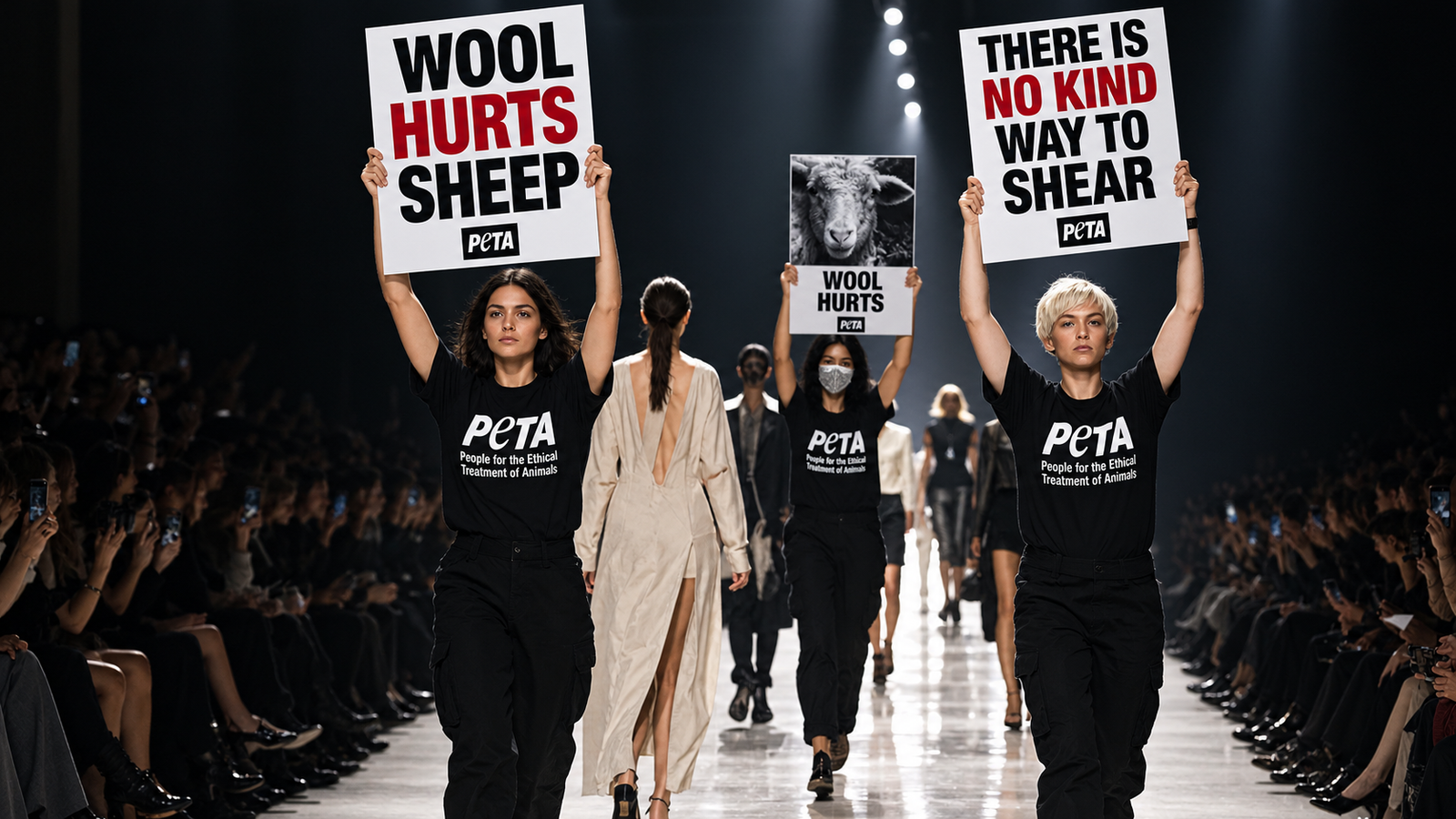
After PETA disruptions at COS in New York and H&M in London reignited the debate around wool and animal welfare, the confrontation raises a wider question for fashion: how should legitimate scrutiny coexist with professional boundaries — and can an industry accustomed to meeting its critics through protest build a more productive framework for change?
Fashion has spent much of the past decade learning the language of boundaries. Workers have them. Models have them. Consumers and communities have them. Increasingly, the industry accepts that commercial ambition does not override the rights of those affected by it.
Activism warrants consideration through the same lens.
The disruption of COS’s Autumn/Winter 2026 show during New York Fashion Week became one of the season’s most contentious moments after PETA supporters entered the runway to protest the brand’s use of wool. The demonstration escalated when Steven Kolb, then president and chief executive of the Council of Fashion Designers of America (CFDA), physically intervened to restrain protesters. Kolb later acknowledged that his response was inappropriate and that security should have handled the situation. He was placed on leave and subsequently resigned after two decades at the organisation.
Four days later, PETA supporters disrupted H&M’s London Fashion Week presentation at Olympia London, extending the campaign from COS, which is owned by H&M Group, to its parent company. Security managed the intervention without a comparable physical confrontation and the show continued.
Does the legitimacy of a cause automatically legitimise every method used to promote it?
The contrast is instructive. Kolb’s intervention should not be defended on the basis that a professional event had been disrupted; security exists precisely to manage such situations. But separating his response from the protest itself leaves a more consequential question unresolved.
The issue behind the disruption is real
PETA’s campaign against wool cannot be dismissed as performance.
The organisation has repeatedly investigated what it describes as serious animal-welfare abuses within global wool supply chains. Its current campaign involving H&M Group follows an investigation by PETA Asia into a South African wool operation associated with a certified supply chain linked to the group. PETA says footage documented sheep being kicked and roughly handled, alongside injuries associated with shearing.
According to PETA, its entities have conducted 17 investigations involving more than 150 wool operations across seven countries.
Such allegations strike directly at one of fashion’s central sustainability propositions: that traceability, standards and third-party certification can provide credible assurance that natural materials have been produced according to defined environmental and welfare requirements.
The Responsible Wool Standard (RWS), administered by Textile Exchange, is among the industry’s most recognised frameworks, covering animal welfare and land management, prohibiting mulesing and establishing certification and chain-of-custody requirements.
Certification, however, is a mechanism of assurance rather than a guarantee that failure cannot occur. Where credible evidence of abuse emerges within a certified supply chain, the appropriate response is not to point to the certificate, but to examine where oversight failed.
Independent scrutiny has an important role here. Investigations by animal-welfare organisations can expose conditions that conventional auditing systems fail to detect and force brands, suppliers and certification bodies to account for the gap between stated standards and conditions on the ground. The value of that scrutiny should not be confused with the method through which attention is drawn to it.
A runway represents more than a corporation
Fashion frequently reduces a complex production ecosystem to the name above the door. A COS show becomes simply COS; an H&M presentation, H&M. Behind the corporate identity, however, sits a considerably larger professional infrastructure.
Designers, assistants, textile developers, pattern cutters, sample makers, casting directors, models, stylists, producers, technicians, hair and make-up teams, photographers, publicists, venue employees and freelancers can spend weeks or months bringing a presentation to the runway.
Most have no influence over a group-level decision to source wool. Some may themselves oppose the use of animal-derived materials. Fashion Week, for them, is not an abstract manifestation of corporate power but a place of work.
This complicates the ethics of disruption. An industry increasingly expected to consider who bears the social and environmental costs of its commercial decisions can reasonably ask the same question of those seeking to reform it. Recognising professional boundaries does not diminish the welfare of animals or the legitimacy of investigating their treatment. It acknowledges that ethical responsibility is rarely confined to a single stakeholder.
Visibility is not the same as systemic change
Disruption has an established logic. Fashion Week concentrates attention in a way that farms, sourcing meetings, certification reviews and supplier negotiations rarely can. Entering a runway ensures that an issue capable of remaining largely invisible within an agricultural supply chain is suddenly placed before an international audience.
PETA has understood the power of that visibility for decades. Its campaigns against fur helped place animal welfare within a mainstream fashion debate that extended far beyond questions of taste and luxury.
The organisation’s engagement with fashion, however, extends considerably further than runway interventions. PETA investigates animal-material supply chains, campaigns directly to brands and retailers and uses shareholder mechanisms to press for corporate change. In 2026, it submitted a shareholder resolution asking H&M Group to reconsider its use of animal-derived materials.
It also operates within the industry. According to PETA, more than 1,000 companies use its PETA-Approved Vegan programme; its Fashion Awards recognise companies adopting animal-free alternatives, while its wider initiatives have included engagement with material innovation, fashion students and educational institutions.
That distinction matters. PETA already participates in both sides of advocacy: public pressure intended to force an issue onto the agenda and less visible engagement intended to influence what happens once it arrives there.
The effectiveness of activism should ultimately be judged not only by the attention it commands, but by its capacity to convert that attention into structural change.
What happens after the cameras disappear?
The most consequential work in animal welfare takes place largely outside the public view: on farms and during shearing, but also through supplier contracts, veterinary protocols, worker training, transportation requirements, traceability systems and the design and enforcement of certification standards.
When credible evidence of abuse emerges, brands carry a responsibility to investigate their supply chains and determine whether remediation, suspension or termination is required. Certification cannot become a substitute for due diligence; it is one component of it.
Animal-welfare organisations occupy an important position within that system precisely because they are independent of it. Their investigations can challenge corporate audits, expose weaknesses in certification and provide evidence that companies themselves may not have uncovered.
The same ecosystem also contains expertise that advocacy alone cannot replace. Farmers understand the realities of animal husbandry and production. Certification bodies design and audit standards. Brands control purchasing decisions. Scientists and material innovators are developing alternatives. Policymakers can establish minimum requirements where voluntary standards prove insufficient.
Meaningful reform depends on these functions intersecting.
A runway intervention can force an issue into public consciousness. It cannot, by itself, redesign a sourcing contract, improve shearing practices, strengthen an audit or bring a new material to commercial scale. Those outcomes require engagement after the spectacle has ended.
Wool is more complicated than ‘animal versus vegan’
At the centre of the dispute is a philosophical difference that cannot simply be negotiated away.
PETA rejects the commercial use of animals for clothing. Within that position, improved welfare standards cannot resolve the fundamental ethical objection because the use of the animal itself remains unacceptable.
Other participants in the sustainability debate take a different position. Some environmental researchers, farmers and industry organisations argue that responsibly managed wool can form part of a lower-impact textile system, particularly when considered alongside fossil-fuel-derived synthetics.
Neither “natural” nor “animal-free” provides a complete sustainability assessment in isolation.
Wool production can carry land-use, emissions and animal-welfare impacts. Synthetic substitutes can introduce fossil-fuel dependence, microplastic pollution and end-of-life challenges. Emerging biomaterials may offer promising alternatives while still facing constraints around performance, availability, price and industrial scale.
Removing one material therefore does not remove the responsibility to assess what replaces it.
A polyester substitute may meet an animal-free objective while shifting the environmental burden elsewhere. A next-generation material may significantly reduce several impacts but remain commercially inaccessible to a mass-market retailer. A certified natural fibre may perform comparatively well against some environmental criteria while remaining vulnerable to welfare failures within individual operations.
These tensions are precisely why the wool debate would benefit from more substantive engagement between groups that approach the issue from different ethical positions. Agreement on the ultimate use of animal-derived materials is not a prerequisite for cooperation on reducing present harm.
Responsibility cannot belong only to fashion
Fashion companies are increasingly expected to exercise due diligence across complex international supply chains. The distance between a corporate headquarters and a farm does not absolve a brand of responsibility for the conditions under which its materials are produced.
The same principle of accountability can reasonably extend to advocacy methods.
Where an organisation possesses evidence of abuse, several routes to intervention exist: engagement with the company, scrutiny of certification bodies, investigation of producers, shareholder action, consumer pressure, public campaigning and, at times, direct protest. These mechanisms are not mutually exclusive, nor will private engagement always produce an adequate response.
Proportionality nevertheless remains relevant. The people whose work is interrupted may have little authority over the practice being challenged, while the organisations capable of changing it may sit several stages further up the corporate or supply-chain structure. This makes one question particularly important.
Is the intervention primarily designed to change the practice, or to generate attention around it?
Disruption has historically played an important role precisely because institutions can resist change until reputational pressure becomes significant. Activists, journalists and whistleblowers have repeatedly brought abuses into public view when established systems failed to address them. Attention has value when it creates leverage. Its longer-term significance depends on what that leverage is used to achieve.
From confrontation to negotiation
The relationship between fashion and animal-welfare organisations is often presented as inherently adversarial. In philosophical terms, it sometimes is. In practical terms, the divide is less absolute.
A company claiming to source responsible wool has an interest in knowing when abuse occurs within its supply chain. A certification organisation has an interest in evidence that identifies weaknesses in its auditing system. Farmers have an interest in workable standards that distinguish responsible production from abusive practice. Designers and brands need materials capable of meeting environmental, technical and commercial requirements. Animal-welfare organisations have an interest in reducing harm and ensuring corporate claims withstand independent scrutiny.
These interests do not erase fundamental disagreement. They do, however, create substantial territory on which engagement is possible.
Negotiation in this context should not mean neutralising criticism. An advocacy organisation that becomes unwilling to confront the industry loses much of the independence that gives its investigations value. Equally, engagement should not allow companies to substitute dialogue for measurable action.
The more credible model is one in which scrutiny and cooperation coexist: evidence is presented, corporate claims are challenged, suppliers are investigated, certification weaknesses are addressed, alternatives are assessed and progress is measured against defined outcomes.
Independence does not require permanent antagonism, just as collaboration does not necessarily mean complicity.
Fashion has increasingly embraced multi-stakeholder approaches to labour rights, environmental standards, traceability and material innovation. Animal welfare should not be uniquely incapable of the same difficult engagement.
The boundary is responsibility
The lesson from the COS and H&M protests is not that animal-welfare activists should leave fashion alone. An industry capable of producing polished sustainability reports while operating through long and opaque supply chains requires external scrutiny.
Nor should the lesson be that professional boundaries render disruptive protest inherently illegitimate. There are circumstances in which pressure becomes necessary precisely because conventional engagement has failed.
The more useful conclusion lies between those positions. Brands cannot treat certification as the end of responsibility. Certification bodies cannot assume an audit makes their standards infallible. Producers cannot be excluded from discussions about practices they are expected to implement. Advocacy organisations cannot assess the ethics of an industry without also considering the consequences and objectives of their own interventions.
Each participant holds part of the system; none controls all of it.
The workers who spent months developing a collection are not abstractions. Neither are farmers whose livelihoods depend on wool, workers responsible for handling animals, consumers attempting to make informed choices or the animals whose welfare initiated the debate.
Ethical fashion cannot work by recognising only the stakeholder whose interests support one side of an argument.
The next stage of accountability may therefore be considerably less visible than a Fashion Week confrontation. It requires brands, producers, certification bodies, scientists, workers and animal-welfare organisations to occupy the same conversation without surrendering their ability to challenge one another.
A runway can create attention. An investigation can expose a failure. Public pressure can compel an institution to respond. None, in isolation, is sufficient to reform a supply chain.
Systemic change begins when evidence is capable of moving beyond confrontation and into the structures where decisions are actually made.