
Mohamed Benchellal the Dutch-Moroccan couturier’s encounter with Uzbekistan becomes a study of fabric, form and the body – and part of a growing platform for contemporary creative exchange.
The architectural investigation underpins BENCHELLAL, MONUMENTAL | “Sculpting Past Tomorrow,” at the State Museum of History of Uzbekistan in Tashkent. Developed during Benchellal’s 2025 residency at the Centre for Contemporary Arts Tashkent, the exhibition presents a new body of sculptural works informed by the country’s culture, craft traditions and architectural heritage.
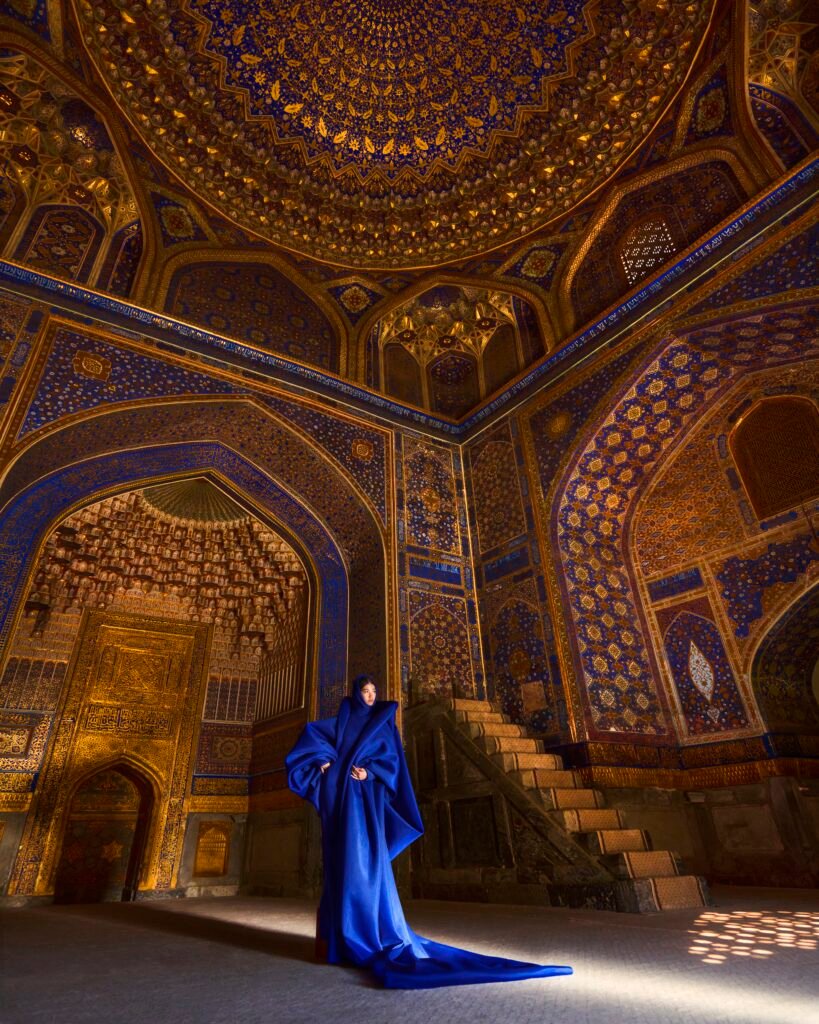
Beneath the gilded ceiling of Tillya-Kari Madrasa in Samarkand, a cobalt-blue gown holds its own against an extraordinary architectural interior. Its sweeping train and concentrated folds give the figure a commanding presence within the surrounding ornament. Fabric gathers around the body, projects outwards and falls across the floor. Against an intricate decorative setting, Mohamed Benchellal makes his statement through silhouette.
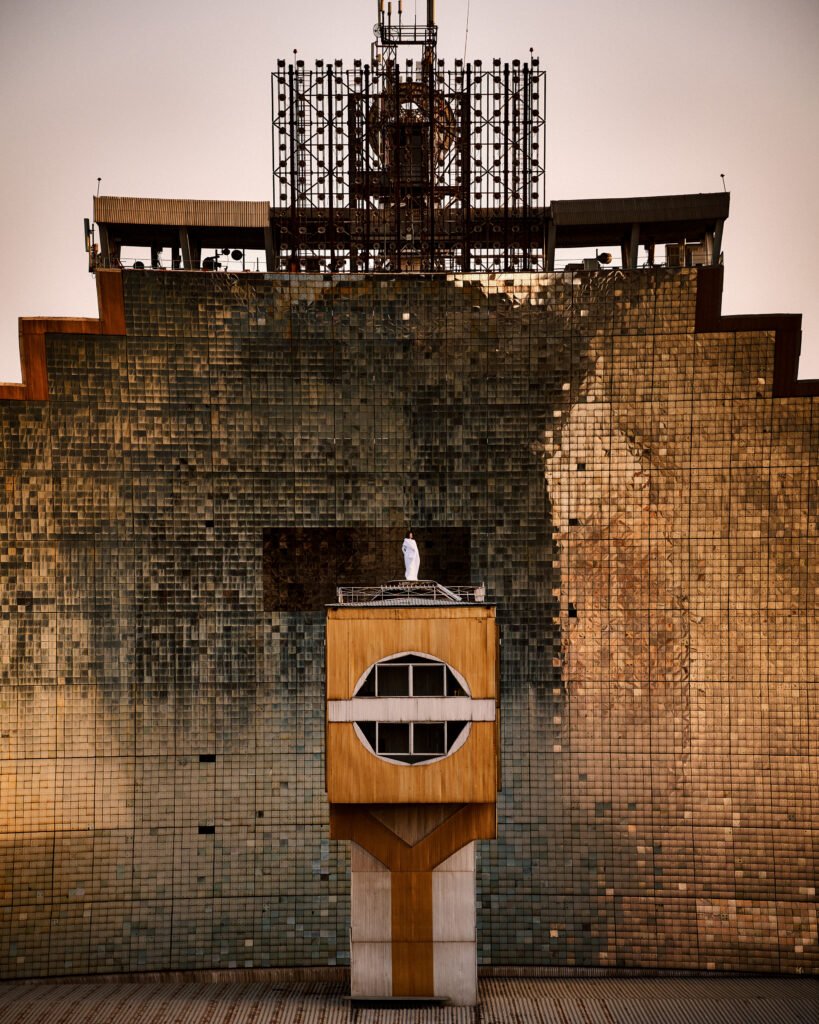
Another photograph changes the relationship entirely. A white-clad figure appears almost miniature against the immense mirrored surface of the Great Solar Furnace in Parkent. The dress gives the body a distinct outline within the overwhelming structure. Across both images, the question belongs to couture: how can fabric change the way a person occupies their surroundings?
The project continues an inquiry first presented at the National Museum of Qatar. In Uzbekistan, a different environment brings new possibilities to the couturier’s practice. Buildings, landscapes and historical references become material for experimentation, with their influence expressed through his handling of cloth and his construction of the dressed figure.
Constructing a Presence
Benchellal’s design language depends on the expressive possibilities of volume. His silhouettes extend beyond the body’s outline, allowing clothing to determine how the wearer is seen. In this exhibition, that established approach becomes the means through which he responds to Uzbekistan.
The creative challenge lies in deciding which qualities of an architectural encounter can be developed within a garment. Monumental proportions, the rhythm of a surface or the impression of enclosure must pass through the practical and expressive demands of fabric.
Architecture offers mass and permanence. Cloth responds to gravity, manipulation and movement. Working between these qualities requires decisions about where a shape holds, where it yields and how its proportions relate to the wearer. A broad fold can suggest solidity while retaining softness; an outward projection can give the figure authority without losing its connection to the body beneath it.
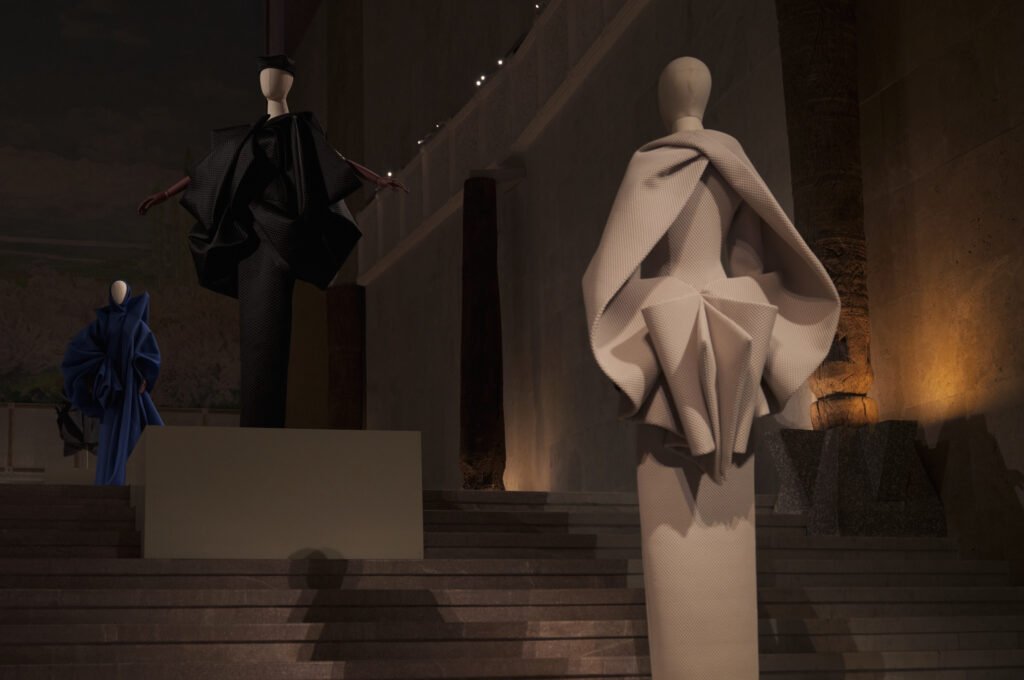
These tensions give Benchellal’s work its distinctive character. The garments command attention through their construction, yet their impact remains inseparable from the person who might wear them. Even in a still photograph or museum display, they invite the viewer to imagine a turn, a step or a change of posture.
The collection’s sculptural ambition therefore develops from couture’s own concerns: the relationship between material and anatomy, the distribution of weight and the shaping of a silhouette. Uzbekistan gives Benchellal new references through which to pursue those questions.
From Encounter to Form
The residency allowed Benchellal to develop the collection through sustained contact with the country. Historic sites, landscapes and modernist buildings offered a varied field of research, brought together through his approach to making.
Commissioned by Uzbekistan Art and Culture Development Foundation chairperson Gayane Umerova, the exhibition emerged within CCA Tashkent’s artist residency programme. Workshops, specialist facilities and curatorial support provided a framework in which observations gathered beyond the studio could develop into finished works. Their subsequent presentation in Tashkent brings the results to audiences whose cultural surroundings informed the project.
Benchellal shapes fabric intuitively, working directly with the material rather than beginning with sketches. This method makes the studio an essential part of the interpretation. An impression gathered at a site must be tested against what the cloth can do—how it folds, falls and holds a form.
The resulting garments resist a straightforward reading as illustrations of buildings. Their references are absorbed into a consistent design language, with each work resolved through the couturier’s judgement. That process allows a diverse architectural landscape to inform the collection without fragmenting its identity.
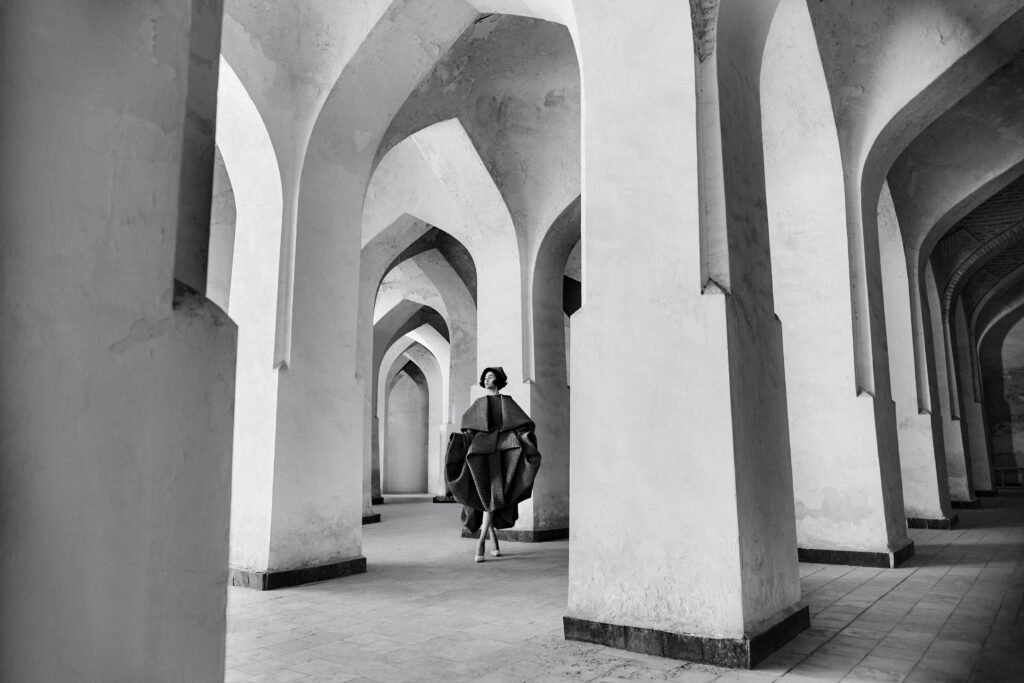
His personal perspective is equally significant. Born in the Netherlands to Moroccan parents, Benchellal brings cultural associations of his own to Uzbekistan. Familiarities with Islamic architecture and ornament inform his response, while the residency introduces other histories and visual experiences. Recognition and discovery operate together.
This gives the project a clear point of view. The collection expresses an individual encounter with Uzbekistan, shaped by the couturier’s background, sensibility and working methods. Its cultural depth comes from the attention given to that encounter and the creative decisions it generates.
Couture in the Museum
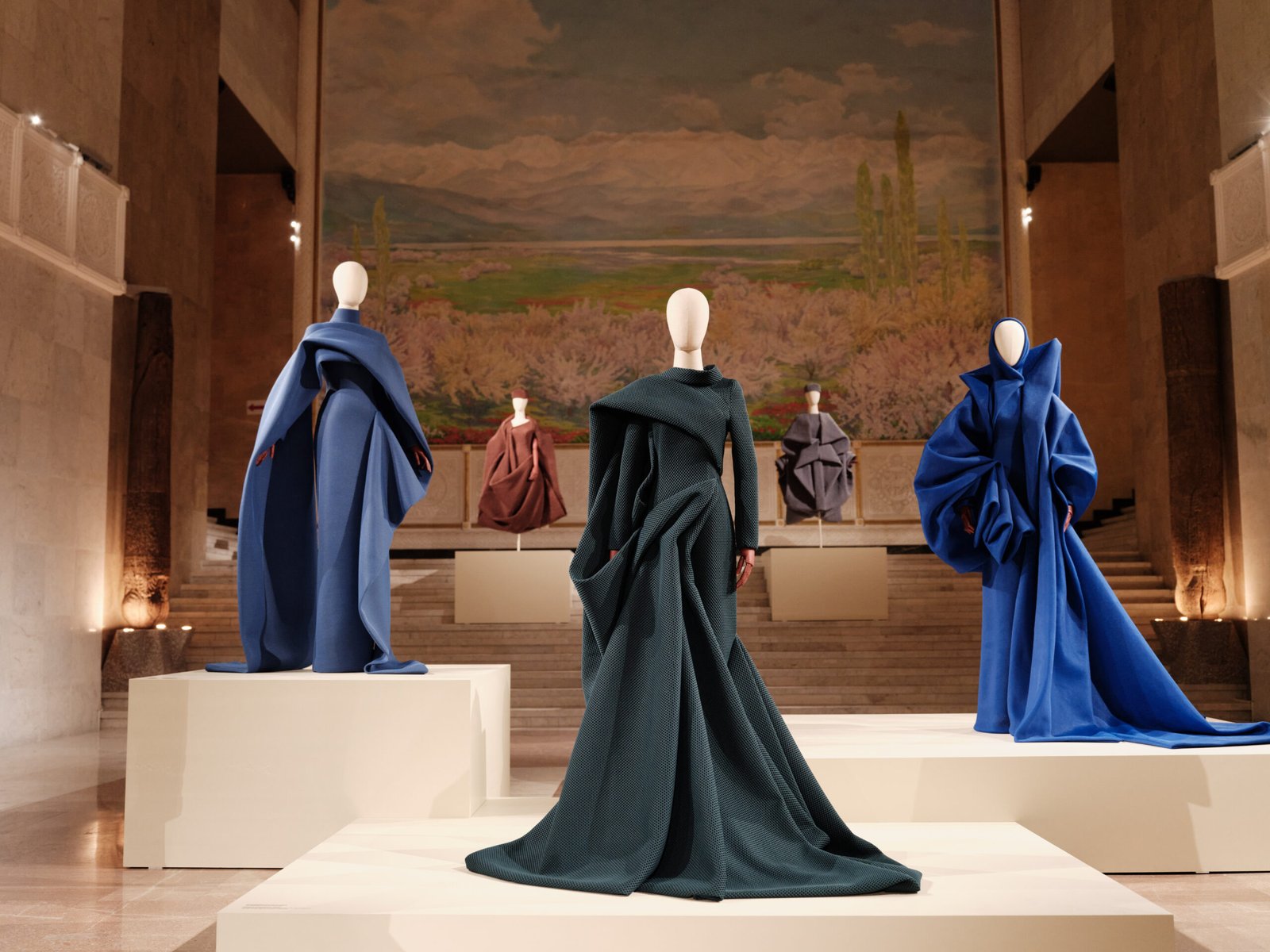
At the State Museum of History of Uzbekistan, the works are arranged across stepped platforms. Differences in height, breadth and colour establish a rhythm through the installation, allowing the viewer to consider each garment individually and as part of the collection.
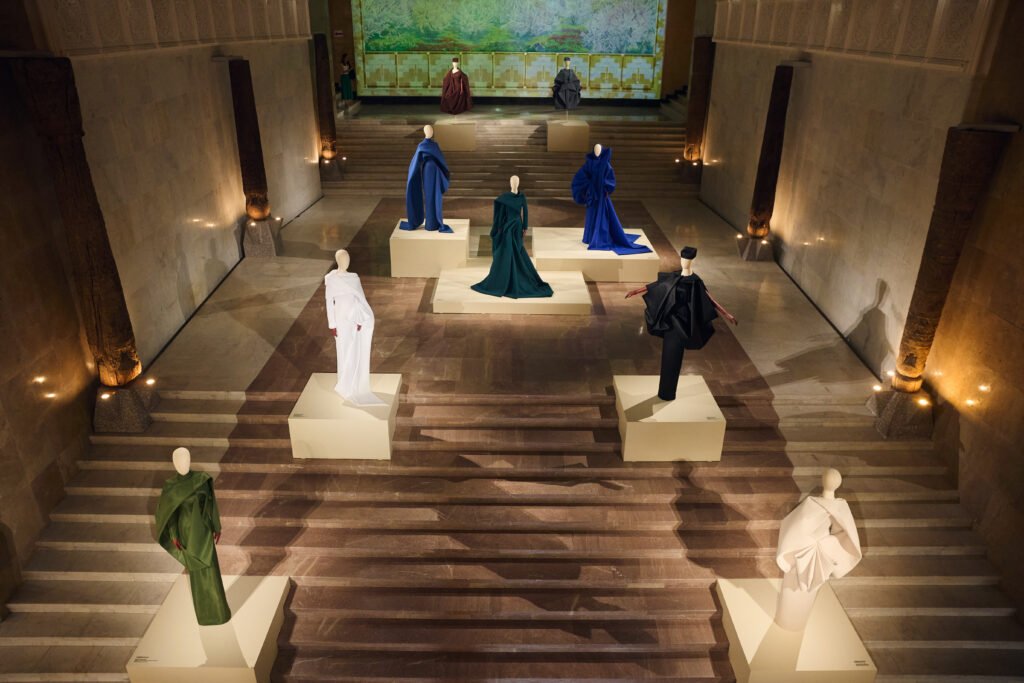
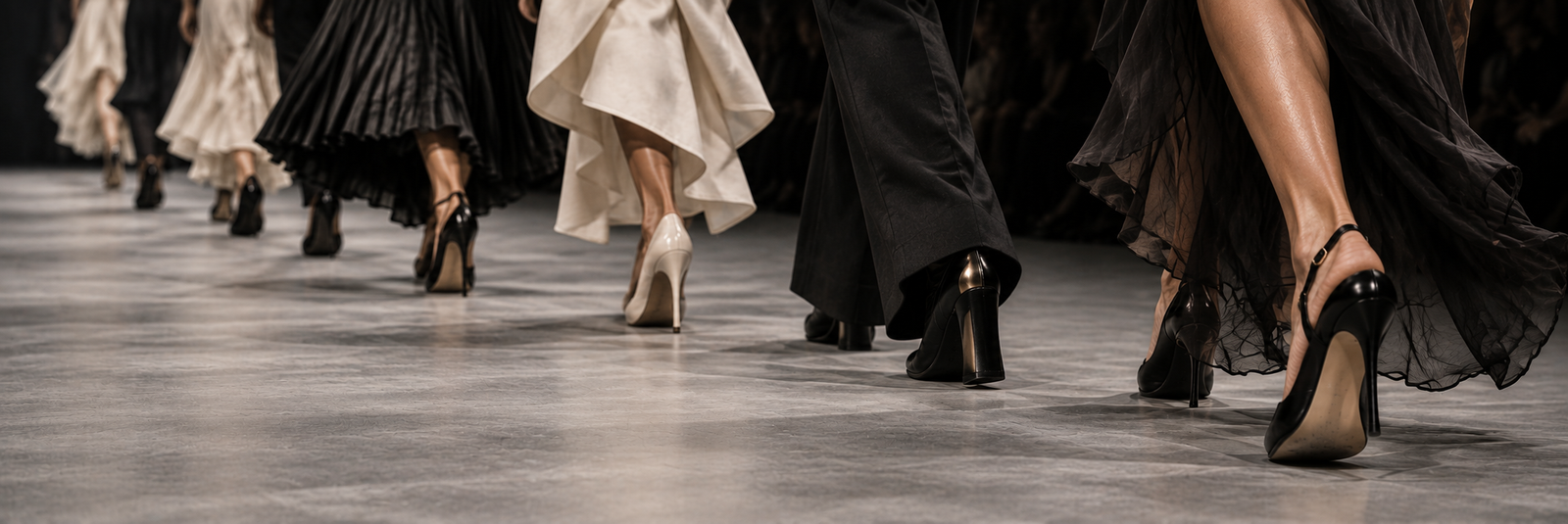
The setting changes the pace of looking. On a runway, a silhouette is encountered in motion and quickly succeeds another. In the museum, attention can settle on a fold, the balance between upper and lower proportions or the way fabric extends beyond the figure. Construction becomes available to sustained examination.
The exhibition’s proposition of couture as a contemporary artistic practice rests on this physical encounter. The garments retain their relationship with the body while inviting consideration of their formal qualities. Clothing’s associations with occasion, identity and use remain present, but the display gives their sculptural ambitions room to unfold.
“Monumental” acquires a particular meaning here. The works are built around human proportions, yet they carry an authority associated with something much larger. Their force comes from the way they concentrate attention and establish a relationship with the surrounding room.
The title “Sculpting Past Tomorrow” also locates the project between inheritance and invention. Historical references supply material for a contemporary practice. Through Benchellal’s decisions, they become forms that belong to the present while suggesting further possibilities for his work.
The Collection Beyond the Museum
The accompanying photographs by Tim Verhallen extend the exhibition’s investigation. Where the installation brings the garments into conversation with one another, his images place them in settings that reveal different aspects of their design
At Tillya-Kari Madrasa in Samarkand’s Registan ensemble, the cobalt-blue gown draws its authority from the gathering and release of fabric. The surrounding gilded decoration is intricate and expansive; the dress establishes a concentrated outline beneath it. Its train carries the composition across the floor, linking the figure to the interior and suggesting how the garment might change with movement.
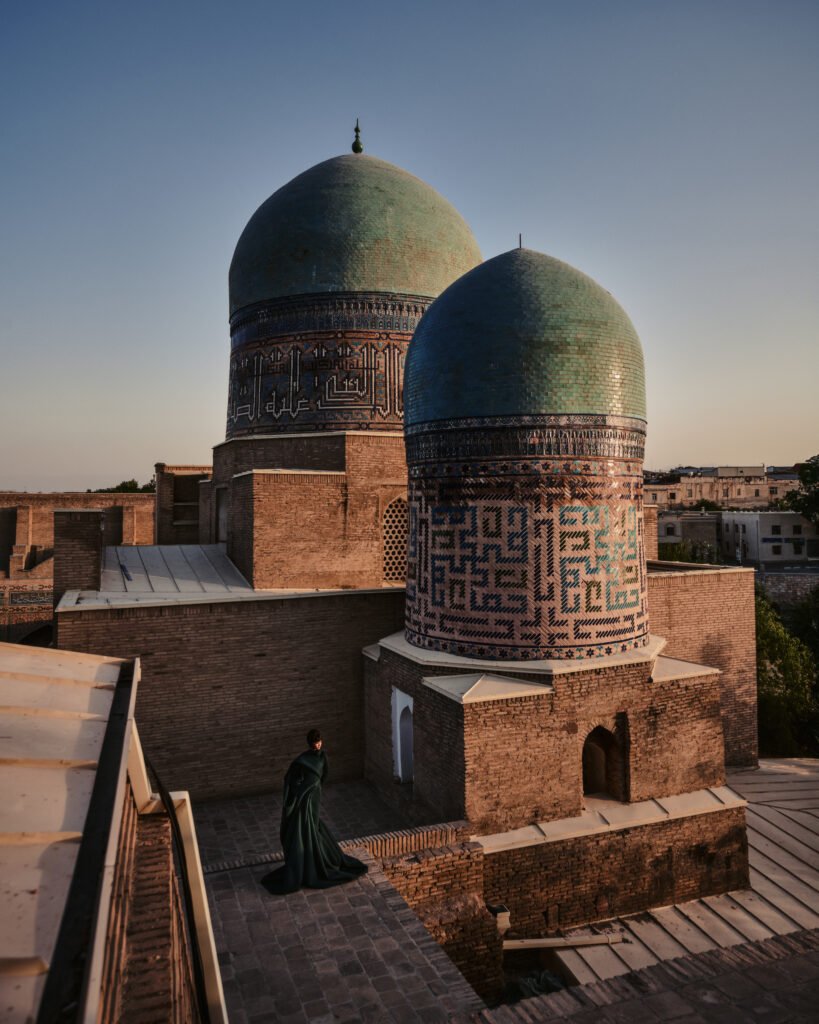
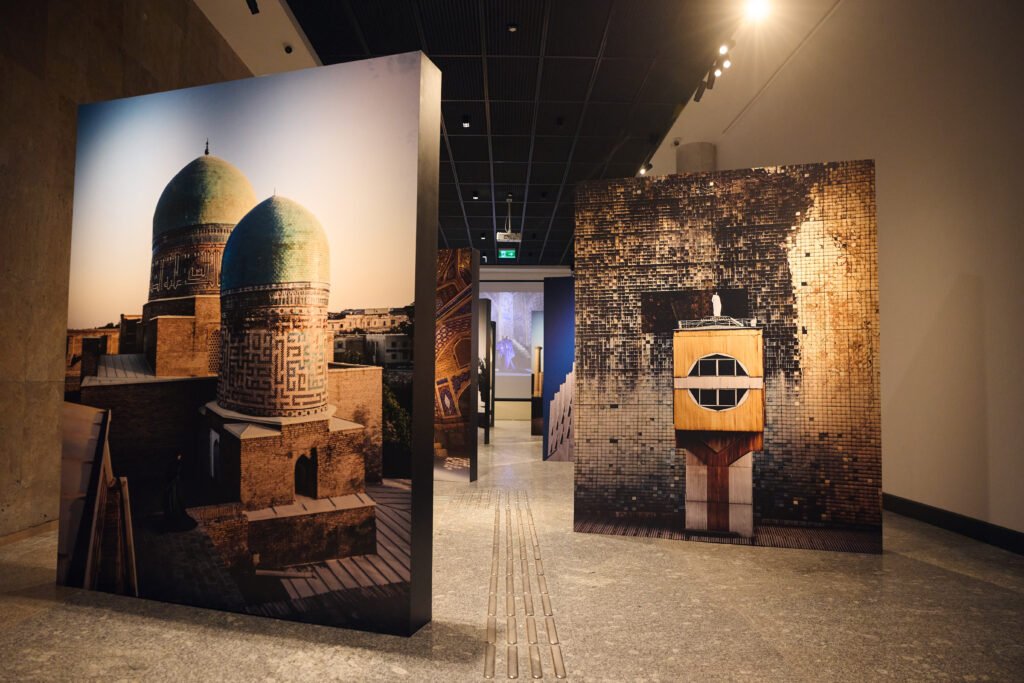
At Shah-i-Zinda, also in Samarkand, a green silhouette appears against turquoise domes and richly tiled architecture. Colour creates an immediate affinity, while the surfaces remain distinct. Broad folds offer a different visual rhythm from the detailed decoration, allowing the garment to acknowledge its setting while preserving the clarity of Benchellal’s design.
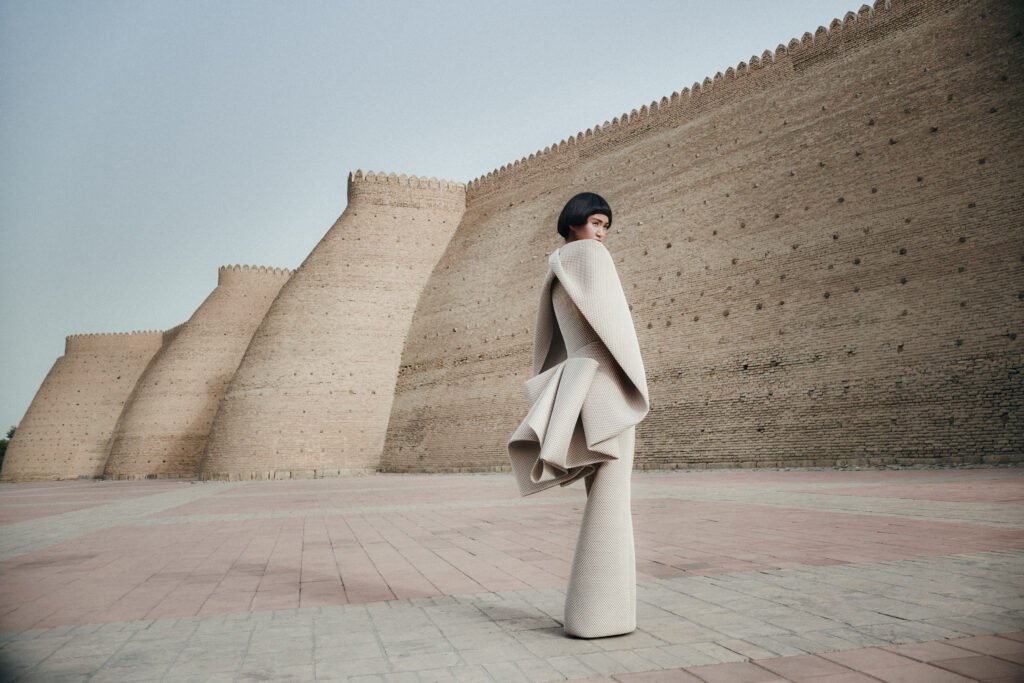
A pale work photographed beside Bukhara’s Ark Fortress becomes especially legible against the immense sloping ramparts. The walls provide an expansive backdrop against which the garment’s contours sharpen. The photograph makes the construction around a single figure appear concentrated and deliberate.
The Great Solar Furnace in Parkent introduces a different reference. Its mirrored concentrator belongs to scientific infrastructure, broadening the collection’s visual territory beyond historic monuments. The white dress, which Benchellal identifies as inspired by the furnace, appears small against the vast surface. The eye locates the figure within the structure, then returns to the garment as an interpretation brought to the scale of the body.
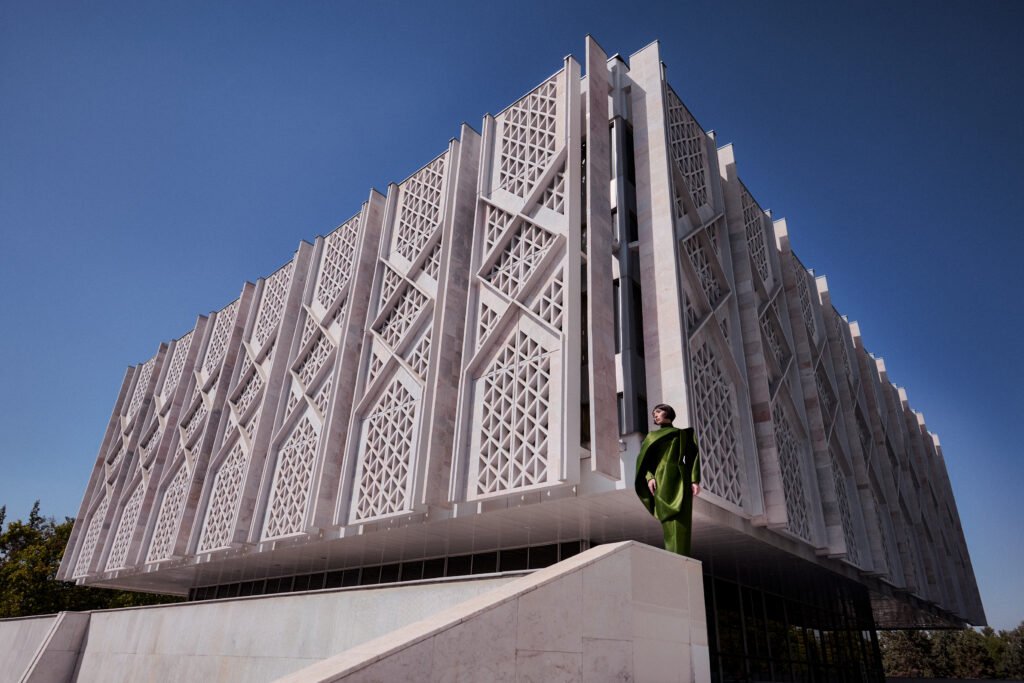
The State Museum of History of Uzbekistan has a dual role in the series, serving as both photographic setting and exhibition venue. Completed in 1970 as the Lenin Museum, the building combines modernist geometry with patterned panjara screens. A green garment photographed against its façade brings the collection into contact with this more recent architectural history. The institution housing the works becomes part of the visual research surrounding them.
Across the photographs, colour, contour and proportion come forward in different ways. The settings sharpen the viewer’s understanding of the garments, while Benchellal’s forms draw attention to particular qualities of the architecture. The collection offers a way of looking at these places through the couturier’s work.
From International Visibility to Creative Infrastructure
The conditions behind the exhibition form part of a wider development in Uzbekistan’s cultural scene. Opened on 6 September 2026, CCA Tashkent provides a permanent setting for exhibitions, research, residencies and public engagement, connecting the production of contemporary work with opportunities to encounter it.
Commissioned by ACDF under Umerova’s leadership, the centre occupies a former diesel station and tram depot built in 1912. Studio KO retained its industrial character while introducing exhibition spaces, a library, a bookshop and facilities for workshops and gatherings. Local artisans contributed to the renovation, including the Rakhimov family ceramics studio, which produced bespoke tiles.
The transformation establishes a working relationship between international architectural expertise and Uzbekistan’s materials and craft knowledge. Those collaborations form part of the institution’s foundation and give practical substance to the exchanges its programme supports.
The inaugural exhibition, Hikmah, curated by chief curator Dr. Sara Raza, brings Uzbek and international artists together through commissions, installations and works from regional collections. Local clay, minerals, craft traditions and found materials enter contemporary artistic production. Benchellal’s project extends the programme into couture, introducing another discipline through which the country’s cultural resources can be explored.
The planned expansion of residencies to Samarkand, alongside initiatives such as the Bukhara Biennial and Uzbekistan’s participation in international art and design platforms, suggests a cultural scene developing greater capacity for sustained creative activity. For fashion, that capacity offers time for research, access to knowledge and opportunities to develop and present new work.
These conditions matter to Uzbekistan’s growing profile as a creative hub. International visibility acquires lasting value through continuing collaboration, opportunities for local practitioners and public access to the results.
Benchellal’s exhibition makes one part of that process tangible. A residency supported the development of a new collection; the museum opens it to sustained viewing; and the photographs reveal how the finished garments engage with the places that informed them.
The outcome remains distinctly his own. Uzbekistan’s architectural heritage enters Sculpting Past Tomorrow through Benchellal’s handling of fabric and his understanding of the body. The encounter expands the possibilities of his couture, while CCA Tashkent provides the conditions for that work to take shape and reach the public.
BENCHELLAL, MONUMENTAL | “Sculpting Past Tomorrow” is on view at the State Museum of History of Uzbekistan, Tashkent, until 8 November 2026. Admission is free.
Visit the official exhibition website.