
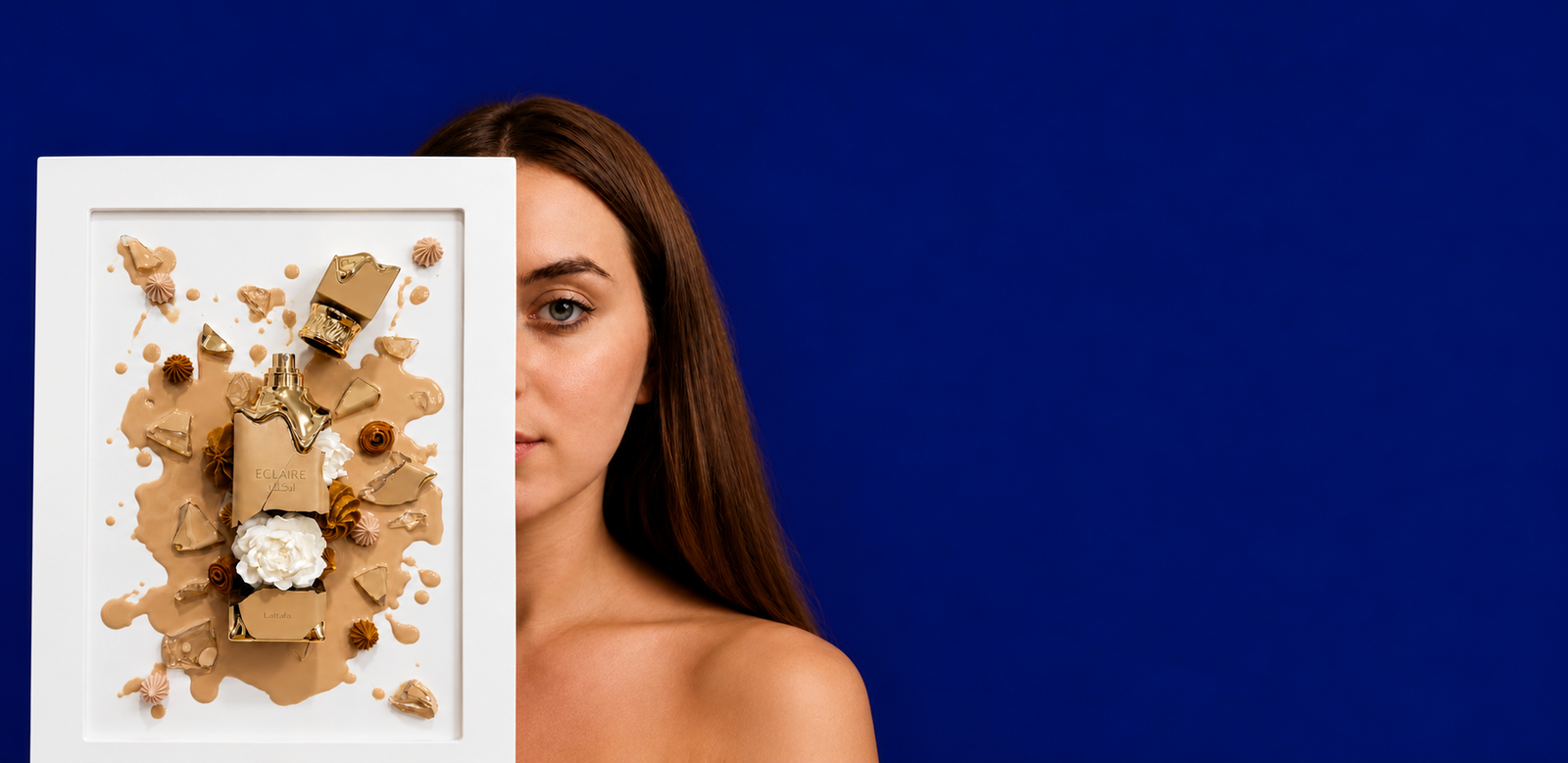
For DARUMA DOM founder Daria Ivanova, an empty perfume bottle is neither packaging nor waste. Preserved in resin and reimagined through materials that evoke its olfactory composition, it becomes an object of memory.
Perfume leaves remarkably little behind. Its physical presence diminishes with every application until only the bottle remains—an object designed to outlive the substance it once contained. For some, it is disposable packaging. For others, it retains the emotional charge of a person, place or period of life.
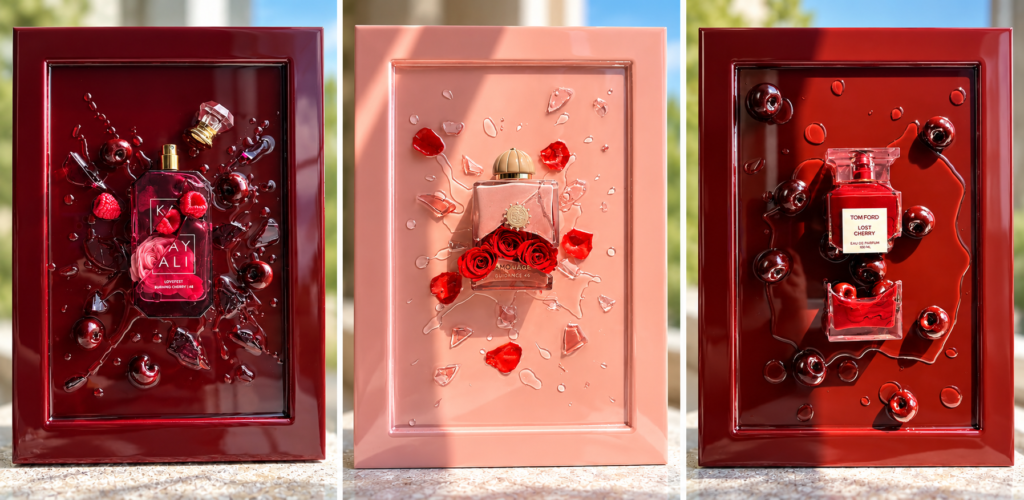
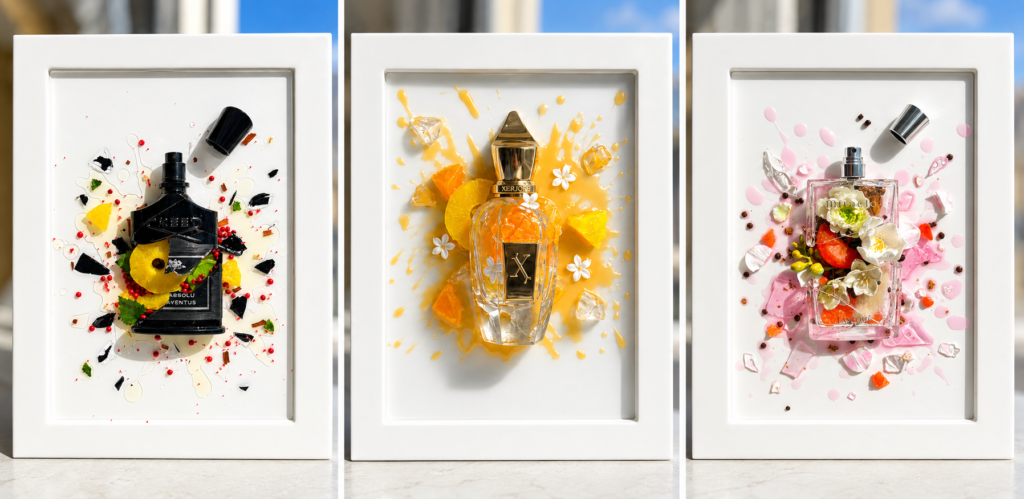
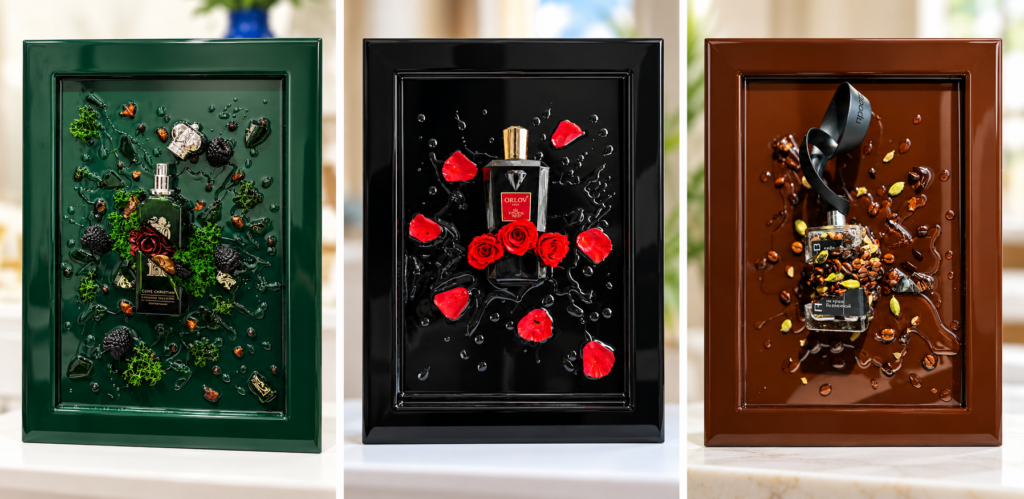
Daria Ivanova works within this tension. At her studio in Volgograd, the 29-year-old founder of DARUMA DOM transforms empty perfume bottles into resin-based compositions. Some remain intact; others are fractured and suspended among flowers, pigments and materials selected in response to the fragrance’s notes. Rather than illustrating perfume literally, Ivanova attempts to give material form to something inherently fugitive.
Her practice emerged after years of working with epoxy resin alongside conventional employment. Trained as an educator, Ivanova first worked with children before moving into banking. Her creative practice continued in private- first at her kitchen table, then at a desk and eventually in a room of its own- but remained secondary to the economic obligations of everyday life.
That division ended in 2025, when the loss of her office position compelled Ivanova to consider a future she had not previously felt able to choose. She rented a studio and committed herself to the practice she had repeatedly deferred. The decisive work followed soon afterwards: a composition made from an empty bottle of Rosa Galore by Attar Collection, accompanied by small roses that articulated the fragrance in visual form. The piece sold before the accompanying video was published; online, the film rapidly accumulated a million views.
That moment introduced DARUMA to a perfume-literate audience, but the practice cannot be explained by virality alone. Ivanova’s work is concerned with interpretation, authorship and the emotional residue carried by objects. In conversation with The Fashion Issue, she discusses making fragrance visible, the limits of commissioned work, the instability of resin and the necessity of protecting one’s creative autonomy.
Your creative practice existed for years alongside work in education and banking. What changed when you began to regard it as a vocation rather than a private necessity?
The shift occurred when I realised that people did not merely respond to the work visually; they wanted to live with it. Until then, resin had remained an essential but private part of my life. I created because I could not imagine living without creativity, but I did not yet believe it could become my profession.
Losing my office position became a decisive rupture. I had responsibilities to my family and could not simply resign without certainty or financial security. When the position disappeared, the choice was effectively made for me. I interpreted it as a sign and rented a studio. In retrospect, I am grateful that circumstances compelled me to enter the unknown.
You had already developed considerable technical experience with resin. When did that knowledge become an artistic language of your own?
That happened in 2025, when I made my first work using a fractured perfume bottle and materials connected to the fragrance itself. I had seen broken bottles incorporated into decorative objects before, but they were generally treated as images or embellishments. I wanted the composition to communicate the perfume.
Resin and fragrance had existed as two separate passions. For some time, I felt that they belonged together, although I did not initially understand what form that union should take. The first composition resolved that question. It felt entirely mine.
It was the first time I felt that the idea I had been waiting for had also been recognised by others.
That first work centred on Rosa Galore by Attar Collection. Why did this particular fragrance initiate the vocabulary of DARUMA?
I already had the empty bottle and a collection of small roses that seemed to belong with it. The relationship was immediate: the name of the fragrance, its central note and the visual material aligned.
I broke the bottle, constructed the composition and recorded the process without anticipating a significant response. The piece was purchased that evening, before I published the video. The film then reached a million views very quickly across social media. Viewers began tagging Attar Collection, and the brand contacted me. It was the first time I felt that the idea I had been waiting for had also been recognised by others.
Your work translates an immaterial experience into a physical one. What, precisely, are you attempting to preserve: the structure of the perfume, its atmosphere or your own response to it?
The process begins with the olfactory pyramid. I study the notes and consider which colours and materials might embody them. I also examine the identity of the perfume house. A composition cannot feel disconnected from the world the house has constructed around the fragrance.
Research, however, is only the foundation. My response remains intuitive. When I encounter a fragrance, its visual atmosphere often arrives immediately. The packaging, brand imagery and my personal perception do not always agree, yet I find a way to reconcile them within the work. It is not a process I can reduce to a formula.
Does this reliance on the perfume’s composition risk making the work illustrative?
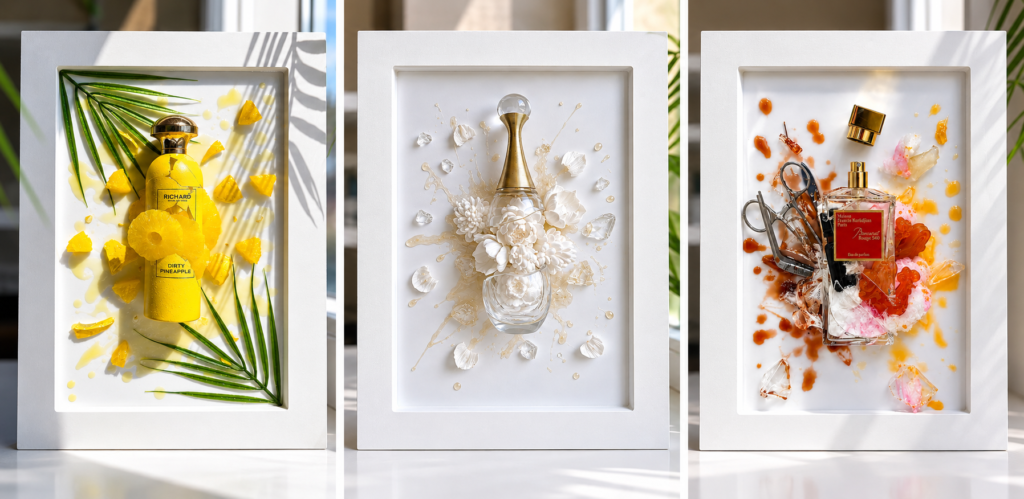
The notes provide structure, but they do not determine the final image. I am not interested in producing a literal diagram of a fragrance. The work must possess an independent visual logic.
Experience allows me to understand how particular materials may suggest wood, flowers, sweetness or mineral depth. The composition itself—the distribution of weight, movement, texture and empty space—belongs to my own visual language. It should remain compelling even to someone who has never encountered the fragrance.
The fragrance is ordinarily my point of departure, but personal history can fundamentally alter the responsibility I feel towards a commission.
Perfume frequently operates as an instrument of memory. How does the private history of a client alter your interpretation of a bottle?
One client entrusted me with a bottle that had been the final gift she received from her father before his death. It carried an engraving, and I asked whether she wanted that inscription incorporated more visibly into the work. She told me that simply seeing the bottle was enough.
In that context, the object no longer functions as packaging. Its value lies in the relationship it preserves. I cannot experience precisely what the client feels upon receiving the finished piece, but I understand that it has assumed a significance beyond its material form.
Your practice gives discarded objects a new function. Do you consider sustainability central to DARUMA?
I believe strongly in reusing materials and reducing unnecessary waste, but sustainability was not the conceptual origin of the work. DARUMA began with my desire to unite resin and perfume.
An empty bottle may appear to have exhausted its purpose. In my practice, it becomes the foundation of another object and acquires a different order of value. The ecological dimension emerged naturally from that transformation. It is an aspect I would like to develop further, including beyond perfume packaging, but it must remain integrated into the artistic proposition rather than attached to it merely as a claim.
Resin appears to arrest movement, yet you describe it as an unstable and unpredictable material. How does that instability shape the finished work?
Resin cannot be controlled absolutely. Seven years of experience allow me to anticipate much of its behaviour, but I am still learning from it. Its movement during curing can produce a sense of organic life that would be difficult to construct deliberately.
There is, however, a distinction between productive unpredictability and technical failure. Dust, paper, glitter or other workshop debris can enter the surface while it cures. Such incidents require sanding, correction and refinishing. The apparent immediacy of the finished object conceals a prolonged process of observation and repair.
How does a commission change when the client attempts to direct every decision?
The work becomes constrained. I listen carefully to the client and need to understand the emotional significance of the bottle, but interpretation requires a degree of trust.
When every placement or colour is prescribed, the object may still be produced by my hands, yet it no longer feels as though it has been conceived by me. The strongest commissions are those in which the client provides context and then permits me to respond. Established perfume professionals often understand this instinctively: creative freedom is not an indulgence but a prerequisite for the result.
The success of the Rosa Galore work brought sudden visibility. Did that recognition change your relationship with the practice?
It confirmed that the work could exist beyond my studio and resonate with people who understood perfume. Orders followed, the audience expanded, and perfume houses and perfumers began acknowledging the compositions.
The original work later found a place in a premium perfume boutique. Seeing it in that environment produced an unexpected sense of self-consciousness, but also a conviction that it had arrived in the right context. It belonged among the objects and fragrances from which its language had emerged.
Imitations of your compositions have since appeared online. What separates the visual premise of DARUMA from its replication?
The visible premise can be repeated: a bottle, resin and materials associated with fragrance. Resemblance at that level, however, does not reproduce the work.
DARUMA depends on two forms of knowledge: an understanding of resin’s technical behaviour and an informed relationship with perfume. Without them, decisions become decorative rather than interpretative. I have seen fresh organic materials embedded without consideration for how they will deteriorate, for example. Such details reveal the difference between copying an appearance and understanding the process behind it.
I am not prepared to disclose every technical method. The practice took years to develop, and I want this language to remain associated with DARUMA.
You declined an opportunity with an established perfume house because it would have restricted your independent practice. What did that decision reveal about your ambitions?
The prestige of the name made the proposal attractive, but the position itself appeared repetitive and limiting. Most importantly, it would have prevented me from continuing to create independently in the way I intended.
Recognition has value, but not when it erases authorship. I want to collaborate with established niche perfume houses, yet the work must remain visibly mine. A partnership should expand the practice rather than absorb it.
Your husband, is closely involved in the studio. How do you define the boundary between his contribution and your authorship?
The initial concept and composition belong to me. Alexander brings technical judgement to the stages required to complete the work, particularly sanding, polishing and problem-solving. He is also the person I turn to when a technical setback makes it difficult for me to see a solution.
As the studio develops, he increasingly supports its organisational structure. DARUMA represents my artistic authorship, but his contribution is integral to its realisation.
Can a practice so closely connected to your intuition be expanded without losing its identity?
Certain technical, administrative and promotional functions could eventually be entrusted to others. Composition is different. It is the point at which I enter into a relationship with the fragrance, and it remains the part of the process I am least willing to surrender.
Growth will require a new structure, but scale cannot become an end in itself. If expansion removes me from the act that defines DARUMA, the business may grow while the practice itself becomes less meaningful.
What form would an ideal collaboration with a niche perfume house take?
I would like to interpret an entire fragrance collection through different forms of object, allowing each perfume to retain its individuality while contributing to a coherent visual world. Such a project could extend beyond individual compositions into retail environments, installations, fragrance launches or collectible editions.
Niche perfume houses appeal to me because they often possess a distinct conceptual identity, a refined visual language and a complex olfactory vocabulary. These qualities give an artist considerably more scope for interpretation.
The specific name, however, is less important than the nature of the exchange. I am interested in collaborations that offer experience, visibility and artistic possibility while preserving both my authorship and the identity of DARUMA.
“For years, I knew that I needed to create, but I did not know where that impulse belonged or whether I could build a life around it.”
Your work preserves the emotional lives of objects belonging to other people. What has DARUMA returned to you?
A sense of direction. For years, I knew that I needed to create, but I did not know where that impulse belonged or whether I could build a life around it.
DARUMA allowed me to recognise my own capacity. It showed me that I could make something distinctive, that it could hold meaning for other people and that I could do it well.
An empty bottle once marked the conclusion of a fragrance. In Ivanova’s work, it becomes the beginning of another form—one in which the scent is no longer present, yet its material, emotional and cultural traces endure.
Discover DARUMA DOM on Instagram: @daruma_dom
*This interview has been edited and condensed for clarity.