

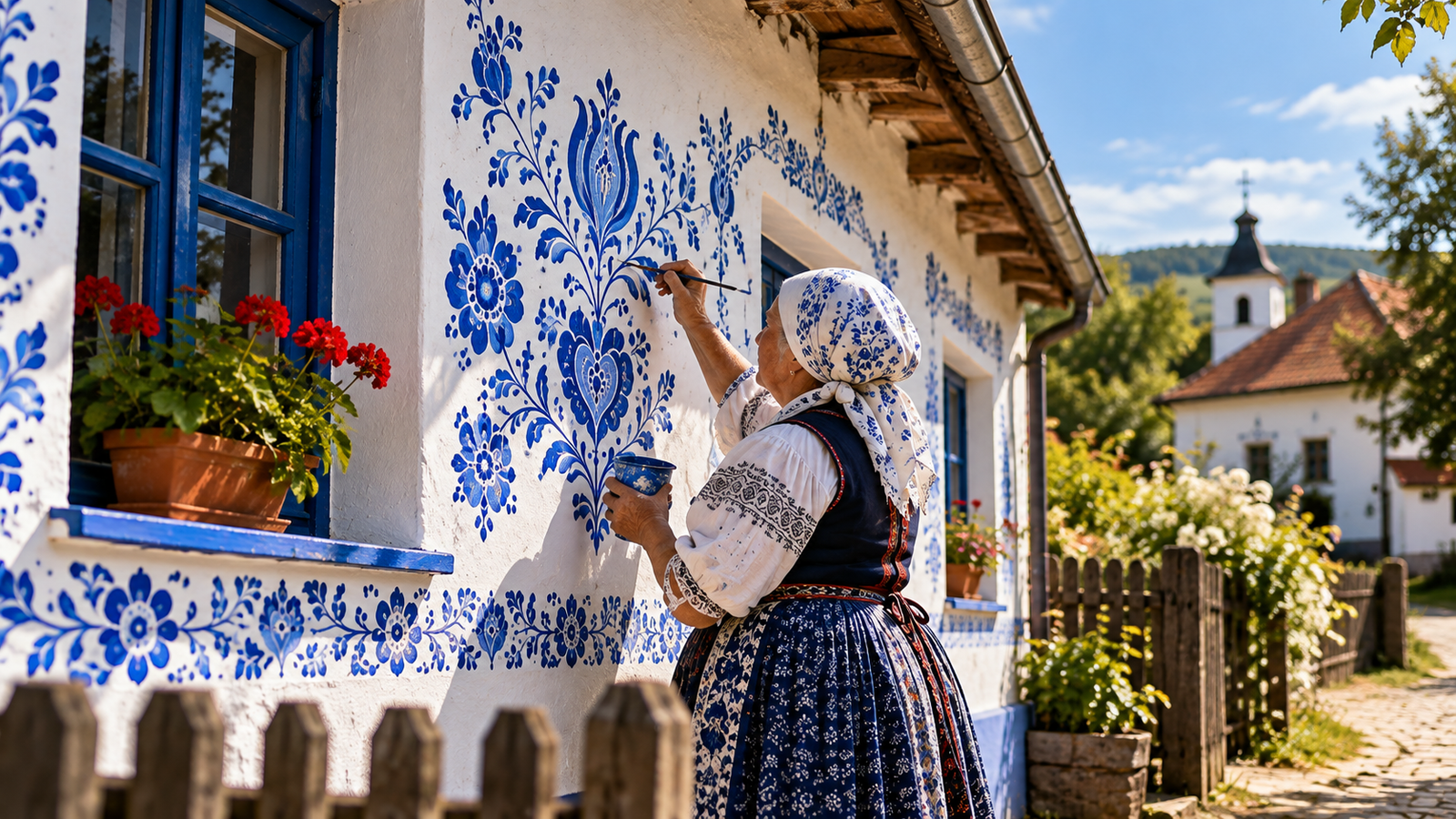
In Louka, a village in South Moravia, Czech Republic, generations of women have preserved a distinctive Moravian folk painting tradition, covering whitewashed walls with intricate blue flowers, hearts and botanical forms. At its centre is an 18th-century chapel whose ornament has been painted, erased and reimagined for decades. From folk painter Anežka Kašpárková to her niece Marie Jagošová, the practice reveals a model of cultural preservation in which heritage remains alive not by resisting change, but through the transmission of knowledge from one generation to the next.
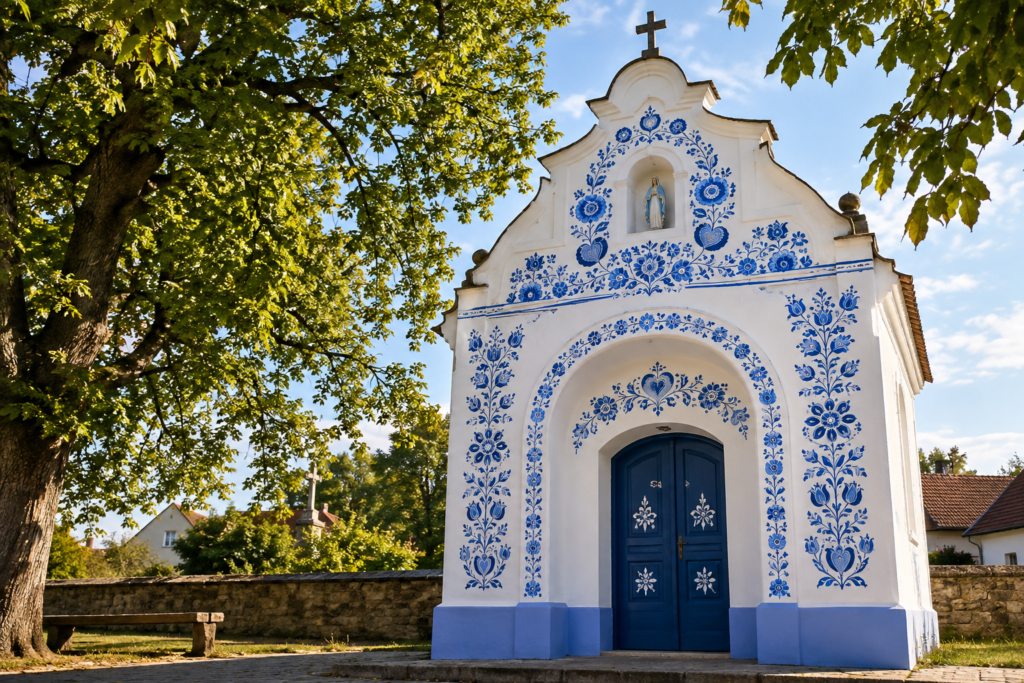
In Louka, preservation follows an unusual rhythm. Across the white façade of the village chapel, ultramarine flowers, leaves and curling botanical forms emerge from the visual vocabulary of Horňácko, the ethnographic region of Moravian Slovakia to which the village belongs. Time and weather gradually alter the decoration; periodic maintenance returns the surface to white. Then another composition begins.
For decades, the woman most closely associated with this ritual was Anežka Kašpárková, a local malérečka, or female folk painter, whose intricate blue ornament transformed the modest chapel into one of the most recognisable expressions of Moravian folk art. Images of Kašpárková working from scaffolding well into old age eventually travelled far beyond the Czech Republic, turning her into an unlikely international symbol of a European craft tradition sustained outside museums, institutions and formal design education.
Yet the story of Louka is larger than the woman who brought it global attention. Kašpárková inherited a practice that existed before her, just as another woman would eventually inherit it from her. What survives in this South Moravian village is therefore not a single artwork, nor even a single artist’s legacy, but something considerably harder to preserve: the knowledge required to make it again.
A Landscape Written in Pattern: The Folk Art of Horňácko
Louka lies in Horňácko, a small ethnographic area of Moravian Slovakia, or Slovácko, close to the Czech-Slovak border and the White Carpathians. Here, architecture, dress, music and craft have historically developed as interconnected expressions of regional identity. Ornament does not belong exclusively to one discipline; it moves between embroidered clothing, woven textiles, domestic objects and architecture.
Traditional Moravian dress in Horňácko is particularly rich in this visual vocabulary. Embroidery appears across sleeves, collars, bonnets and ceremonial garments, while the region also preserves a distinctive form of patterned weaving known as činovati. Historically used for elements of folk dress and household textiles, the technique is recognised today as part of South Moravia’s intangible cultural heritage.
The relationship between Moravian embroidery, traditional dress and architectural folk painting is central to understanding Louka’s blue-painted walls. These are not isolated decorative motifs created simply to embellish a picturesque village. They belong to a much wider system of visual expression that generations encountered across clothing, interiors, religious celebrations and domestic life.
Traditional counted-thread embroidery provides an instructive parallel. Rather than relying exclusively on a design drawn onto fabric in advance, an embroiderer can construct a composition by counting individual threads, working within an established vocabulary while allowing variations to emerge through the maker’s own hand. The result belongs unmistakably to a tradition without necessarily reproducing exactly what came before.
The women painting Louka’s walls have worked according to a similar principle: tradition supplies the grammar; the painter determines the composition.
The Women Behind Moravia’s Folk Painting Tradition
In Czech, a female folk painter is known as a malérečka. Such women once played a more visible role across Moravia and neighbouring regions, where painted façades and architectural details formed part of village life. Their work belonged to an environment in which decorative knowledge was frequently acquired informally, through observation and participation rather than institutional training.
Modernisation gradually altered that landscape. Older houses disappeared or were renovated using new materials, while changing lifestyles reduced the everyday demand for many traditional practices. Skills once embedded within community life became increasingly specialised, surviving through a diminishing number of practitioners.
Against this backdrop, Louka’s chapel assumed particular importance. The building became not simply a surface for decoration, but a place through which the knowledge of ornamental painting could continue to be practised and transmitted.
The tradition predates Kašpárková. Local accounts identify Marie Maňáková as one of the women who decorated the chapel before her, while former Louka mayor Anna Vašicová has recalled the involvement of other local women in maintaining its ornamentation. Vašicová herself remembered helping to fill in painted designs while substituting for her mother.
This history complicates the popular narrative that formed around Kašpárková after photographs of her work circulated internationally. She was not an isolated folk artist who suddenly decided to cover a Czech village in blue flowers. She belonged to an existing chain of female knowledge and, over the course of decades, became its most visible custodian.
Anežka Kašpárková: The Woman the World Discovered
Born in 1928, Czech folk painter Anežka Kašpárková spent much of her working life in agriculture. Painting existed alongside that life rather than as a conventional professional career. She decorated eggs, plates and Christmas ornaments and eventually assumed responsibility for painting Louka’s chapel, continuing a practice associated with earlier local painters.
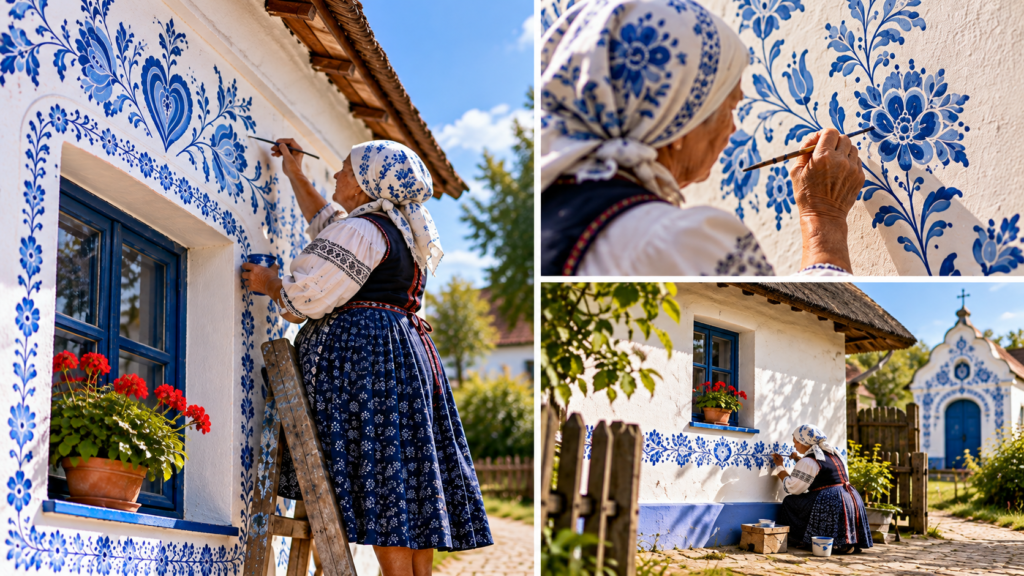
By the time international media discovered her, Kašpárková was already an elderly woman. Photographs showed her in a headscarf, standing on scaffolding with a small brush in hand, surrounded by extraordinarily controlled blue floral compositions. The contrast proved irresistible: a woman approaching 90 producing intricate work on an architectural scale without the professional infrastructure normally associated with public art.
What those images often failed to communicate was the depth of the practice behind them.
Kašpárková worked within the established ornamental language of Horňácko, but she did not simply reproduce a fixed template. Contemporary Czech reporting observed her painting without preparatory sketches, developing compositions directly on the wall. Familiar flowers, leaves and curvilinear forms could be rearranged and reinterpreted, allowing the façade to remain recognisably traditional without becoming a static reproduction of an earlier design.
The distinction is fundamental. Kašpárková was preserving a system of making rather than a predetermined image.
The chapel itself had long occupied an important place within village life. Its origins reach back to the early 18th century, with a bell bearing the date 1715, while a frontal niche containing a statue of the Virgin Mary was added in 1818. Its religious function became intertwined with the community’s care for the building, particularly around children’s First Communion, when families traditionally participated in preparing and refreshing the chapel.
Periodic whitewashing was consequently not an act of destruction but part of the building’s maintenance. Czech accounts document the chapel being whitewashed approximately every two years, after which its blue ornament was recreated. The apparent impermanence of the paintings was built into the tradition itself.
Kašpárková’s attitude towards her work was equally removed from contemporary notions of artistic authorship. She resisted presenting herself as an artist and spoke instead about the pleasure of painting and her desire to make her surroundings more beautiful. There was little distinction between creativity, service and community responsibility. The work was valuable not because it was signed or preserved as an individual artistic statement, but because someone continued to do it.
By the end of her life, Kašpárková had become inseparable from the image of Louka’s painted chapel. She died in March 2018 at the age of 90, leaving the village with a practical question that goes to the heart of any living craft tradition: who would know how to continue?
From Aunt to Niece: Marie Jagošová Continues the Tradition
The answer came from within Kašpárková’s family. After her death in 2018, her niece, Moravian folk painter Marie Jagošová, assumed responsibility for the chapel’s ornamentation, beginning work shortly afterwards in preparation for that year’s First Communion celebrations. Like her aunt, she undertook the work outside a conventional professional framework and without payment.
Jagošová had spent years observing Kašpárková, but inheriting the practice did not mean reproducing her aunt’s designs line for line. Czech reporting from the period immediately noticed differences between the two women’s work. Jagošová drew on what she had learned from Kašpárková while introducing motifs derived from nature, her own imagination and, significantly, traditional Moravian dress, or kroj.
The connection brings the story back to the relationship between fashion, textile and architecture. A decorative vocabulary embroidered onto a sleeve or incorporated into ceremonial dress can inform a flower painted around a chapel window. Motifs migrate between materials and generations while remaining rooted in a recognisable regional identity.
For Jagošová, the practice also carries a spiritual dimension. She has described painting the chapel as an expression of gratitude to the Virgin Mary and connected its ornament to both traditional costume and the surrounding landscape. Before beginning her work, she has said, she seeks guidance from her guardian angel and remembers the folk painters who worked on the building before her.
Her approach demonstrates why living heritage cannot be understood solely through replication. If Kašpárková had copied Maňáková exactly, and Jagošová had subsequently copied Kašpárková, the tradition might have survived visually while losing the creative agency that sustained it in the first place. Instead, each woman inherits a framework within which individual decisions remain possible.
The motifs change, but the language remains legible.
Eighty-Two Layers of Memory
In 2026, a major restoration of Louka’s chapel revealed just how physically embedded that history had become.
What began as repair work exposed significant structural problems. The chapel had developed cracks, while moisture posed a continuing threat to a building constructed directly on earth without conventional foundations. Restoration involved stabilising the masonry, improving drainage and working with traditional lime-based materials compatible with the historic structure.
During conservation, specialists examined the accumulation of coatings on the building and identified an extraordinary 82 layers of limewash.
The discovery offered a material record of a practice defined by repetition. Generation after generation had refreshed the building. Whitewash covered earlier surfaces; new ornament replaced what had faded or disappeared. What appeared temporary at any single moment had, over decades and potentially centuries, accumulated within the fabric of the architecture itself.
Rather than stripping away every trace of previous decoration, conservators preserved areas containing historic blue Horňácko ornament. According to the Municipality of Louka, earlier painted layers were protected beneath a separating layer and limewash so that evidence of the generations of folk painters who worked on the chapel would remain within the structure.
In June 2026, the municipality confirmed that Marie Jagošová was once again painting Horňácko ornament on the restored chapel.
The decision created an unusual dialogue between two approaches to heritage. Conservation protected the historic material beneath the surface, while living tradition required something different: another painter, another brush and another composition in blue.
In June 2026, the municipality confirmed that Marie Jagošová was once again painting Horňácko ornament on the restored chapel. The earlier work remained protected below while a new interpretation appeared above it. Few images describe living heritage more precisely.
Preserving Knowledge, Not Just Objects
The international attention surrounding Kašpárková understandably transformed her into the face of Louka’s tradition. Yet concentrating on one exceptional woman risks obscuring the network of knowledge that made her work possible.
Before Kašpárková there was Maňáková and, according to local accounts, other women who participated in decorating and maintaining the chapel. After her came Jagošová. Around them exists a wider regional craft culture in which knowledge has repeatedly travelled between mothers, daughters, aunts, nieces, neighbours and other practitioners.
That pattern of transmission extends beyond architectural folk painting. Horňácko’s traditional weaving and Moravian embroidery continue through craftspeople who learned techniques within families and communities, while Czech cultural institutions document practitioners whose knowledge was acquired from previous generations rather than reconstructed solely from archival sources.
Taken together, these practices challenge a conventional understanding of preservation. Heritage is often treated as something whose value depends on resisting change: a garment placed behind glass, a painting protected from intervention, a building maintained as closely as possible to a particular historical moment. Louka offers another model. Its blue ornament survives because change is built into the practice.
For contemporary fashion, the distinction is particularly relevant. Heritage is frequently treated as an aesthetic resource: embroidery is digitised, motifs are extracted and traditional textiles are referenced in new collections. Yet preserving the appearance of an object does not necessarily preserve the knowledge required to make it. A museum can conserve a garment, an archive can catalogue a pattern and a photograph can document a painted façade. None of these, on their own, can teach another pair of hands how to create the next one.
A museum can conserve a garment, an archive can catalogue a pattern and a photograph can document a painted façade. None of these, on their own, can teach another pair of hands how to create the next one.
This is where the story of Louka extends beyond folk art. Across fashion and craft, conversations around cultural preservation increasingly depend on distinguishing between preserving an aesthetic and sustaining the community knowledge behind it. A motif can survive long after the skills, rituals and relationships that created it have disappeared. Louka’s Moravian folk painting tradition has endured because it has remained an active practice rather than becoming solely an archival reference.
There is, however, an increasingly urgent question within that model. As the number of practitioners capable of carrying traditional skills forward diminishes, the challenge is no longer simply whether the chapel itself can be conserved. Its 2026 restoration demonstrates that architecture can be stabilised, historic layers documented and old ornament protected. The more difficult question is whether there will always be someone who understands what should happen once the wall is white again.
For now, Marie Jagošová continues to paint the chapel that her aunt painted before her, drawing from the same regional vocabulary without surrendering her own hand. Beneath her work lie earlier layers, some deliberately conserved, others accessible only through photographs and memory. Around her remain the textiles, costumes, landscape and rituals from which Horňácko’s visual language developed.
Eventually, her paintings, too, will fade or disappear beneath another layer of lime. In Louka, that does not necessarily represent the loss of the work. Disappearance has always been part of its continuation.
The future of the tradition will ultimately depend on something less tangible than the survival of any single flower painted onto the chapel wall: whether someone else learns the language well enough to make it their own.
After generations of whitewash, weather and renewal, Louka’s most important cultural inheritance is not the blue ornament itself.
It is knowing how to begin again.