Eight emerging designers are turning discarded materials, unconventional fibres and overlooked imperfections into a compelling argument for circular fashion.
Fashion’s waste problem is often discussed at the end of a garment’s life: what happens when it is no longer wanted, no longer wearable or simply pushed aside by the next collection. The Redress Design Award 2026 asks designers to intervene much earlier—before the first pattern is cut and while every material decision is still open.
Organised by Hong Kong-based environmental NGO Redress, the annual competition places circular design at the centre of the creative process. Its 2026 finalists—Alexandra Burch, David Schuch, Holly Shih, Issac Tong, Jasmine Cheuk, Jon Liesenfeld, Tal Zohar and Yi Ding—approach that challenge through markedly different materials, techniques and visual languages.
Together, their collections transform discarded leather offcuts, secondhand hardware and industrial waste through reconstruction and upcycling. They also explore emerging alternatives such as biodegradable fruit leather and ethical non-livestock wool, questioning what fashion’s raw materials can—and should—look like.
Design Is Where Impact Begins
The environmental impact of a garment is not determined only by how it is produced, sold or eventually discarded. According to research cited by Redress, an estimated 80% of that impact is established during the design stage. That figure shifts the conversation. Circularity is not simply an operational concern to be addressed after a collection has been conceived; it is a creative parameter with the potential to shape silhouette, construction, material and longevity from the beginning.
An estimated 80% of a garment’s environmental impact is established during the design stage.
The Redress Design Award assesses its finalists through this lens. Their collections are judged on circular strategies including low-impact design and production processes, waste reduction, longevity and recyclability, alongside creativity, originality and innovation. Rather than treating sustainability as an aesthetic category, the competition positions it as a design discipline.
A Closer Look at the Collections
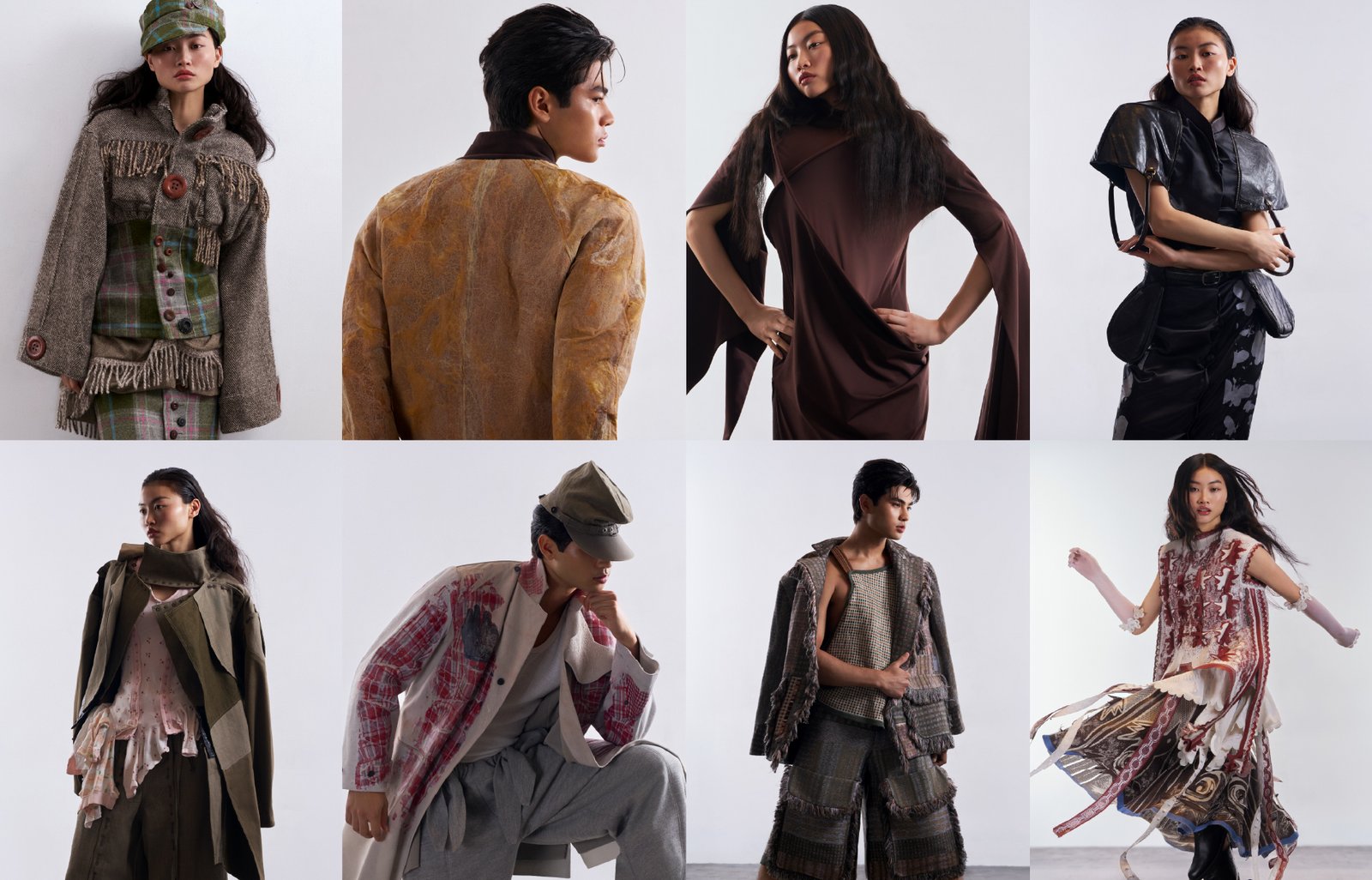
The finalist photoshoot, photographed by Hong Kong creative Paul Sunga, brings the material decisions behind each collection into focus.
Frayed edges, visible joins, irregular surfaces and repurposed components are not concealed. Instead, they become part of the visual identity of the garments. The images move between carefully composed portraits, tactile details and behind-the-scenes moments, revealing both the finished looks and the processes that shaped them.
The finalists of the Redress Design Award are proving that thoughtful design can transform textile waste into something beautiful. Getting up close to these garments, you see how every material choice, texture and technique tells a story.
That closeness matters. Circular fashion can sometimes be reduced to statistics, certifications and technical vocabulary. Here, it is presented as something physical: cracked surfaces, layered textiles, exposed hardware, unexpected proportions and materials carrying visible traces of a previous life. The resulting collections do not attempt to disguise their origins. Their imperfections are part of the proposition.
Eight Designers, Distinct Perspectives
Across the finalist collections, familiar materials are separated from their original functions and reconsidered. Tailoring is reconstructed through contrasting panels. Leather is transformed into sculptural components. Domestic and decorative textiles are reassembled into garments with movement and volume. Hardware becomes both functional and expressive, while traditional ideas of polish are replaced by texture, irregularity and evidence of the hand. The variety of approaches is significant. There is no single visual formula for responsible design and no requirement for circular fashion to conform to one recognisable aesthetic.
What connects the finalists is a willingness to work within material constraints rather than around them. Waste is not treated as an inconvenience to be hidden but as a starting point for experimentation.
The Grand Final
The Redress Design Award 2026 will conclude in Hong Kong on 2 September, when the eight finalist collections are presented at the Grand Final Fashion Show and the competition’s first-prize and People’s Choice winners are announced. The international jury brings together perspectives from design, publishing, manufacturing and sustainability, including Orsola de Castro, author and fashion activist; Rachel Franklin, Director of ESG at Simple Approach; Cherry Mui, Editorial Director of Vogue Hong Kong; Rod Henderson, President of TAL Apparel Ltd; designer and Redress alumnus Angus Tsui; and Redress founder and board chair Dr Christina Dean. The first-prize winner will travel to the UK to work with Simple Approach and luxury womenswear house Roksanda on an upcycling project, while all finalists will enter the Redress Alumni Network.
The programme extends beyond the competition itself, with six alumni brands also being presented during the Grand Final and at CENTRESTAGE from 2–5 September. Together, the finalist and alumni collections position circular design not as a constraint on creativity, but increasingly as part of the technical and creative vocabulary shaping fashion’s next generation.
Watch the Livestream
The Redress Design Award 2026 Grand Final Fashion Show will be livestreamed globally on Wednesday, 2 September, at 5pm HKT / 11am CET. The livestream will be available through Redress’s Facebook and WeChat channels.
The Redress Design Award is organised by environmental NGO Redress and supported by the Cultural and Creative Industries Development Agency of the Government of the Hong Kong Special Administrative Region as lead sponsor.
Photoshoot credits: Photographer Paul Sunga; models Pak Yan Wong, Self Management Hong Kong, and Max Holmström, Primo Management Ltd; creative stylist Matthieu Amelin; hair Henry Tse for Davines; make-up Cindy Lai for MakeupBees; production Katt Bidegain, Charly Cheung and Nancy Liu; studio Soho House Hong Kong; lighting Ming Suet; BTS videographer Jimmy Yu; BTS photographer Nicky Chan.