
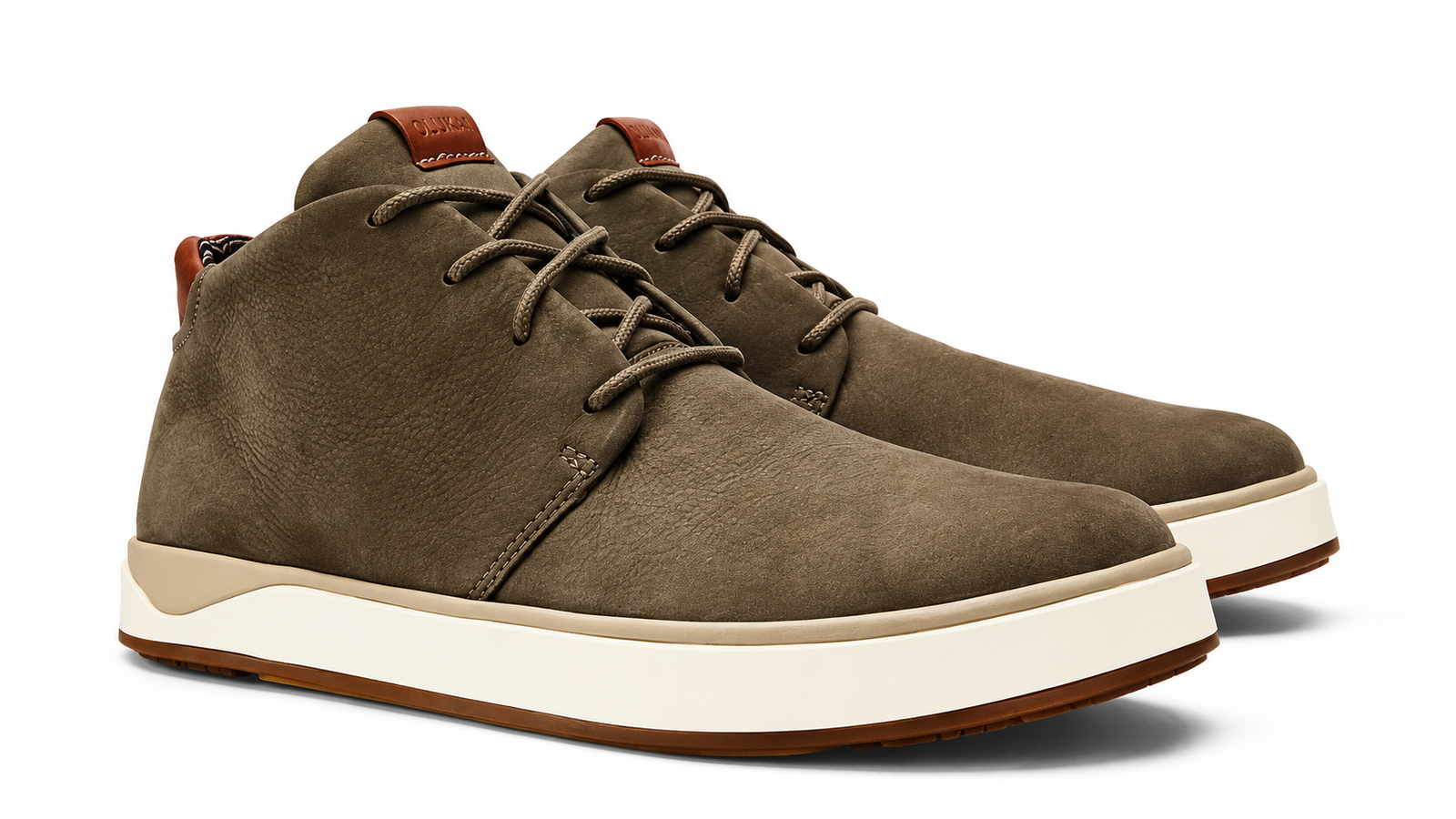
The limited-edition collaboration brings together Hawaiian craftsmanship, premium leather and resoleable construction, placing durability and repairability at the centre of contemporary footwear design.
In an industry where newness often drives consumption, the ability to repair and retain a product offers a different measure of value. Premium footwear brand OluKai is exploring this approach through a collaboration with Hawaiian master bladesmith Neil Kamimura, introducing a limited-edition leather boot conceived to develop character with age rather than be replaced at the first signs of wear.
OluKai x Neil Kamimura Pāhi draws on principles familiar to traditional metalworking: material quality, precision, functionality and an understanding of how objects perform over time. The collaboration translates Kamimura’s approach to craftsmanship into footwear, combining considered construction with practical features intended to support prolonged use.
At the centre of the design is a resoleable outsole, allowing a component exposed to repeated wear to be replaced without necessarily discarding the entire boot. It is a relatively straightforward proposition, but one that raises a wider question for contemporary footwear: how might designing for maintenance change the relationship between products and their owners?
From the Blacksmith’s Workshop to Footwear Design
Born and raised on Hawaiʻi’s Big Island, Neil Kamimura is a self-taught bladesmith whose practice draws on a family connection to blacksmithing. He gained wider recognition after winning the History Channel’s Forged in Fire competition and has since built an international following for his handcrafted knives and swords.
His work is shaped by an understanding of how materials respond to physical stress, repeated handling and changing conditions. Whether forging a blade or restoring a vintage motorcycle, Kamimura works with objects whose performance depends on the relationship between material selection, construction and maintenance.
Those considerations informed the development of Pāhi, which was designed to move between demanding workshop environments and everyday use without sacrificing comfort or a refined appearance.
Describing the partnership in OluKai’s official announcement, Kamimura said it felt like an extension of his craft. He emphasised the importance of creating footwear capable of supporting long hours in the workshop while withstanding regular exposure to the elements.
The collaboration is therefore rooted less in decorative references to blacksmithing than in the practical requirements of someone whose working life depends on durable equipment.
Materials Designed to Develop With Wear: The Pāhi is constructed from premium pull-up leather, treated with oils and waxes to support flexibility and resistance to moisture. Unlike finishes intended to preserve a uniform appearance, pull-up leather develops variations in colour and texture as it bends and responds to use.
Over time, this process creates a distinctive patina, allowing each pair to acquire an individual appearance. The material’s changing surface becomes part of the design rather than a characteristic to conceal.
According to OluKai, the leather treatment is also intended to help resist drying, cracking and hardening. These characteristics are relevant to a boot designed for repeated wear, although its long-term performance will ultimately depend on use, maintenance and environmental conditions.
Functionality extends to the sole, which incorporates a traction-focused design intended to provide grip across different surfaces. Cushioning and rebound are intended to offer support during prolonged periods of standing and walking, reflecting Kamimura’s requirements in the workshop.
Together, these elements position the Pāhi between work-inspired footwear and contemporary everyday design, with material performance taking precedence over seasonal styling.
Repairability and the Value of Product Longevity
The collaboration’s most significant feature from a responsible design perspective is its resoleable construction. Footwear presents particular challenges for product longevity because its components deteriorate at different rates. Soles may lose traction or structural integrity while leather uppers remain serviceable, creating a situation in which an otherwise usable product is discarded because one component can no longer perform its function.
By allowing the outsole to be replaced, the Pāhi offers a potential alternative to premature replacement. This design consideration reflects a broader shift towards products that can be maintained over time, rather than treated as disposable once a particular component reaches the end of its useful life.
Repairability, however, should not be confused with a demonstrated reduction in environmental impact. Its benefits depend on the availability and cost of repair services, the durability of the remaining components and whether consumers choose to maintain their footwear.
OluKai has not provided a product-specific lifecycle assessment or comparative environmental data for the Pāhi in its launch announcement. The boot’s resoleable construction is therefore best understood as a tangible contribution to potential product longevity, rather than proof of a quantified environmental benefit.
This distinction is particularly relevant as fashion brands increasingly incorporate durability and circularity into their product narratives. Design features that enable repair can be meaningful, but their environmental value is ultimately determined by how products perform and are used over time.
Craftsmanship as a Long-Term Design Philosophy
Beyond its technical features, the collaboration highlights the continuing relevance of specialist craftsmanship in contemporary product development. Kamimura’s practice relies on skills refined through experience, experimentation and a detailed understanding of materials. His approach reflects a tradition in which the quality of an object is assessed not only by its initial appearance but also by its functionality, resilience and capacity to remain useful.
OluKai has sought to translate that philosophy into a boot that balances performance with understated design. Kerry Kondrady, the brand’s Chief Marketing Officer, described the Pāhi as a product intended to withstand demanding use while maintaining a timeless aesthetic.
The project also sits within OluKai’s broader stated commitments to product quality and more responsible manufacturing. The company identifies efforts to reduce wastewater and hazardous substances in production among its environmental initiatives and supports community programmes in Hawaiʻi through the Ama OluKai Foundation.
These commitments provide context for the brand’s approach, although they do not independently establish the environmental performance of this particular collaboration.
The more immediate significance of the Pāhi lies in its attempt to incorporate maintainability into the original design brief, rather than treating repair as an afterthought.
Beyond the First Signs of Wear
As the footwear industry examines ways to address material consumption and product waste, durability is increasingly relevant to discussions of responsible design. Yet longevity cannot be achieved through material selection alone. It requires construction that can withstand repeated use, components that can be maintained and a consumer willing to keep a product in circulation.
The Pāhi brings these considerations into a limited-edition collaboration grounded in the working philosophy of a craftsman. Its leather is intended to evolve aesthetically, while its replaceable outsole offers a practical means of extending its service life.
Whether the boot fulfils that promise will become clearer through real-world wear and access to repair. Nevertheless, the collaboration demonstrates how traditional principles of making and maintaining objects can inform contemporary footwear design.
In a market frequently defined by what comes next, the Pāhi offers a proposition centred on what is worth keeping.
The OluKai x Neil Kamimura Pāhi retails for $300, with general availability from 22 October through OluKai’s official website and selected OluKai and Boot Barn retail locations, while supplies last.
Further information about Neil Kamimura’s craftsmanship is available through T. Kamimura Blacksmith.