
Part of the Paulo de Oliveira group, the Portuguese textile manufacturer is transforming production waste into recycled technical materials for automotive, construction, footwear and other industrial applications.
Portuguese textile manufacturer Penteadora is expanding its recycling capabilities through a new business dedicated to nonwoven materials made from industrial textile waste. Supported by an investment of approximately €4 million, the initiative marks a strategic extension of the company’s manufacturing activities into technical textiles, opening new commercial opportunities beyond conventional yarn and fabric production.
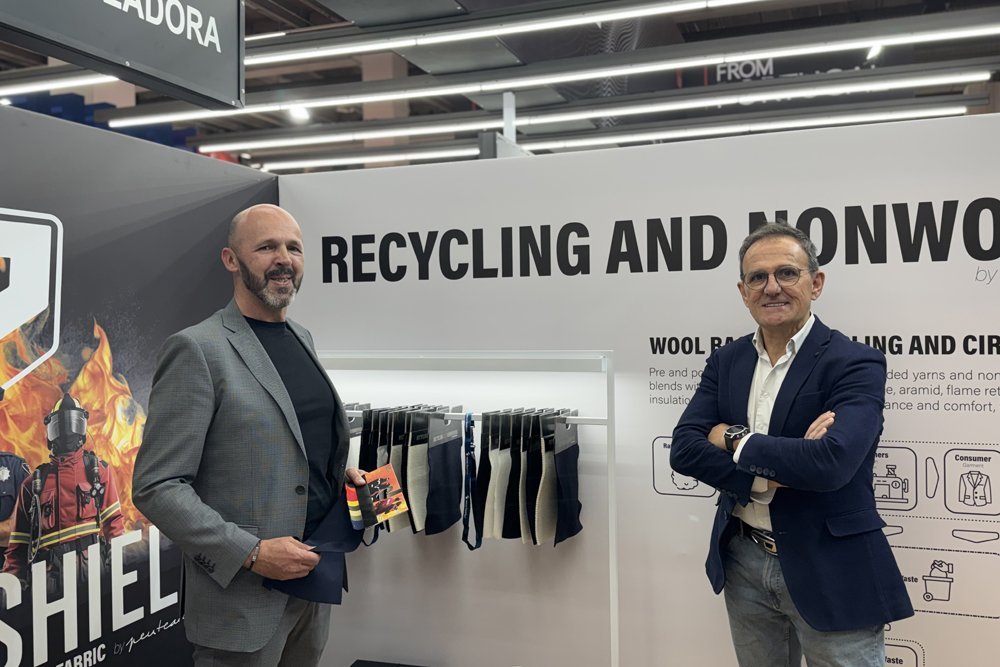
Part of the Paulo de Oliveira group, Penteadora presented its first developments in needle-punched nonwovens at Techtextil in Frankfurt, introducing materials designed for applications ranging from automotive components and footwear to construction and fire protection. The project, which began taking shape approximately five years ago, builds on the company’s established practice of reincorporating manufacturing waste into textile production. Its latest development reflects a broader shift towards finding commercially viable applications for recovered fibres, particularly as European manufacturers seek to improve resource efficiency and diversify their product portfolios.
Turning Textile Waste Into New Industrial Materials
Penteadora’s new operation focuses on converting textile residues into nonwoven structures with specific technical characteristics. Unlike conventional woven or knitted fabrics, needle-punched nonwovens are produced by mechanically entangling fibres, allowing manufacturers to develop materials with different compositions, thicknesses and performance properties. The process creates opportunities to recover fibres that may not be suitable for conventional yarn production while retaining value from materials already circulating within the manufacturing system.
Speaking to Portuguese industry publication Portugal Têxtil during Techtextil, Penteadora’s commercial director Ângelo Correia explained that the objective extends beyond recovering waste generated by the company itself. The strategy encompasses the wider Paulo de Oliveira group, which produces approximately 700 kilograms of wool-based textile waste daily, primarily wool and polyester blends. These residues provide an important source of raw material for the new production line, reducing the need to rely exclusively on newly sourced fibres.
The company is also exploring ways to recover manufacturing offcuts from its customers, potentially establishing a system in which materials originally supplied for garment production can return for processing into new industrial products. Post-consumer textiles remain a longer-term possibility, although their inclusion would depend on partnerships and effective sorting infrastructure. For now, Penteadora is prioritising industrial waste, where fibre composition, material quality and origin can be more reliably controlled.
The development represents an extension of textile circularity beyond the traditional boundaries of fashion manufacturing. Rather than directing recovered fibres exclusively back into clothing production, Penteadora is investigating applications in sectors where their existing properties can deliver technical value. The company is working with wool and polyester blends alongside specialised fibres previously used in protective clothing, including aramids and flame-resistant viscose.
Among the applications under development are thermal and fire-protection barriers for railway and metro seating, where nonwoven materials could be incorporated beneath visible upholstery. According to Fernando Merino, the technical consultant involved in developing the new operation, the processing method can preserve certain inherent properties of the original fibres, although their performance requirements differ from those of the fabrics from which they were recovered.
Correia also explained that flame-resistant characteristics can be retained during processing, but not necessarily at the same level of protection as the original material. This distinction is particularly important for technical textiles, where suitability depends on the requirements of the intended application rather than recycled content alone.
Initial fire-resistance testing has already been carried out for some materials, while additional assessments, including smoke-emission testing, are required for particular applications. Merino emphasised that certification and testing requirements vary considerably between sectors, with materials intended for public transport subject to different standards from those used in construction.
From Material Recovery to Commercial Scale
Beyond fire protection, Penteadora is developing potential applications in automotive manufacturing, where recycled nonwovens could provide thermal barriers near engines, acoustic insulation and components for vehicle interiors. The company is also investigating technical insoles for footwear production, insulation products for construction and decorative applications, as well as mattress fillings and protective layers that could make use of wool’s natural thermal properties.
The breadth of these applications reflects the company’s intention to establish a diversified technical textile portfolio rather than develop a single recycled product. As Correia explained to Portugal Têxtil, the objective is to offer potential customers nonwoven materials suitable for a wide variety of uses, with performance characteristics adapted to different industrial requirements.
To support the expansion, Penteadora has invested in a production facility equipped to manufacture needle-punched nonwovens in varying fibre compositions, thicknesses and weights. Samples presented at Techtextil ranged from 1.5 to five millimetres in thickness, with material weights approaching 1,500 grams per square metre. The production line is designed to manufacture nonwovens up to 3.2 metres wide, with a reference capacity of approximately 500 kilograms per hour, depending on the characteristics of the material being processed.
These capabilities provide a foundation for industrial development, although the transition from technical samples to established commercial products will depend on customer requirements, testing, certification and production economics. For manufacturers working across multiple sectors, recycled materials must meet the same functional expectations as conventional alternatives, particularly in applications involving fire resistance, insulation and structural performance.
Penteadora’s expansion also comes against the backdrop of changing demand within European technical textiles. The company has reported growing interest in fabrics for military and defence applications, a trend Correia said has accelerated since 2024. Although distinct from its recycled nonwovens initiative, this activity reflects the group’s wider diversification into specialised materials and performance-driven manufacturing.
With exports accounting for more than 85 percent of its business and France and Germany among its principal international markets, Penteadora operates within a European manufacturing landscape increasingly shaped by material efficiency, technical innovation and supply-chain resilience.
The environmental value of its recycled nonwovens will ultimately depend on more than the proportion of recovered fibres used. Processing energy, product durability, manufacturing efficiency and the materials being replaced will all influence their overall performance. Nevertheless, the initiative demonstrates how established textile manufacturers can identify new commercial applications for production residues while reducing the amount of material leaving the industrial value chain.
For Portugal’s textile sector, Penteadora’s investment illustrates an approach to circular manufacturing that combines existing industrial expertise with product diversification. By transforming wool blends and specialised textile waste into materials for other industries, the company is seeking to create additional value from resources already available within its supply chain.
As the European textile industry continues to confront questions of resource use and industrial competitiveness, projects of this kind point towards a broader definition of circularity: one in which recovering materials is closely connected to developing viable markets for their next use.
Source: Portugal Têxtil — Penteadora Integra Não-Tecidos Reciclados no Portefólio