
From lower-emission wool and regenerative cotton to industrial textile recycling, this year’s Climate and Nature Impact Awards reveal why fashion’s environmental ambitions depend as much on investment and long-term partnerships as they do on technological progress.
For years, fashion’s sustainability debate has centred on the promise of innovation: new fibres, alternative materials, regenerative agriculture and technologies capable of transforming discarded clothing into valuable resources. Yet developing solutions is only part of the challenge. Financing them, integrating them into established supply chains and ensuring their commercial viability have proved considerably more difficult.
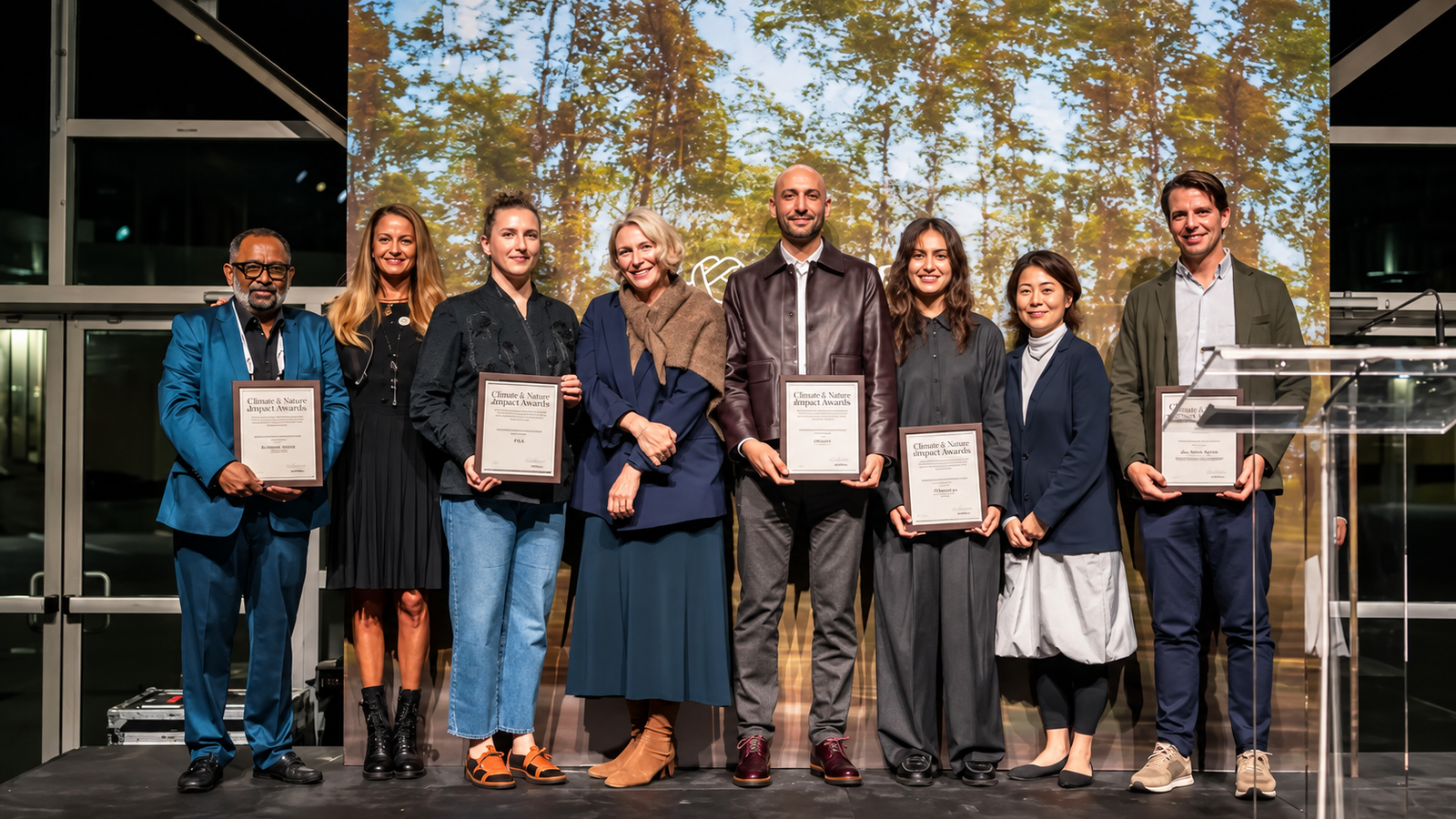
That reality was evident among the winners of Textile Exchange’s 2026 Climate and Nature Impact Awards, announced on 15 October following a ceremony at the organisation’s annual conference in Vancouver, Canada. The five recipients represent different parts of the global textile economy, from sheep farms in Australia and cotton fields in India to industrial recycling facilities in Sweden. What connects them is an effort to overcome the practical barriers that have repeatedly prevented promising environmental initiatives from achieving wider adoption.
Presented on 14 October by Textile Exchange Chief Executive Officer Claire Bergkamp and Board Chair Marci Zaroff, the awards recognised individuals and partnerships working across raw-material production, waste management, recycling and regenerative agriculture. Beyond their individual achievements, the projects reflect a broader shift in the industry’s approach to environmental responsibility, one that increasingly requires brands, manufacturers, producers and investors to share the costs and risks of change.
Where Environmental Progress Begins
For American fashion brand Theory, the challenge began far from the design studio, on a sheep farm in New South Wales, Australia. Working with parent company Fast Retailing, Congi Farm, environmental technology company Sea Forest and Italian wool manufacturer Botto Giuseppe, the brand explored whether methane emissions associated with wool production could be reduced before the fibre entered the fashion supply chain.
The collaboration, which received the Collaboration for Global Impact Award, involved a 120-day pilot in which 2,000 Merino sheep were given SeaFeed, a seaweed-based feed supplement developed by Sea Forest. According to Textile Exchange, the intervention reduced enteric methane emissions by 43%, avoiding approximately 54.5 metric tonnes of carbon dioxide equivalent (CO₂e). The resulting wool was subsequently incorporated into Theory’s Spring 2026 Regal Wool collection, connecting an agricultural emissions-reduction initiative with a finished product.
The significance extends beyond the reported reduction, which applies to the trial rather than Theory’s entire wool supply chain. Agricultural producers, technology developers, manufacturers and the fashion brand each played a role in bringing the project to market. Gonzalo Pertile, Theory’s Vice President of Sustainability, pointed to lessons in implementation, measurement, traceability, cost and scalability. These considerations will ultimately determine whether similar interventions can move beyond individual farms and become established sourcing practices.
A related challenge is emerging in regenerative cotton production, where environmental improvements must be balanced against the economic realities facing farmers. In India, Amiha Agro has worked with approximately 8,000 farmers across 35,000 acres to introduce practices intended to improve soil health, reduce reliance on chemical inputs and strengthen resilience to changing climatic conditions.
The programme earned its director, Amitabh Singh, the Regenerative Land Leadership Award. Textile Exchange reported estimated water savings of between 20 billion and 35 billion litres through improved agricultural and irrigation practices, alongside reduced dependence on synthetic fertilisers and pesticides. The organisation also cited improvements in soil organic carbon and benefits reaching more than 40,000 people in rural communities through lower production costs and greater farming stability.
While these programme-reported figures indicate the potential of regenerative agriculture, they also raise a question often overlooked when fashion companies announce responsible sourcing commitments: who bears the financial burden of changing how raw materials are produced? Farmers may need to invest in new practices, equipment, training and monitoring long before the economic benefits become apparent. Without dependable purchasing relationships and financial support, even promising approaches can struggle to expand.
The Business of Making Circularity Work
If agricultural initiatives demonstrate the importance of intervention at the beginning of the supply chain, Sweden’s Circulose illustrates what happens when technological innovation advances faster than commercial demand.
The company produces CIRCULOSE, a dissolving pulp made entirely from recycled cotton textiles that can be converted into new man-made cellulosic fibres. Its Ortviken facility was developed to bring chemical textile recycling into commercial-scale production, offering a route to recovering materials that might otherwise be discarded.
Yet the facility’s history has exposed the financial vulnerability of emerging recycling technologies. Originally operated by Renewcell, the plant’s future became uncertain following the company’s bankruptcy in 2024, despite growing interest in textile-to-textile recycling. The subsequent acquisition of Renewcell’s assets by investment firm Altor, and efforts to restart operations under Circulose, placed the question of commercial demand at the centre of the company’s recovery.
In February 2026, Circulose announced plans to resume commercial production during the fourth quarter of the year, supported by volume commitments from 11 fashion brands. Agreements with four fibre producers — Tangshan Sanyou, Aditya Birla’s Birla Cellulose, Jilin Chemical Fiber and China Textile Academy Green Fibre — were also established to support the conversion of recycled pulp into finished fibres. The Ortviken facility has a stated annual capacity of 60,000 tonnes, although this represents potential output rather than confirmed current production.
The collaboration received Textile Exchange’s Textile-to-Textile Ecosystem Award, recognising the partnerships required to support industrial recycling. Its importance extends beyond a single facility. Recycling businesses cannot survive on technological capability alone; they need predictable orders, reliable manufacturing partners and sufficient investor confidence to maintain operations. For fashion brands, supporting circularity therefore requires more than occasional collections made with recycled materials. It demands purchasing commitments capable of sustaining the infrastructure on which those products depend.
There is another side to the circular economy, however, that receives considerably less attention than advanced recycling facilities: the people responsible for collecting, sorting and processing waste before it can become a new resource.
That work is central to Green Worms, the Indian social enterprise founded by Jabir Karat, recipient of the Ryan Young Climate Leader Award. Named in memory of Textile Exchange’s former Chief Operating Officer and the architect of its Climate+ strategy, the award recognises leadership in addressing emissions associated with fibre and raw-material production.
Green Worms combines waste collection, sorting, processing and material recovery with efforts to create employment opportunities and improve conditions for people working in waste management. Its operations direct recovered materials to recyclers and other processing facilities, while the organisation also operates a plastic-film recycling plant. It has announced plans to establish a mechanical textile-to-textile recycling facility in Tamil Nadu, extending its activities into the recovery of fibres from discarded garments.
The initiative draws attention to the workforce underpinning circular fashion. While brands increasingly promote recycled content and new material technologies, the labour involved in recovering those materials remains essential. Expanding recycling capacity without addressing working conditions, fair compensation and the distribution of economic value risks reproducing existing inequalities within a different production model.
Who Pays for the Transition?
The question of financing brings the discussion back to the beginning of the supply chain, where the cost of adopting new agricultural practices can determine whether environmental commitments translate into lasting change.
Environmental solutions company PUR, winner of the Removing Economic Barriers Award, has developed regenerative wool programmes designed to address this challenge through partnerships with luxury brands and agricultural producers. Working with farms certified under the Responsible Wool Standard, the company combines brand investment, technical assistance, producer agreements and environmental monitoring to support practices extending beyond existing certification requirements.
Since 2020, the programmes have supported 16 producers across nearly 17,000 hectares, mobilising approximately $350,000 in direct funding for implementation, according to Textile Exchange. The model aims to reduce the financial burden on farmers while giving brands a more active role in improving the production systems from which they source materials.
Its relevance is particularly evident in luxury fashion, where material quality, provenance and traceability are closely tied to sourcing strategies. Yet the principle applies more broadly. Agricultural producers cannot reasonably be expected to absorb the full cost and risk of environmental improvements while the commercial benefits are distributed further along the value chain. For regenerative practices to gain wider acceptance, the economics must work for those responsible for implementing them.
This tension runs through each of the winning initiatives. Theory’s emissions-reduction project required cooperation between agricultural and commercial partners. Amiha Agro’s cotton programme depends on farmers having the resources and incentives to adopt new practices. Circulose needs committed buyers to support industrial recycling, while Green Worms demonstrates that circularity also relies on workers and waste-management infrastructure. PUR, meanwhile, addresses the financing arrangements needed to make agricultural change economically feasible.
Beyond the Pilot Project
What emerges from the 2026 Climate and Nature Impact Awards is a picture of an industry increasingly concerned with implementation rather than innovation alone. The projects suggest that progress becomes more achievable when commercial relationships extend beyond conventional purchasing arrangements and companies take greater responsibility for the systems producing their materials.
There are, however, limits to what individual initiatives can demonstrate. A successful emissions-reduction trial does not establish that a brand’s overall supply-chain emissions are falling. Improvements reported by a regenerative agriculture programme do not necessarily translate into measurable progress across an entire sourcing region. Nor does industrial recycling capacity guarantee that recycled fibres will replace virgin materials at a scale sufficient to reduce the industry’s overall environmental footprint.
These distinctions matter as sustainability claims face greater scrutiny and businesses come under pressure to demonstrate results rather than intentions. Long-term monitoring, credible measurement and transparency around commercial performance will be essential in determining which approaches deliver lasting environmental benefits.
The five winners offer different responses to the same underlying challenge. Fashion’s environmental transition requires changes not only to the materials it uses, but to how those materials are produced, financed, recovered and purchased. Innovation can provide the solutions. Whether they achieve meaningful scale will depend on the industry’s willingness to invest in them beyond the pilot stage.
For more information about the organisations and initiatives featured in this article, visit their official websites:
- Textile Exchange – Organiser of the Climate and Nature Impact Awards
- Theory – Collaboration for Global Impact Award
- Fast Retailing – Theory’s parent company
- Sea Forest – Developer of SeaFeed
- Circulose – Textile-to-Textile Ecosystem Award
- Green Worms – Ryan Young Climate Leader Award
- PUR – Removing Economic Barriers Award
Source: Textile Exchange — 2026 Climate and Nature Impact Awards