
In Colombia’s capital, public institutions, businesses and women-led workshops are working together to transform discarded textiles into new products, demonstrating how local collaboration can turn circular fashion ambitions into practical action.
The future of circular fashion may depend as much on the relationships between people as it does on advances in materials and recycling technologies. In Bogotá, Colombia, an expanding network of businesses, public institutions and women artisans is demonstrating how existing skills and local partnerships can give discarded textiles a new purpose.
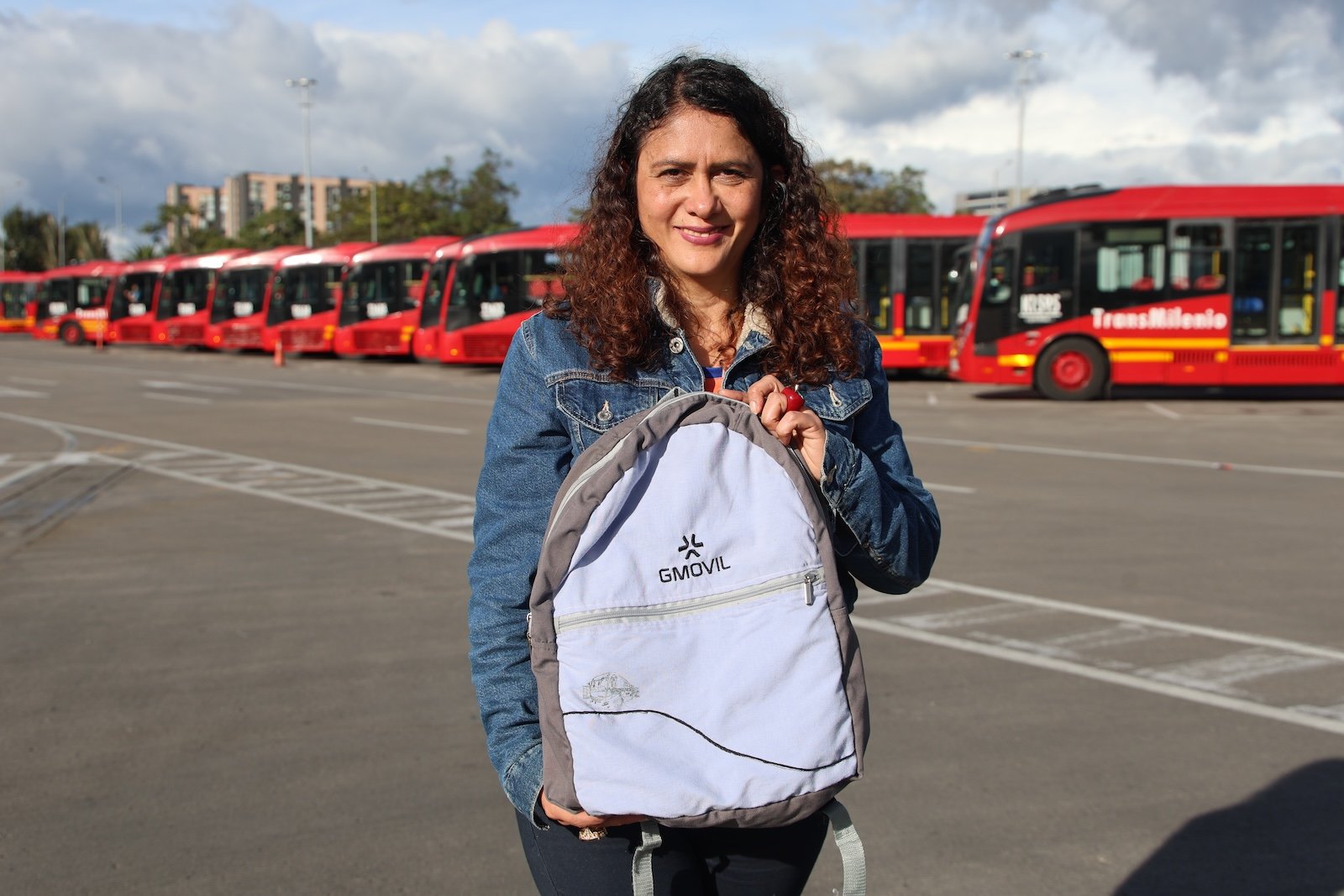
At the centre of this effort is Dotaciones Circulares, a programme coordinated by Bogotá’s District Secretariat of Environment that connects organisations disposing of work uniforms with local makers capable of transforming them into functional products. Since 2025, the initiative has recovered more than one tonne of textiles and produced 7,250 new items, including backpacks, lunch bags and tool organisers.
Yet the figures tell only part of the story. What distinguishes the initiative is the system of cooperation behind it: companies contribute materials, women-led workshops provide the craftsmanship, and public institutions help establish the connections that allow discarded garments to return to use.
Connecting Businesses, Artisans and Public Institutions
Work uniforms are a familiar but often overlooked source of textile waste. Across transport, construction, retail and service industries, garments are regularly replaced because of changing operational requirements, branding or wear. While some may no longer be suitable for their original purpose, portions of their fabric can remain usable.
Dotaciones Circulares seeks to recover that value by creating a relationship between the organisations discarding textiles and the people with the skills to transform them. According to an announcement published by Bogotá’s District Secretariat of Environment on 18 October 2026, ten companies and organisations have supplied uniforms and denim garments to the initiative since 2025. Among them are E-Somos Fontibón and GMóvil, operators within the city’s integrated public transport system.
Rather than approaching textile waste as an isolated environmental problem, Bogotá is treating it as an opportunity to bring different parts of the community into a shared circular economy.
The recovered materials are transformed into products that return to participating organisations and their employees. In this way, companies become more than suppliers of unwanted garments; they also help create a destination for the materials once they have been remanufactured.
The model addresses one of the practical challenges facing circular textile initiatives: connecting material recovery with production capacity and demand. Collecting discarded clothing is only the beginning. Keeping it in use requires sorting, design, skilled labour and organisations willing to purchase or distribute the resulting products. By coordinating these activities, the programme demonstrates how a local circular economy can begin to take shape through relationships between businesses and communities that might otherwise operate independently.
The Women Giving Discarded Textiles a New Purpose
Behind the transformation of uniforms into new products are the women of Manos Reparadoras, a remanufacturing initiative associated with Bogotá’s Red Moda Circular network. Their work draws on sewing, garment construction and repair skills that are essential to textile reuse but frequently receive less attention than industrial recycling technologies. Through the programme, discarded garments become raw materials for accessories and practical objects, creating opportunities for existing craftsmanship to serve new markets.
For the women involved, the initiative is not simply about recovering textiles. It also provides a route towards greater economic participation through work that builds on their professional knowledge.
Margin Molina, a member of Manos Reparadoras, explained in the District Secretariat of Environment’s official announcement that the programme had enabled her to become a supplier to several companies, helping her gradually expand her remanufacturing business.
Her experience points to a wider opportunity within circular fashion. When businesses and public institutions recognise local makers as part of their supply networks, traditional garment skills can become a foundation for new commercial relationships.
The programme also challenges the assumption that innovation in sustainable fashion must necessarily originate in laboratories or large-scale manufacturing facilities. In Bogotá, some of the most relevant work is taking place through the application of established techniques, adapted to materials that would otherwise be discarded.
The value of these skills extends beyond the products themselves. They support the possibility of building a local production network in which knowledge, labour and recovered materials remain connected to the communities that use them.
From Individual Projects to a Citywide Network
Dotaciones Circulares forms part of Red Moda Circular, a wider effort to connect textile businesses, designers, garment workers, repair specialists and citizens around reuse and more responsible material management.
The network operates within Bogotá’s broader circular economy strategy, which seeks to encourage cooperation between government, businesses, educational institutions and civil society. Its approach extends beyond discarded uniforms. In May 2026, the District Secretariat of Environment announced a collaboration involving Manos Reparadoras and Kenzo Jeans: Reborn, in which unwanted denim was transformed into a collection of bags.
The project brought together collected garments, local production skills and a commercial fashion partner. It offered another example of how existing textiles can become the starting point for new products while creating opportunities for women working in garment remanufacturing.
According to the city’s May announcement, 108 participants were registered with Manos Reparadoras at that time, contributing to repair and remanufacturing activities across different neighbourhoods.
The same announcement reported that the city’s RenovaModa collection programme had recovered approximately 184 tonnes of clothing, footwear and other textiles between 2022 and April 2026. These figures relate to the wider textile recovery programme, rather than to Dotaciones Circulares alone, but they illustrate the broader infrastructure supporting Bogotá’s circular fashion activities.
The distinction matters. A circular textile economy cannot be measured by a single project or collection campaign. It requires systems that allow materials to move between collection points, workshops, businesses and consumers, supported by organisations capable of maintaining those relationships.
Bogotá’s developing network suggests how individual initiatives can become connected parts of a wider local strategy.
Why Community Participation Matters for Circular Fashion
Circularity is often discussed through the language of material innovation, recycling capacity and resource efficiency. These are important elements, but they do not operate independently of the people and institutions responsible for putting them into practice.
For discarded uniforms to become new products, companies must be willing to release the materials, workshops must have the skills and capacity to process them, and participating organisations must identify a use for the finished goods.
The contribution of each participant is different, yet the system depends on their cooperation.
This is particularly relevant for smaller producers and community-based enterprises, which may possess the technical knowledge required for repair and remanufacturing but lack direct access to consistent orders or large institutional customers. Public coordination can help establish those connections, although the long-term success of such initiatives depends on viable business arrangements and continued demand.
The Bogotá programme illustrates how circular fashion can become a shared responsibility rather than an activity confined to individual brands. Businesses contribute materials and purchasing opportunities, artisans provide production expertise, and public institutions support the network through which these relationships develop.
Importantly, the initiative also places economic participation alongside environmental objectives. The women involved are not simply volunteers contributing to a waste reduction campaign; they are skilled makers whose work can form part of commercial supply relationships. That distinction is central to understanding the social dimension of circular fashion.
Measuring the Impact of Collective Action
The programme’s reported results provide an indication of what coordinated local participation can achieve. More than one tonne of discarded textiles has been redirected into 7,250 products since 2025, according to Bogotá’s environmental authority.
These outcomes demonstrate material recovery and remanufacturing activity, although they do not independently establish the initiative’s overall environmental impact. The available reporting does not include a detailed lifecycle assessment, comparative emissions data or information about the durability and eventual disposal of the remanufactured products. Nor does it provide comprehensive figures on the income generated for participating artisans or the long-term financial arrangements supporting their businesses.
Such information would be valuable in assessing how the programme develops, particularly as circular fashion initiatives increasingly face expectations to demonstrate both environmental and social outcomes.
Nevertheless, the model raises an important question for cities and fashion businesses elsewhere: how much textile waste could be addressed by connecting existing material streams with local skills and production networks?
Not every solution requires the creation of an entirely new industrial process. In some cases, progress may begin with identifying what is already available within a community and establishing the partnerships needed to make better use of it.
A Community-Led Approach to Fashion’s Circular Future
Bogotá’s experience offers a perspective on circular fashion that places collaboration at the centre of the conversation. The programme is coordinated by public institutions, but its practical operation depends on businesses willing to participate and makers capable of giving discarded textiles a second life. Its achievements are therefore collective, reflecting the contributions of organisations and individuals across the city.
For women working in garment repair and remanufacturing, these partnerships can create opportunities to develop their enterprises and reach new customers. For participating companies, they provide an alternative way to manage unwanted uniforms. For the city, they contribute to a broader effort to retain useful materials within the local economy.
The longer-term challenge will be to sustain these relationships, expand participation and ensure that the economic opportunities created remain viable.
What makes Bogotá’s approach relevant beyond Colombia is not simply the number of products it has generated, but the recognition that a circular textile economy must be built through people as well as materials.
In a fashion industry searching for more responsible models of production and consumption, Bogotá offers a reminder that meaningful change can begin when communities, businesses and institutions find a reason to work together.
The initiative is coordinated by Bogotá’s District Secretariat of Environment through its Red Moda Circular programme.
Read the official announcement on Dotaciones Circulares and learn more about Bogotá’s circular economy ecosystem.