

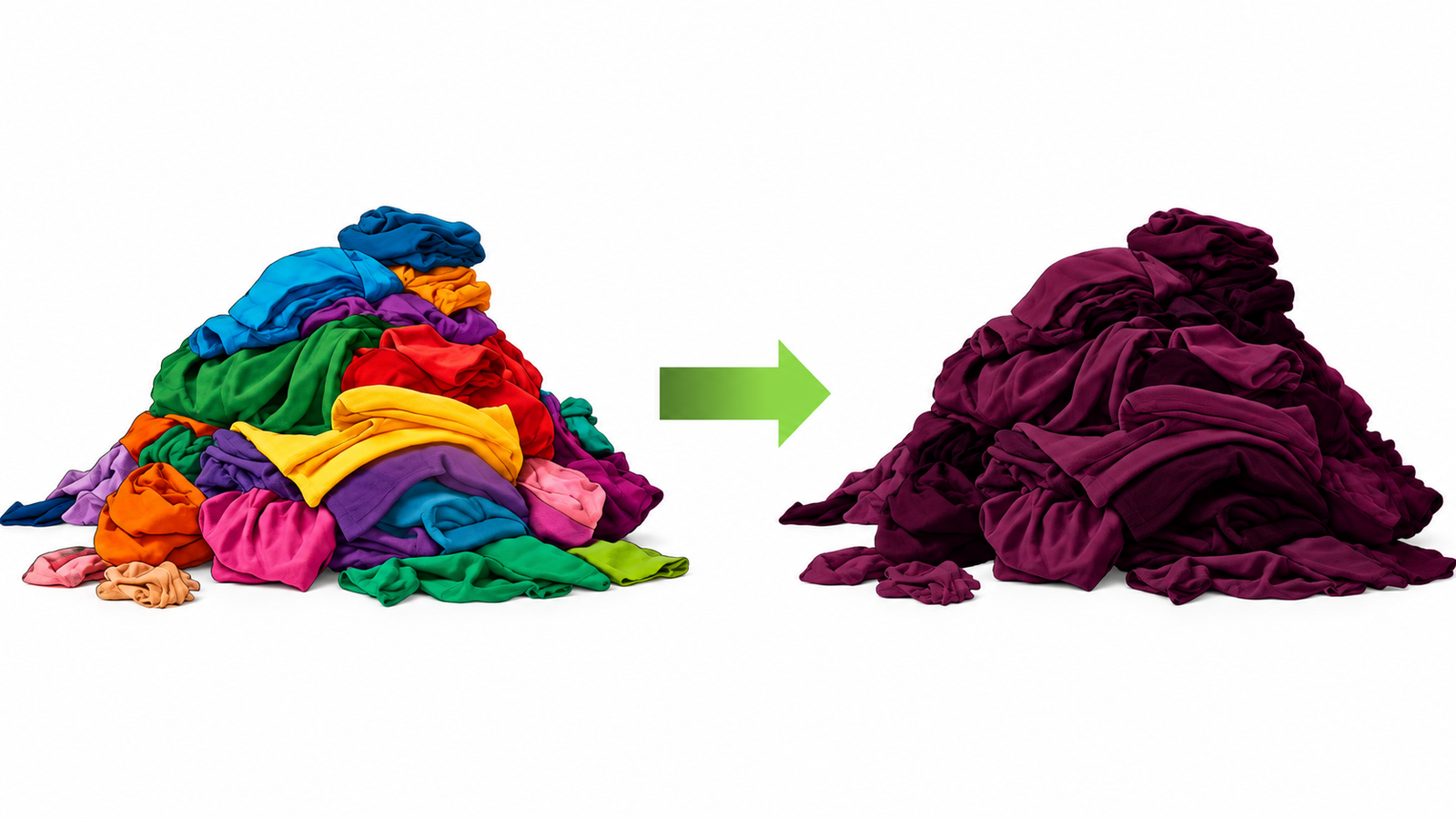
Scientists at the University of Fukui have demonstrated a process that redistributes existing dyes between polyester fabrics, potentially addressing one of the technical barriers to textile recycling.
The challenge of recycling coloured polyester has long complicated efforts to build a circular textile industry. Although polyester fibres can be recovered and processed for reuse, the dyes embedded in them present an additional obstacle. Removing these colourants can require substantial quantities of chemicals, water and energy, making the recovery of coloured textiles more technically demanding.
Researchers at Japan’s University of Fukui have now demonstrated an alternative approach: changing the colour of polyester by redistributing the dyes already present in the fabric, rather than removing them before further processing.
Announced by the university on 22 October 2026, the research uses supercritical carbon dioxide (CO₂) to transfer existing dyes between differently coloured polyester fibres, producing new, uniform shades without introducing additional colourants. The findings could contribute to future textile recycling processes, although the technology has yet to be tested with mixed post-consumer textile waste.
Rethinking the Colour Problem in Polyester Recycling
Polyester remains one of the most widely used fibres in global textile production, valued for its durability, versatility and relatively low manufacturing cost. Yet these same characteristics can complicate recycling, particularly when garments contain persistent dyes and other chemical treatments.
Conventional approaches to recycling coloured polyester may involve removing existing dyes before fibres can be recoloured or processed into new textile products. Depending on the method, this can introduce additional chemical treatments and resource requirements.
The University of Fukui researchers investigated whether the colour-removal stage could be avoided altogether.
The study was conducted by Senior Assistant Professor Jianhua Ren, Professor Kazumasa Hirogaki and researcher Isao Tabata. Their approach relies on supercritical carbon dioxide, a form of CO₂ maintained under high temperature and pressure, where it exhibits properties that allow it to penetrate polyester fibres and facilitate dye movement.
Instead of stripping the original colour, the process enables dye molecules to migrate between fabrics until a more uniform distribution is achieved.
How the Recolouring Process Works
To test the method, the researchers prepared polyester fabrics using three dyes: Blue BG, Yellow G and Red 4 G. Differently coloured fabrics were then treated together with supercritical CO₂ at 120°C and a pressure of 25 megapascals. During treatment, dyes moved between fibres, gradually producing new colours.
In one experiment, blue and yellow fabrics were combined at a ratio of 1:3. After 30 minutes, the fabrics displayed different greenish shades. After 60 minutes, their colours had become nearly identical, and after 90 minutes, both had reached a uniform green.
By adjusting the proportions of the starting fabrics, the researchers were able to produce different shades, ranging from yellowish green to blue-green. Further experiments involving combinations of three dyes demonstrated a broader range of colour possibilities.
The team also developed a mathematical colour-matching model that accounts for interactions between dyes, improving the accuracy with which the resulting colour strength could be predicted. Microscopic analysis indicated that the dyes were distributed evenly while the observed fibre microstructure remained unchanged.
Together, these results demonstrate that polyester colour can be modified through controlled dye redistribution without first removing the original dyes.
The potential significance of the method lies in its ability to address colour as part of textile reuse rather than treating existing dyes exclusively as a barrier.
If successfully developed for industrial applications, the process could offer textile recyclers another option for working with coloured polyester, potentially reducing the need for separate dye-removal and recolouring stages.
However, the environmental implications require further investigation. Supercritical CO₂ processing operates under elevated temperature and pressure, meaning its overall energy requirements, operational costs and potential resource savings must be assessed before comparisons with established industrial methods can be made.
The current research also has important limitations. Experiments were conducted using polyester fabrics with known dye compositions under controlled laboratory conditions. Real textile waste streams are considerably more complex, often containing multiple fibre types, finishes, contaminants and combinations of dyes.
The researchers acknowledge that further testing is necessary to establish how the method performs with mixed textile waste and whether it can be adapted for larger-scale processing.
These questions will be central to determining whether the technique can move beyond laboratory demonstrations and become a commercially viable component of textile recycling infrastructure.
From Laboratory Research to Industrial Application
The study, titled Sustainable and Predictable Color Change of Dyed Polyester Fibers through Supercritical Carbon Dioxide Fluid Treatment, was made available online on 29 May 2026 and is scheduled for publication in the November 2026 volume of The Journal of Supercritical Fluids, Volume 237.
The University of Fukui formally announced the findings on 22 October, bringing renewed attention to the research and its potential applications in textile circularity.
While the process does not itself constitute a complete fibre-to-fibre recycling system, it addresses a specific technical challenge that can influence the recovery and reuse of coloured synthetic textiles. For an industry seeking to retain greater value from existing materials, the ability to modify colour without first removing dyes presents an avenue for further development.
Whether the approach ultimately becomes commercially viable will depend on its performance with real textile waste, its scalability and its environmental and economic efficiency compared with existing technologies.
For now, the research offers a laboratory demonstration of how colour management could become part of the solution to polyester’s recycling challenges, rather than another obstacle to keeping synthetic fibres in circulation.
Research: University of Fukui, Japan — Read the original research announcement