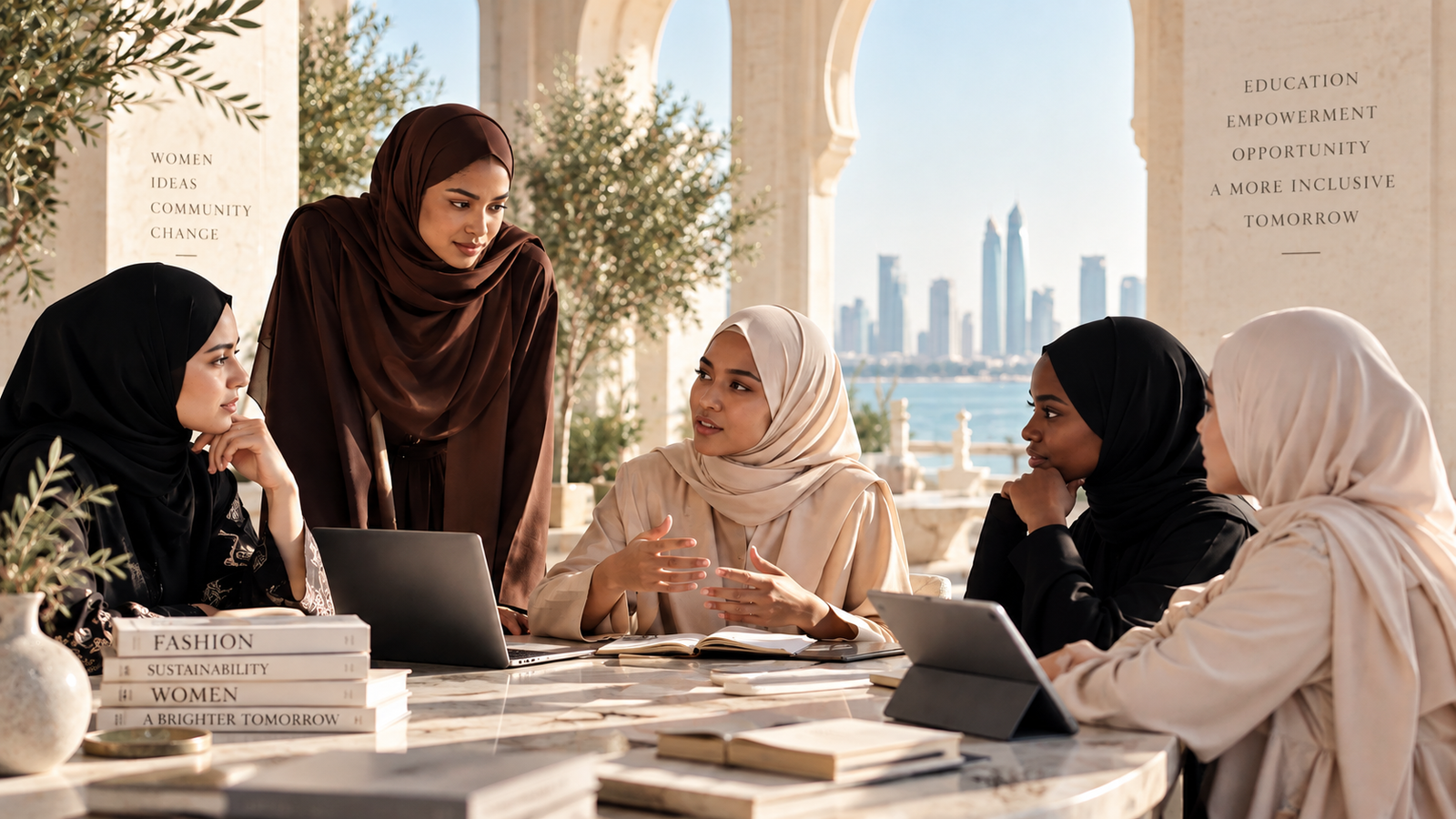
From sustainable fashion and planetary health to technology and social impact, a new generation of young Muslim women is entering leadership from very different directions. Through the Ri’aya Young Adult Stewardship Program in Doha, ParagonCorp and Wardah are helping some of them build the networks, knowledge and confidence to go further.
Leadership does not always begin in a boardroom. For a group of young Muslim women who gathered in Doha this summer, it began through two weeks of conversations spanning identity, ethics, sustainability, technology, society and the responsibilities that come with creating change.
The 2026 Ri’aya Young Adult Stewardship Program, organised by the Al-Mujadilah Center and Mosque for Women in Qatar, brought together 30 young women from different backgrounds for an intensive programme designed to strengthen their ability to participate confidently in local and global society.
Supporting that journey was ParagonCorp, the Indonesian beauty company behind Wardah, through the ParagonCorp Wardah Open Scholarship.
The partnership places a beauty business in a space that extends considerably beyond products. At its centre is a larger question: what does women’s empowerment look like when investment moves beyond representation and towards education, access and leadership?
Building leadership across borders
Designed for young Muslim women aged 17 to 22, Ri’aya combines intellectual exchange, mentorship and capacity development with an exploration of Islam, Muslim history and contemporary global challenges.
Participants engage with subjects including digital society, sustainability, ethical decision-making and cross-cultural dialogue, creating a space where disciplines and experiences that might rarely meet can inform one another.
The 2026 programme ran in Doha from August 9 to 23. ParagonCorp’s involvement builds on its partnership with the initiative in 2025, with selected participants from Indonesia and Malaysia receiving support through the Wardah Open Scholarship covering travel, accommodation and meals. But perhaps the most interesting part of the programme is not its structure. It is the women entering it.
Among the 2026 scholarship recipients is Callista Aldenia, an Indonesian fashion designer and creative entrepreneur whose interests bring together sustainable fashion and youth empowerment.
Alongside her is Amira Puji Hastuti, whose work connects planetary health, public health, Islamic ethics and community service, and Syahirah Mohd Zaki from Malaysia, whose interests extend across technology, data analytics, financial analysis and technology for social good.
Their fields may appear unrelated, but that is precisely what makes the exchange interesting.
The challenges facing the next generation rarely exist neatly within a single industry. Climate, technology, culture, economic participation and social inclusion increasingly overlap. Bringing a fashion entrepreneur into conversation with women working in health, data and social impact creates possibilities that a conventional industry-specific programme may not.
When beauty invests beyond the product
Wardah’s involvement deserves attention for another reason. Built around halal beauty, the Indonesian brand operates in a category whose relationship with women has traditionally centred on products, image and representation. Supporting education and leadership offers a different proposition.
Meaningful empowerment requires more than campaigns celebrating women. Scholarships can provide access to knowledge, international networks and experiences that continue producing value long after a campaign has ended.
It reflects a broader question for fashion and beauty businesses. As brands increasingly position themselves as cultural actors with values extending beyond what they sell, how they use their resources becomes part of that identity.
There is also something important in the programme’s refusal to prescribe a single definition of leadership. A designer developing a sustainable fashion business may create impact differently from a public-health advocate or technology specialist. Leadership can emerge through entrepreneurship, research, community work, creativity or institutional change.
The programme’s international dimension adds another layer. Bringing young Muslim women together across countries and disciplines allows their ambitions and experiences to exist beyond a single narrative of what Muslim women’s leadership is supposed to look like.
Instead, leadership becomes plural.
There remains an important question around any corporate-backed empowerment initiative: what happens afterwards?
A two-week programme cannot remove the structural barriers women may encounter in entrepreneurship, education, technology or creative industries. Its longer-term value depends on what participants carry forward — the relationships they maintain, projects they develop, opportunities they access and communities they influence.
For ParagonCorp and Wardah, continued involvement will similarly determine whether the partnership represents a sustained investment in women’s advancement rather than a moment of corporate visibility. The fact that the collaboration has continued beyond its first year is therefore significant.
Fashion and beauty have become increasingly comfortable with the language of women’s empowerment. The harder question is what sits behind it.
Representation matters. Visibility matters. But creating opportunities for women to develop knowledge, networks, confidence and creative or economic agency can take the idea considerably further. For the young women who came together in Doha this year, Ri’aya offered a space to consider leadership not as a predetermined destination, but as something shaped through knowledge, exchange and responsibility.
And perhaps that is where empowerment becomes most meaningful: not by telling the next generation of women what leadership should look like, but by giving them more tools to define it for themselves.