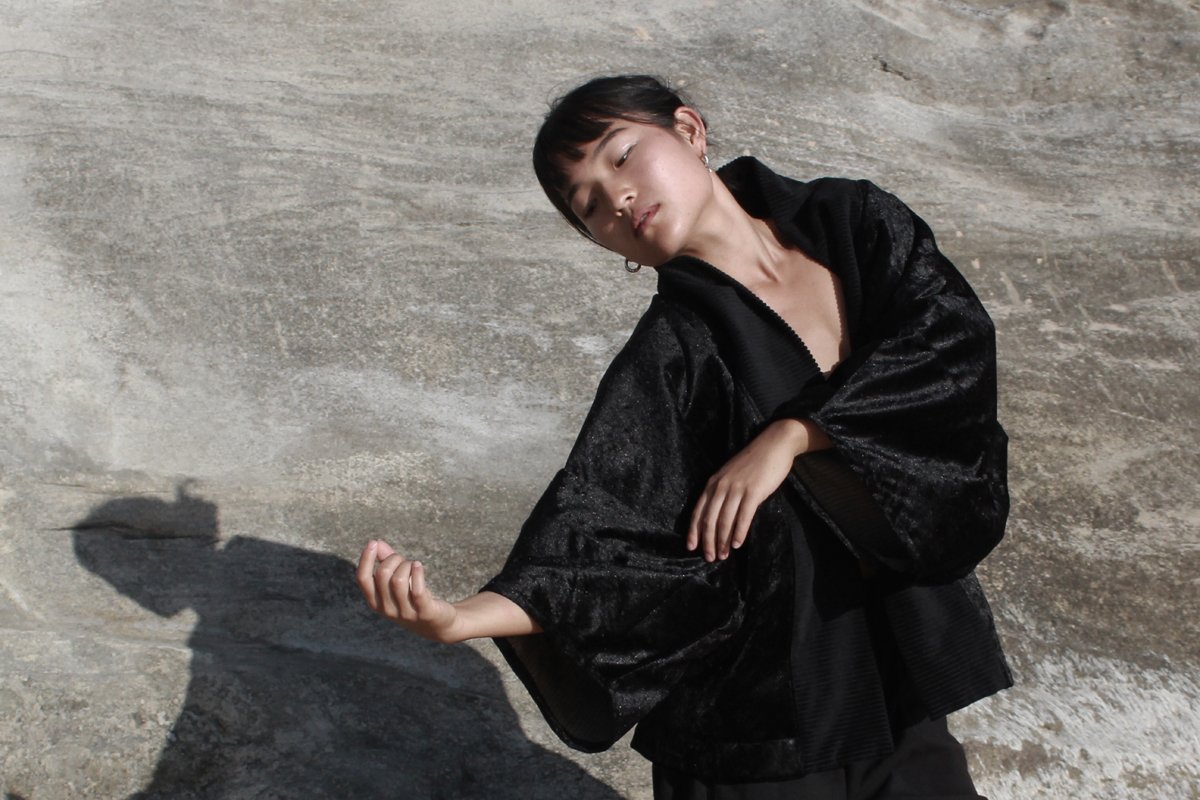
The Fashion Issue’s Editor-in-Chief, Ekaterina Da Silva, speaks with Portuguese designer Cristina Neves about her experimental approach to clothing, the possibilities of the kimono and the materials that guide her work.
Trained in fine arts at ESAD in Caldas da Rainha and later in fashion design at World Academy in Carnaxide, Neves develops and makes her pieces herself. Her practice brings together fluid silhouettes, sculptural folds and elaborate geometric surfaces, drawing on Japanese aesthetics through a distinctly personal design language.
Here, she reflects on the urge to create and her belief that clothing can offer freedom, protection and a stronger sense of self.
Her work has expanded from conceptual leather bags into garments, with the kimono offering a starting point for exploring volume, movement and the space around the body. Working primarily with deadstock fabrics, alongside unconventional materials such as used bicycle inner tubes and camouflage netting, she lets their qualities and limitations influence what takes shape.
“Sometimes we are afraid to take that first step. But when we do, it is as though the whole path opens in front of us.”
— Cristina Neves
TFI: What first drew you to fine arts at ESAD, and what later led you to study fashion design at World Academy?
Cristina Neves: I studied visual arts in high school, so exploring an artistic practice felt inevitable. At the same time, I took a four-year course in drawing and painting at a private school. Throughout that period, I felt a need to express myself through an irreverent personal style. I sewed and altered my clothes, creating my own pieces and developing my own style. I never liked feeling like another sheep in the flock.
It was a form of self-expression, but also part of a broader urge to create. I had a little workspace in my room, and I loved having all my tools around me. I needed to make something new every day.
A few years later, I decided to pursue fashion because my interest in experimenting with textiles and patterns kept growing.
TFI: How did your work with handbags develop into a clothing practice?
Cristina Neves: I worked at a company that made leather bags for a while. After it closed, I decided to create my own line of leather handbags with an avant-garde, experimental approach.
During my fashion design course, I began creating capsule collections and researching references for moodboards. That process helped me develop my own approach to clothing.
I spent almost a year thinking about creating a line of kimonos and Japanese-inspired clothing. People encouraged me, saying they would love to have one of my kimonos. Eventually, I realised I just needed to start. Sometimes we are afraid to take that first step. But when we do, it is as though the whole path opens in front of us. The creativity comes like a river, and you cannot stop.
TFI: You still make handbags. How do they fit into your work today?
Cristina Neves: I make fewer handbags than garments. At the moment, I am focused on kimonos and clothing inspired by Japanese aesthetics.
But it is almost as though the bags follow me. I cannot get rid of them! Often, it isn’t me deciding to make a bag. It is the material talking to me, telling me that it wants to become one. So I say, “Okay, you want to be a handbag? I’ll go ahead with that.”
“I don’t plan the handbags in the same way as the clothing. The materials give me the language to create them.”
— Cristina Neves
TFI: You trained in Portugal and work there today, while Japanese aesthetics are an important reference for you. What drew you towards that creative direction?
Cristina Neves: My connection with Japanese aesthetics began with the idea that a garment doesn’t need to be excessive to have presence.
Japanese clothing, particularly the kimono, introduced me to a different way of thinking about the relationship between fabric and the body. Coming from Portugal, I naturally bring my own background to that language. I am interested in creating something contemporary, urban and unique through those references.
TFI: What does the kimono give you as a starting point for experimentation?
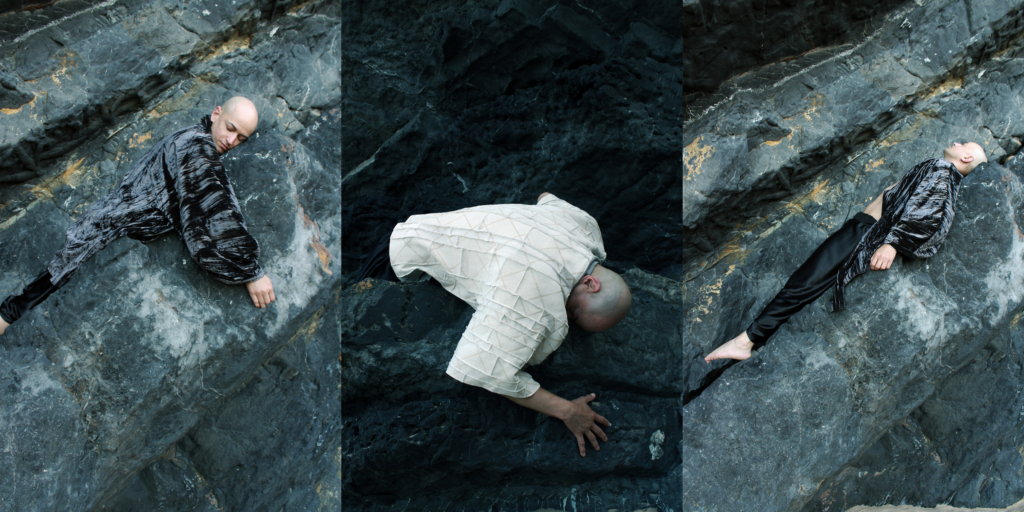
Cristina Neves: The kimono has simple lines and a simple pattern. That simplicity allows me to experiment with new layers, folds, structures and volumes.
It doesn’t dictate the shape of the body; it creates space around it. What interests me is the possibility of transforming and deconstructing it while maintaining freedom and comfort.
TFI: Repeated folds, raised strips, geometric openings and loops appear throughout your work. What interests you about building surfaces this way?
Cristina Neves: Creating a surface through repeated folds and complex geometry is like crafting a suit of armour or a dragon’s back, full of undulations that adapt to movement.
The process is like meditation. I am interested in using origami construction to create a protective layer or a second skin.
TFI: Some of your garments have a sculptural presence even on a mannequin. How does your background in fine arts influence that approach?
Cristina Neves: My background in fine arts taught me to see a garment as a work of art. I like creating pieces that have a sculptural identity while remaining wearable.
The fluidity comes from my interest in comfort, movement and freedom. The structure comes from my interest in architecture, geometry and visual presence.
What connects those two sides is the balance in life itself. Some days you feel relaxed, and on others you feel pressured. That balance between forces is what makes the world go round.
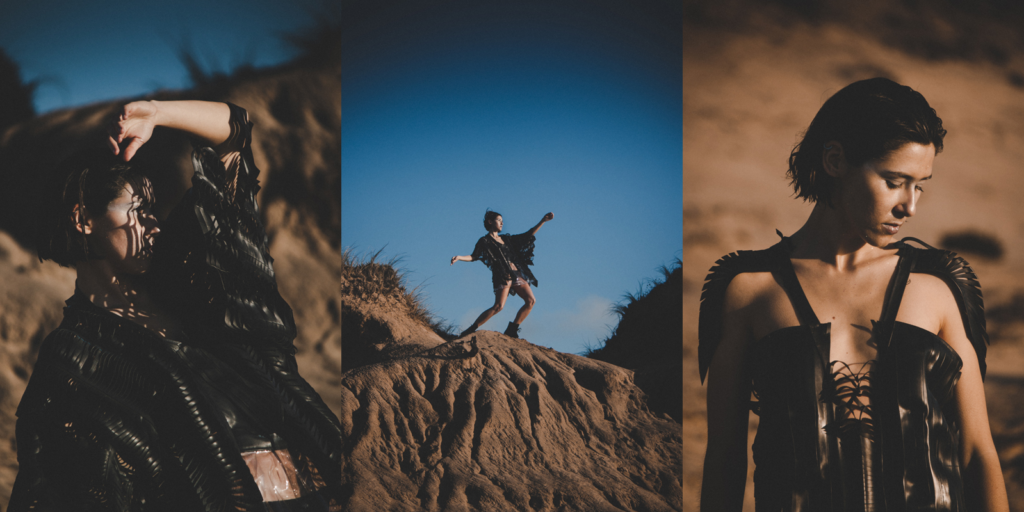
TFI: The metallic pieces and the black openwork garment have an almost armour-like quality. What do you want someone to feel when wearing them?
Cristina Neves: They do have a warrior-like character. I am fascinated by the way clothing can alter how we feel, giving us presence, strength or a different energy. I see the collection as a contemporary form of protection, offering a sense of identity and confidence.
“Creating a collection that is entirely purple, blue or black isn’t really my process.”
— Cristina Neves
TFI: How do deadstock and unconventional materials shape your practice?
Cristina Neves: Around 80% of the materials I work with are deadstock fabrics; the rest are unconventional materials. I source the fabrics through an agent who works with factories in Porto, Portugal, that produce clothing and fabrics.
These materials often have a history and are available in limited quantities, which can make the pieces unique and unrepeatable. Their texture, weight, shine and even imperfections influence the creative process. Materials are often the beginning of the conversation. Their weight might suggest a particular volume, while their softness might lead me towards something more fluid.
TFI: Does that availability affect how you develop collections?
Cristina Neves: Sometimes I don’t plan a collection as a fixed whole. The work develops from previous pieces, with variations.
I might begin with a simple kimono, then create a more complex version, followed by another with more exaggerated volumes and oversized silhouettes. It develops that way.
Creating a collection that is entirely purple, blue or black isn’t really my process. Deadstock fabrics are available in limited quantities, and I like working with those possibilities.
TFI: How do you think about gender, fit and freedom of movement when designing?
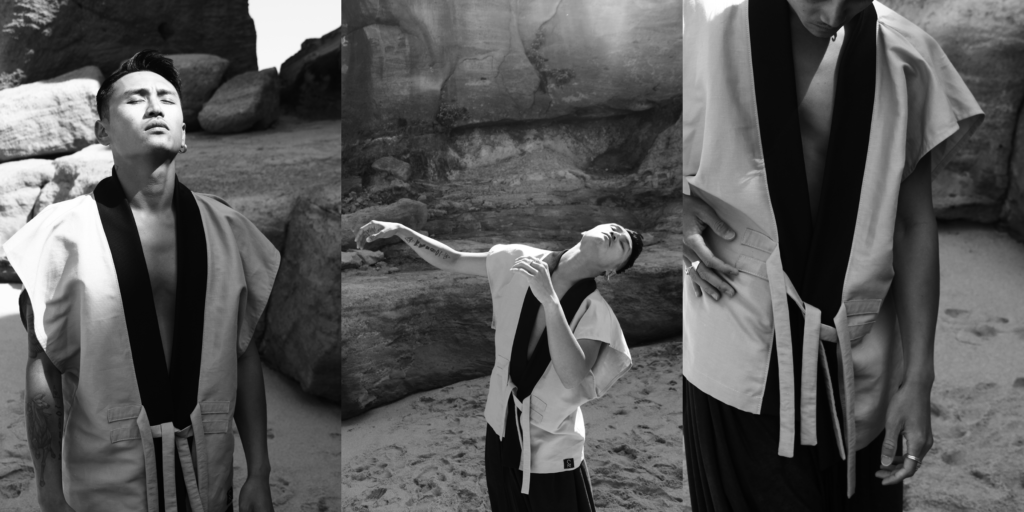
Cristina Neves: My silhouettes are generous and adaptable, allowing them to work across different bodies and genders. I am interested in clothing that does not impose an idea of masculinity or femininity.
TFI: You describe part of your work as loungewear. What does that mean to you when the pieces have such a strong visual presence?
Cristina Neves: Loungewear means freedom and comfort. It means elegance indoors and outdoors, allowing someone to feel relaxed while still looking sophisticated. For me, it lives somewhere between everyday clothing, fashion and wearable ritual.
TFI: How have customers responded to the more experimental pieces?
Cristina Neves: Usually, they are curious about the unusual shapes or construction, and then they want to see how the piece looks on the body.
It is interesting when someone initially thinks a garment is too experimental, then tries it on and discovers that it feels natural to wear.
TFI: How does your atelier operate, and how long does it take to make a piece?
Cristina Neves: I develop the pieces myself, from the initial concept and pattern-making through sampling, cutting, sewing and finishing.
The process isn’t always linear. I move between the mannequin, the fabric and the pattern, making adjustments directly to the piece and discovering new shapes and folds as I work.
The time depends on the complexity. A lighter summer kimono might take around two days, while a winter piece might take four. A very complex garment can take around a week and a half.
Working on a small scale allows me to maintain a close relationship with each piece. For me, that is what designer fashion is about.
TFI: What would you like to explore next?
Cristina Neves: I want to keep experimenting with unconventional materials. Working with camouflage netting was a new experience, and I loved it. If I can give a material a second life, even better.
Previously, I worked with used bicycles inner tubes that had punctures. I wanted to give that material another life.
I would like to keep finding materials with interesting textures, shine, shapes and movement, bringing something unexpected to the work while continuing to explore the kimono.
I also want to grow internationally and reach new markets, clients and countries. My ambition is for the brand to become more mature and distinctive, with pieces that are immediately recognisable as Cristina Neves. I want to create clothing that gives people presence, freedom and confidence.
Discover more at Cristina Neves.
Images courtesy of Cristina Neves. Photography by Cristina Neves, Joana Maria Sousa
*This interview combines written responses and a follow-up conversation and has been edited for clarity and length.