
With The 99 Percent, Matières Fécales delivered one of Paris Fashion Week’s most politically charged spectacles. But as the independent label scales its ambitions, the show exposed a more consequential tension between cultural impact, creative originality and the economics of luxury.
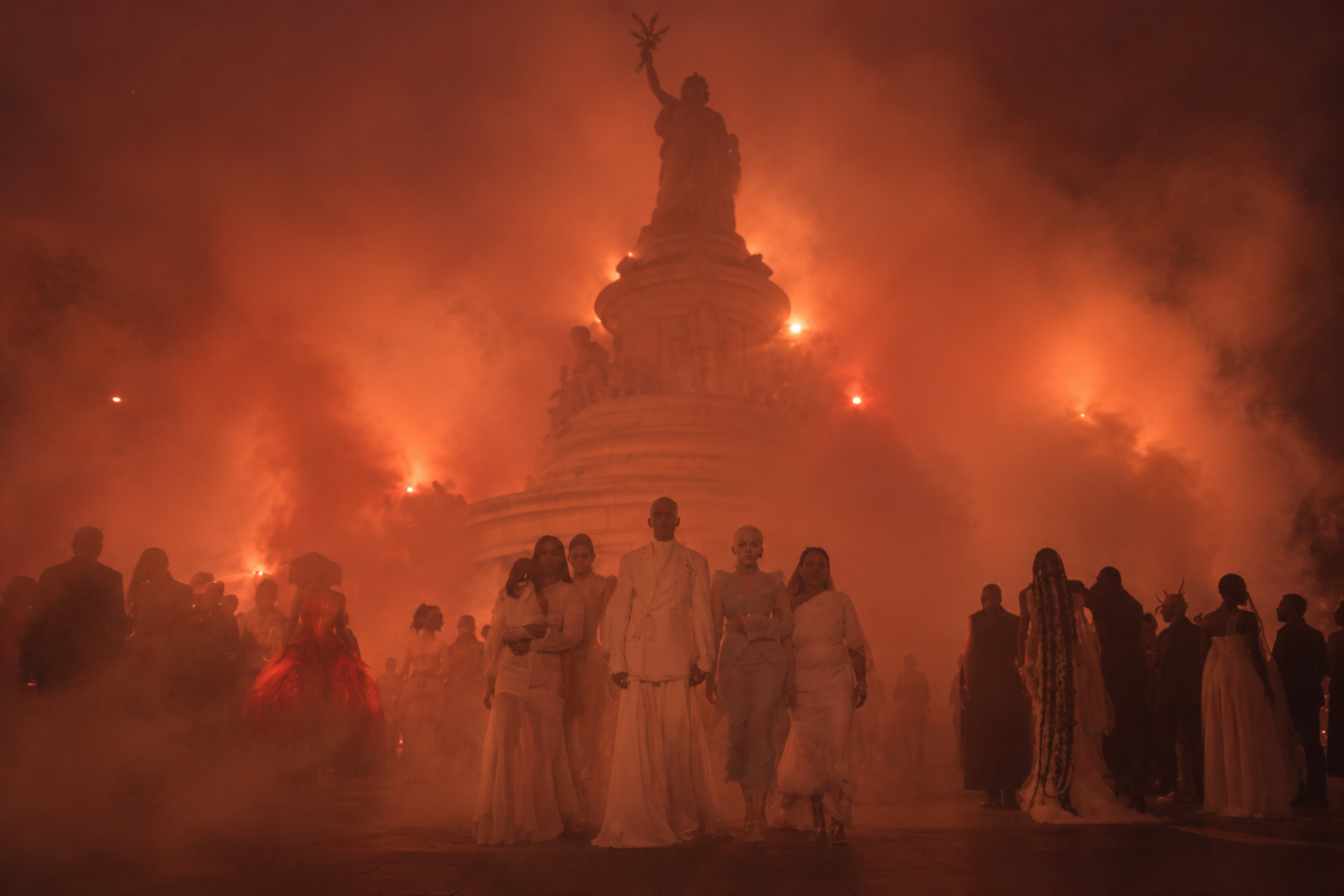
Paris Fashion Week has become highly efficient at producing spectacle. Genuine disruption is considerably harder to manufacture. For Spring/Summer 2027, Matières Fécales founders Hannah Rose Dalton and Steven Raj Bhaskaran brought The 99 Percent to Place de la République, staging an ambitious examination of class, migration, family and social power through 99 models of colour spanning generations, body types and backgrounds.
Pregnant women dressed in white opened the show carrying babies. Members of Bhaskaran’s family appeared on the runway. Punks followed in distressed denim, prosthetic horns and exaggerated curling nails. References to liberté, égalité, fraternité eventually gave way to sculpted tailoring, feathered eveningwear and metallic gowns. The finale presented the show’s most explicit image: a model in gold lamé carrying two hyperrealistic figures resembling wealthy older white men, their eyes covered with dollar bills.
As fashion theatre, it was effective. As a proposition for a luxury brand increasingly moving from the industry’s margins towards its centre, it was more complicated.
The presentation began more than an hour behind schedule amid widespread reporting around Rihanna’s late arrival. Several garments invited immediate comparison with established design signatures, from Alexander McQueen and John Galliano’s Dior to the oversized vocabulary associated with Vetements and Demna’s Balenciaga. And a collection positioned around the 99 percent was ultimately being presented by a luxury business whose products are necessarily available to a far narrower consumer base.
Those tensions do not invalidate the project. They are precisely what makes Matières Fécales worth examining.
When the 99 Percent Waits for the 1 Percent
The first tension emerged before the show began. El País and La Vanguardia were among the publications reporting on the delay and Rihanna’s late arrival, while fashion commentator Beka Gvishiani, founder of Style Not Com, publicly criticised a situation that left hundreds of guests waiting.
What has not been publicly established is who made the decision to hold the presentation, or whether Rihanna had any involvement in that decision beyond arriving late. The distinction is important. What could be observed was the resulting contradiction: an audience assembled for The 99 Percent waited more than an hour while attention increasingly focused on the arrival of one of the world’s most commercially powerful celebrities.
For Matières Fécales, Rihanna’s attendance represented a significant visibility opportunity. Celebrity placement has become an increasingly important component of brand-building, particularly for independent labels competing with conglomerate-backed houses for media attention during the major fashion weeks. A single globally recognisable attendee can extend the reach of a runway far beyond traditional fashion media.
But visibility comes with its own hierarchy. Fashion may increasingly market itself around community and accessibility, yet its attention economy remains structured around scarcity, status and proximity to cultural power. Who is seated, photographed and dressed can carry almost as much communications value as what appears on the runway.
For a show interrogating inequality, the circumstances surrounding its opening inadvertently demonstrated the very system it sought to question.
The issue is therefore less Rihanna’s lateness than what the episode revealed about contemporary fashion: even rebellion requires amplification, and amplification remains concentrated among a remarkably small group of people.
From Outsider Identity to Luxury Proposition
Dalton and Bhaskaran built Matières Fécales through precisely the kind of outsider identity the traditional fashion establishment once struggled to accommodate.
The pair met while studying fashion in Montreal and developed an aesthetic around experimental clothing, prosthetics, extreme footwear and radical transformations of their own appearances. Their bodies became part of the brand’s communications strategy long before Matières Fécales operated like a conventional fashion business. Even the name – French for fecal matter – functioned as a rejection of the industry’s established codes of refinement and desirability.
That positioning proved remarkably effective. An unmistakable visual identity generated online attention, Dover Street Market Paris provided institutional support, Rick Owens and Michèle Lamy became prominent supporters, and celebrity interest expanded the brand’s reach. Matières Fécales subsequently began the difficult transition from subcultural phenomenon to credible luxury label.
The 99 Percent arrives at an important point in that evolution. Bhaskaran has publicly connected the collection to his upbringing in an immigrant family and to experiences of economic hardship, religion, masculinity and belonging. His mother Grace, sister Shandeal and niece Vihannna appeared in the show, giving the political proposition an explicitly autobiographical foundation rather than treating inequality as an abstract seasonal theme.
That distinction strengthens the project. Fashion’s adoption of social causes has frequently been criticised when political messaging appears detached from the companies deploying it. Here, the narrative was grounded, at least in part, in the designer’s own experience.
But Matières Fécales is no longer operating entirely from the outside. Its growing industry support, celebrity visibility and luxury positioning mean the brand is increasingly participating in the ecosystem it built its identity by challenging. For any independent label built around disruption, that transition creates a strategic question: how do you institutionalise an outsider identity without neutralising the qualities that made it culturally relevant in the first place?
Representation as a Luxury Proposition
Place de la République gave that question a particularly charged setting. Associated with protest, public assembly and French republican identity, the location stood in deliberate opposition to Matières Fécales’ previous presentation, The One Percent, staged inside Paris’s former stock exchange as an examination of wealth and excess.
If the previous collection looked towards concentrated privilege, The 99 Percent turned towards those historically underrepresented within luxury fashion’s image-making apparatus. Its casting was therefore fundamental to the proposition rather than simply an exercise in diversity.
The narrative moved from motherhood and family into punk, resistance and explicit references to the French republican motto before gradually adopting more conventional expressions of luxury. Raw denim and prosthetics gave way to tightly constructed tailoring, embellishment, feathers, metallic fabrics and voluminous eveningwear.
That progression was significant. Matières Fécales was not rejecting luxury so much as attempting to redistribute its visual codes: placing bodies, communities and cultural references traditionally positioned outside the industry’s central narrative within the language of fantasy, craftsmanship and status.
The finale pushed that argument furthest. A model in gold carried two hyperrealistic figures created by artist Sarah Sitkin depicting wealthy older white men with dollar bills covering their eyes. The reversal of conventional relationships between race, wealth and power was intentionally unsubtle, designed for immediate visual comprehension and, inevitably, digital circulation.
Yet representation and redistribution remain different propositions. Expanding who is visible within luxury can carry significant cultural value without changing who owns companies, controls capital, participates in production or can afford the finished product.
That distinction becomes particularly relevant when a brand’s political positioning begins to form part of its commercial identity.
When Influence Overpowers Identity
If The 99 Percent was confident in its narrative, its design language was less consistently resolved.
Fashion is inherently referential. Creative directors routinely mine house archives, historical dress and the work of previous generations. Influence is not evidence of imitation; originality in fashion often lies in the transformation of familiar ideas rather than their invention from nothing.
But references become more problematic from a creative standpoint when the audience recognises the source before it recognises the designer.
Several looks in The 99 Percent approached that threshold. A crimson feathered, sleeveless, high-necked dress invited comparison with Alexander McQueen’s Spring/Summer 2001 Voss collection. Sculpted jackets with sharply articulated waists recalled the vocabulary John Galliano developed at Christian Dior, including his reinterpretations of the house’s Bar silhouette.
Elsewhere, oversized knitwear, distressed streetwear and slogan pieces operated within territory already heavily associated with Vetements and Demna’s Balenciaga, while the darker, body-distorting elements inevitably entered a visual conversation with Rick Owens.
These comparisons are critical observations rather than allegations of copying or intellectual-property infringement. Fashion’s visual history is too interconnected for similarity alone to establish either.
The more relevant issue for Matières Fécales is differentiation. The brand has already achieved considerable differentiation in image-making. Dalton and Bhaskaran’s approach to beauty, prosthetics, casting and performance is recognisable without a logo, a significant asset in an industry where attention is increasingly fragmented.
The product proposition is less consistently distinct. At its most successful, a designer absorbs influences until they become subordinate to a new creative language. In parts of The 99 Percent, the opposite occurred: the historical or contemporary reference remained more legible than Matières Fécales’ reinterpretation.
That gap between the strength of the brand universe and the distinctiveness of the product may become increasingly important as the business develops. Provocative image-making can generate awareness; a sustainable luxury proposition ultimately requires product with enough creative authority to exist beyond the spectacle that introduced it.
The Economics Behind the Message
The show’s central economic tension is straightforward: Matières Fécales is using luxury to speak about inequality. That is not necessarily inconsistent. Luxury products do not need to be universally affordable to engage meaningfully with social questions, and labour-intensive or responsible production frequently carries costs that mass-market pricing obscures.
But when inequality becomes central to brand storytelling, the structure of value creation becomes part of the editorial conversation.
For The 99 Percent, Matières Fécales incorporated handwoven cotton from Burkina Faso and embroidered sari textiles produced in Varanasi, India, bringing craft traditions outside the conventional European luxury canon into the collection.
Their inclusion is culturally significant. Assessing their economic impact is more difficult.
Without publicly available information detailing how these production relationships are structured, how value is distributed or whether partnerships extend beyond the current collection, it would be premature either to present them as a model of equitable collaboration or to suggest exploitation.
The absence of that information does, however, illustrate a broader shift in fashion. As brands increasingly use craft, community and social impact as components of their positioning, consumers and media are asking not simply where an object comes from, but how value moves through the supply chain.
French publication 20 Minutes also reported that a portion of sales from the collection would support La Maison d’Allanah. Public information reviewed by TFI does not establish the precise financial terms or eventual impact of that commitment.
For Matières Fécales, the opportunity is therefore larger than symbolic inclusion. If the brand can connect its political narrative to transparent, durable production relationships, The 99 Percent could evolve from a compelling communications proposition into something more structurally meaningful.
Beyond the Spectacle
For all its unresolved questions, The 99 Percent achieved something increasingly difficult in contemporary fashion: it created genuine emotional investment. That matters.
Runway shows today perform multiple functions simultaneously. They introduce product, generate content, service celebrity relationships, communicate brand positioning and compete for attention across increasingly compressed digital cycles. The result can be technically accomplished but culturally forgettable.
Matières Fécales was not forgettable. The show was excessive, personal and deliberately confrontational. It placed class, race, migration, family and privilege inside the same creative framework and resisted resolving those subjects into an easily consumable message. Its imperfections were visible, but so was its ambition.
The question facing Dalton and Bhaskaran is what comes next? They have established an unusually strong visual identity and demonstrated an ability to command attention well beyond the scale of an independent label. They have also shown that political and autobiographical storytelling can become an effective part of their brand architecture without feeling entirely manufactured.
The next stage requires the clothes to carry more of that weight. As Matières Fécales moves further into the luxury establishment, spectacle alone will become less differentiating. Celebrity endorsement can accelerate visibility, provocative casting can generate conversation and political imagery can produce cultural relevance, but none can substitute indefinitely for a product language that is recognisable on its own terms.
That is why the contradictions within The 99 Percent ultimately make the show more consequential rather than less. It criticised hierarchy while benefiting from celebrity power; widened luxury’s visual representation while remaining part of an exclusive market; and proposed a highly distinctive political world through clothes that occasionally remained visibly indebted to existing fashion languages.
Fashion needs that discomfort. It also needs the scrutiny that comes with it.
Matières Fécales has already demonstrated that it knows how to make the industry look. Its next challenge is harder: making the clothes impossible to mistake for anyone else’s.