
From a six-month journey through India to building a Portuguese fashion label rooted in traditional craftsmanship, Vera Luís Cupido has spent more than a decade developing Raja Pura on her own terms. In an intimate conversation with The Fashion Issue, she reflects on the people who shaped her creative journey, the realities of responsible production and the life-threatening diagnosis that transformed her understanding of success.
THE FASHION ISSUE | IN CONVERSATION
In the workshops of Pushkar, Rajasthan, where Vera Luís Cupido first began experimenting with textiles and garment design, fashion was not initially a business proposition. It emerged from conversations with local makers, hours spent sketching in small shops and an unexpected connection to a country she had dreamed of visiting since childhood. Sixteen years later, those early encounters remain central to Raja Pura, the Portuguese fashion label she founded in 2010, whose collections reinterpret previously worn Indian saris through contemporary silhouettes.
Today, Raja Pura operates two boutiques in Portugal’s Algarve region, in Lagos and Silves, alongside an online business. Its production model brings together repurposed textiles, traditional Indian techniques and longstanding relationships with families and small workshops in Rajasthan. For Cupido, these relationships are not simply part of the supply chain; they have developed alongside her personal life, extending across generations and shaping her understanding of what responsible fashion should represent.
Her journey, however, has been anything but linear. Before fashion, Cupido imagined a career in journalism. A return to Portugal from Barcelona redirected those ambitions, while a subsequent six-month journey to India introduced her to the people who would eventually help establish Raja Pura. Years later, a diagnosis of metastatic breast cancer confronted her with an entirely different question: what would she do with her life if she had the opportunity to continue living it?
Veste a tua força — “Wear Your Strength.”
The experience fundamentally changed her priorities and brought a more personal dimension to the brand’s philosophy, Veste a tua força — “Wear Your Strength.” Yet Cupido’s story is not solely one of illness and recovery. It is equally about creative independence, cultural exchange, the value of human relationships and the challenges of building a business without abandoning the principles on which it was founded.
In this exclusive interview with The Fashion Issue, Cupido discusses the beginnings of Raja Pura, the artisans who continue to shape its collections, the significance of returning to India after treatment and why she believes fashion should make space for individuality rather than conformity.
An Unexpected Path Into Fashion
The Fashion Issue: You studied journalism and spent time at a radio station in Barcelona, yet your career ultimately took a different creative direction. What did you imagine your future might look like at that stage of your life?
Vera Luís Cupido: I was very young and still searching for my place in the world. I chose journalism because I had always been curious and adventurous. I loved travelling and hoped that journalism would allow me to discover new places, meet people and experience different cultures.
I was preparing to pursue a master’s degree in photojournalism at the Autonomous University of Barcelona. At the time, the university organised reporting projects in the Balkans, particularly in Bosnia, where students documented post-war Sarajevo. I was passionate about that kind of work and the possibility of telling stories through photography. For personal reasons, I returned to Portugal. Looking back, I believe that decision ultimately shaped the difference between the person I might have become and the life I lead today.
Shortly afterwards, you travelled alone to India for six months. What drew you there, and how did that experience change your understanding of the world and your place within it?
India had been one of my greatest dreams since childhood. I had always felt drawn to its culture, colours, food, music, language and the stories surrounding its gods and goddesses. There was something about the country that fascinated me long before I had the opportunity to visit.
When I returned from Barcelona, I met someone who travelled to festivals with a world-food restaurant and an ethnic clothing shop. I started helping him with the shop and loved it. The garments were made in India, and he had been travelling there for many years. Listening to his stories gave me the courage to make my childhood dream a reality.
At the end of that summer, I bought a plane ticket to India for six months. I won’t lie — I was afraid. I was nervous about travelling alone, but I knew it was something I needed to do.
“I felt that the journey would change my life, help me grow and give me an entirely different perspective on the world.”
— Vera Luís Cupido, Founder of Raja Pura
Cupido’s first days in India brought considerable culture shock, intensified by limited internet access and the difficulty of staying in touch with family. Yet as she travelled across the country by bus, train, plane and motorbike, unfamiliarity gave way to fascination. “I always had this strange sense of belonging, almost as though I had been there before, perhaps in another lifetime,” she recalls. Her six-month journey culminated in Varanasi, a city she describes as embodying India’s spirituality, rituals, art, craftsmanship and the coexistence of life and death. “I knew I was exactly where I was meant to be, and I knew I would return.”
Building Raja Pura Through Relationships
Raja Pura began through informal creative exchanges in the workshops of Pushkar rather than through a conventional business plan. How did those encounters develop into the foundations of a fashion label?
During my first journey to India, I met the families and artisans I still work with today. In Pushkar, a town built around a sacred lake, I spent weeks visiting their shops and workshops, listening to their stories and learning about their craftsmanship. What began as a personal interest in Indian culture gradually developed into a creative collaboration. Through our conversations, we started exchanging ideas, sketching designs, making patterns and selecting fabrics. Those early experiments became the first garments of Raja Pura.
There is a saying I heard there: “In India, everything is possible!” The artisans had an extraordinary ability to transform my ideas into finished pieces, and I quickly realised that designing alongside them was what I wanted to pursue. Before my six-month journey had ended, the foundations of Raja Pura were already in place. What began as an informal collaboration gradually evolved into a fashion brand over the following years, giving me a reason to return to India and continue working with the people who had helped bring it to life.
For Cupido, the relationships established during her first visit to India have become as important as the garments themselves. Many of the families she met in Pushkar continue to produce Raja Pura’s collections, with some workshops now managed by the next generation. What began as informal collaborations has developed into a network of personal and professional relationships spanning more than a decade. “We have grown and built entire lives alongside one another. Some of us were practically children when we first met,” she recalls. Today, their connection extends well beyond production: Cupido regularly visits their homes, shares meals with their families and maintains contact from Portugal.
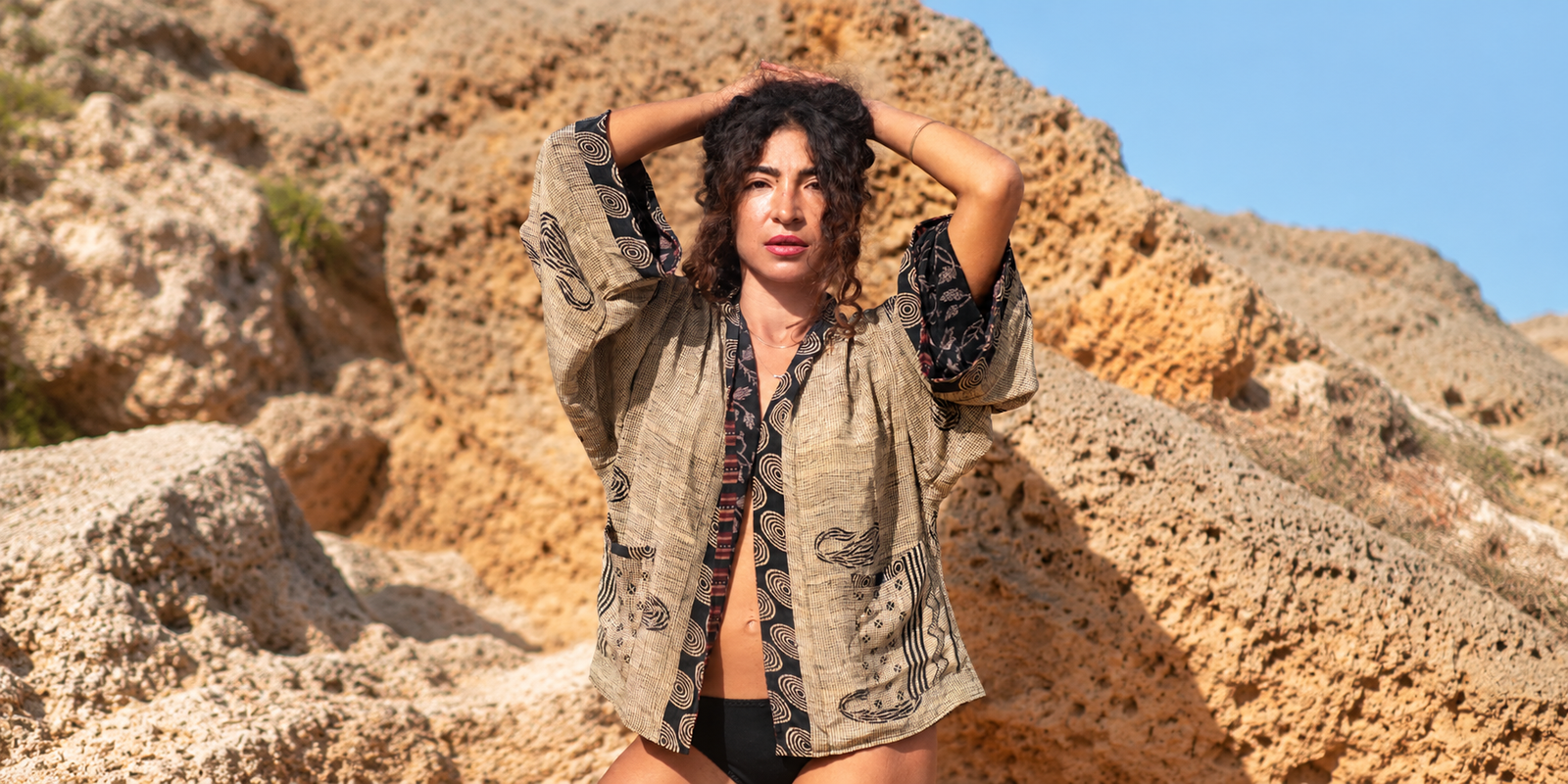
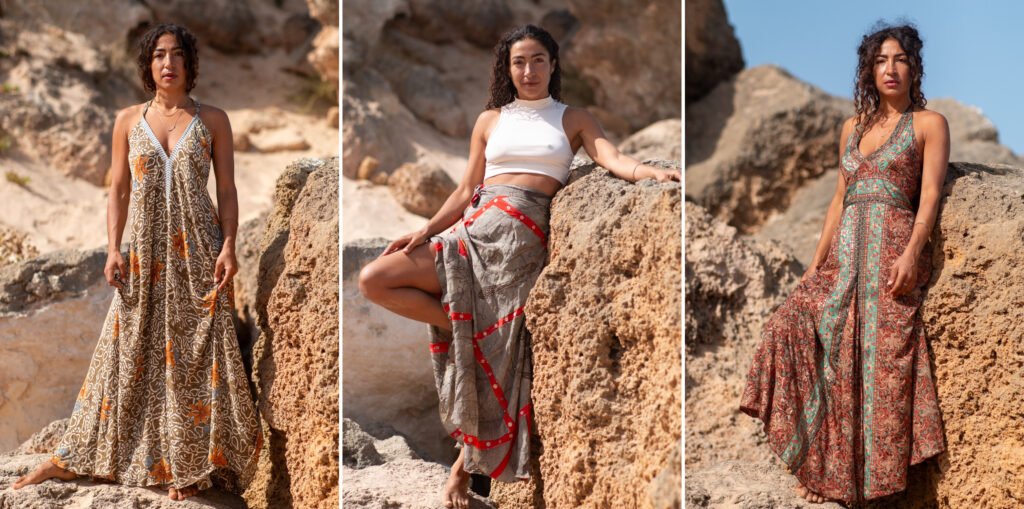
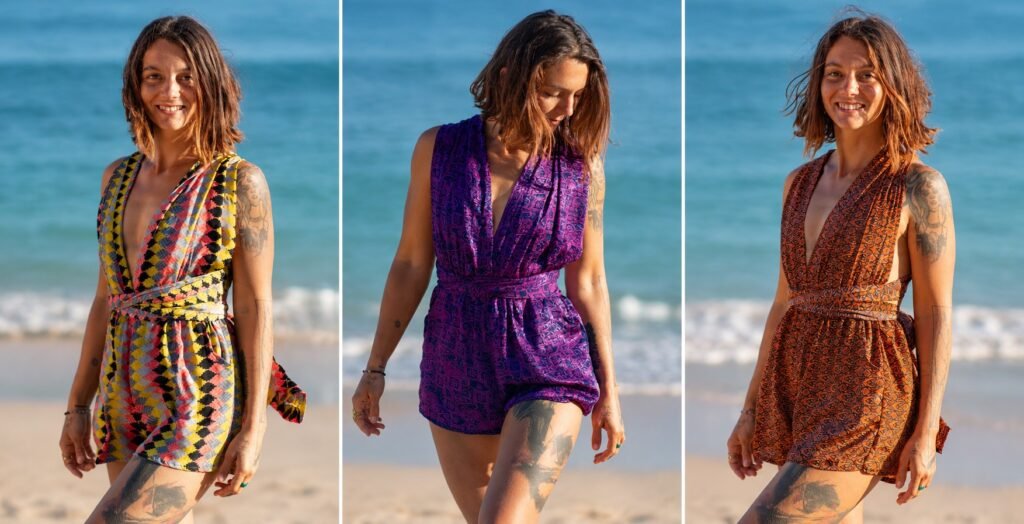
These relationships also shape the brand’s creative identity. Raja Pura combines contemporary silhouettes informed by Cupido’s Portuguese background with the colours, textiles and traditional techniques of Rajasthan. Previously worn saris are central to its collections, alongside block printing and other artisanal processes. For Cupido, the creative exchange is collaborative rather than dictated by seasonal trends. “We don’t follow trends. We come together and create,” she explains.
Previously worn saris are central to Raja Pura’s collections. When selecting textiles in India, what qualities attract you to a particular piece?
This is one of my favourite parts of the work. I spend days in India selecting saris, sometimes looking through hundreds of them, and I never stop admiring the ones I see women wearing in the streets. Every sari has its own colours, patterns and details. I look at the softness of the fabric, its sheen and the combination of colours, but my selection also depends on the garment I imagine creating. I particularly love Masala saris, with their distinctive shine and golden details. I also work with crepe and silk saris, including pieces with hand embroidery. Each textile offers different creative possibilities.
How much does the fabric itself influence the final design?
Most of the time, it is the fabric that tells me what it wants to become. A particular sari might be perfect for a skirt but unsuitable for a dress. I usually have several silhouettes in mind, from trousers and tops to dresses and jumpsuits, but as I select the textiles, I am also deciding what each one will become.
Beyond design, Raja Pura’s production model reflects Cupido’s commitment to the communities involved in making its garments. Certain pieces, including kimonos, are sewn by groups of women working with local ateliers. Although the label remains relatively small, Cupido considers its contribution to household incomes and financial independence significant. She sees the work as an opportunity for women to support their families, provide education for their children and improve their living conditions.
The brand’s approach to sustainability has developed alongside these relationships. Rather than relying exclusively on newly manufactured fabrics, Raja Pura repurposes previously worn saris and surplus textiles from other brands, producing limited collections and transforming production remnants into accessories and packaging. Its use of traditional techniques also reflects Cupido’s interest in preserving artisanal knowledge.
Sustainability has become an increasingly commercialised concept within fashion. What does responsible production mean to you in practice?
It means respecting traditional craftsmanship, knowing who makes your garments and understanding the conditions in which they are produced.
“For some time, I believed sustainability was mainly about using 100 percent natural fabrics. Today, I understand that it involves much more.”
— Vera Luís Cupido, Founder of Raja Pura
It also means limiting production to avoid unnecessary surplus and recognising the value of materials that already exist. We create capsule collections using fabrics left behind by other brands, give new life to previously worn saris and transform production remnants into bags, scarves and hair accessories. These practices developed naturally through the way I have always worked. For me, that is sustainability in practice.
When Life Changes Direction
In 2020, Cupido was diagnosed with metastatic breast cancer, an experience that profoundly altered her personal priorities and relationship with the business she had spent years developing. Her first oncologist warned that she might not survive treatment, and for almost two years, her attention shifted almost entirely towards recovery. The uncertainty forced her to reconsider what she wanted from life and how she would approach the future if she had the opportunity to continue building one.
“When I thought I was going to die, everything changed. I was forced to put myself first and fight to survive. My non-negotiable was to live.”
— Vera Luís Cupido, Founder of Raja Pura
How did your diagnosis change your understanding of the life you wanted to live and the work you wanted to create?
I began to feel that I hadn’t made the most of life, and I was determined that, if I recovered, I would live with greater purpose and authenticity. When you go through something like that, you realise how quickly everything can change. As soon as I began recovering, my greatest wish was to return to India. Setting foot in that country again would mean that the worst was behind me and that I had another opportunity to do what I loved.
I also wanted Raja Pura to become something more meaningful. I wanted to inspire other women who had experienced similar challenges and show that it is possible to build a wonderful life afterwards, even with the scars that illness leaves behind. It was no longer simply about creating clothing. I wanted the brand to represent courage, resilience and the freedom to live authentically.
Cupido opened Raja Pura’s first boutique in Lagos in late 2022, but it was not until the end of 2023 that she returned to India. Rather than announcing her arrival, she decided to surprise the people she had worked with for years. The reunion with Manohar, one of her earliest collaborators in Pushkar, remains among her most vivid memories.
What do you remember most vividly about returning to India and seeing the people behind Raja Pura again?
I didn’t tell anyone I was coming. I simply went and appeared at the shops. When I walked into Manohar’s shop, only an employee was there. He recognised me immediately and became so emotional that he could barely speak. He called Manohar and started shouting, “You won’t believe who’s back! You won’t believe who’s here! It’s Vera! Vera is here!”
They all knew I had been ill, and none of them had imagined that I would return. When Manohar arrived and saw me, he began to cry and embraced me. Even today, he tells me that it wasn’t a miracle — it was God’s will.
“For me, returning to India meant being able to continue the life I had built and reconnect with the people who had become such an important part of it.”
— Vera Luís Cupido, Founder of Raja Pura
Wearing Your Strength
Following her recovery, Raja Pura’s philosophy acquired a more personal dimension. The phrase Veste a tua força — “Wear Your Strength” — reflects Cupido’s belief that women should feel free to express themselves without conforming to expectations. The individuality of the brand’s garments, each shaped by the characteristics of its original textile, offers a tangible expression of that philosophy.
What does “Wear Your Strength” mean to you, and what do you hope women take from that message?
It is a reminder that we should not waste our lives wearing something that doesn’t suit us simply to please others or fit in. It is about having the courage to live according to our own values, desires and identity.
Every piece we create from sari silk is different, with its own colours and patterns. I believe that individuality has been increasingly lost through fast fashion, where so much is standardised. I want to create something unique for people who are also unique. What appeals to one woman may not appeal to another, and that difference is precisely what makes fashion interesting.
Today, Raja Pura operates boutiques in Lagos and Silves, alongside its online business. Yet expansion presents a particular challenge for a label built around limited production, one-of-a-kind textiles and longstanding artisan relationships. Cupido acknowledges the commercial realities of growth but remains determined that the people behind the collections should benefit from the brand’s development.
As Raja Pura grows, how do you envision expanding the business without compromising the relationships and principles on which it was founded?
The relationships I have built with the people behind Raja Pura are firmly established, and maintaining that closeness is non-negotiable. I believe that as my business grows, the people producing my garments should also benefit from that growth.
We are all part of the same team, and what happens here in Portugal has a direct impact on the people I work with in India. Perhaps it is a somewhat utopian vision, but I genuinely believe in building a future together, where everyone has the opportunity to progress.
As the conversation turns towards Breast Cancer Awareness Month, Cupido returns to the message she hopes Raja Pura will carry beyond its collections. Her experience has made her acutely conscious of life’s uncertainty, but she is equally determined that her story should not be defined solely by illness. Instead, she hopes it will encourage women to recognise the possibilities that may remain, even after profound personal change.
For a woman who may be facing a breast cancer diagnosis or beginning treatment, what would you most want her to understand from your experience?
I want her to know that even against all odds, not everything is necessarily lost. It is not always the end of the road, even when it feels that way.
“I believe there is a light within us as human beings that is capable of extraordinary things.”
— Vera Luís Cupido, Founder of Raja Pura
It is important to prioritise ourselves, love ourselves and remain true to who we are. I also want women to know that it is possible to live a wonderful life after something so traumatic, even with everything that may change or be lost along the way: hair, a breast, nails, libido, energy and so many other things people do not always speak openly about.
Cancer is incredibly difficult, but I believe the best parts of life may still be ahead of us. For me, the experience became a reason to pursue things I might never previously have had the courage to do.
Raja Pura | Official Website | Instagram @raja_pura
*This interview has been edited for clarity and length