Working with deadstock and reclaimed household textiles, Veronika Trnková is building a wardrobe around familiar forms and playful details. The founder speaks to The Fashion Issue about the beginnings of Fløre, defining its identity and learning what belongs in the world she is creating.
A beautiful fabric used to be reason enough for Veronika Trnková to begin something new. She could see its possibilities immediately, even when the garment she imagined had little connection to the pieces around it. Building Fløre has introduced another question: what makes it belong?
It is a question her husband and business partner, Cameron Rose, regularly asks. For the Prague-based designer, answering it has meant examining decisions she once made intuitively. An attraction to a textile remains the starting point. Giving it a place within the label requires a clearer understanding of what she wants to make.
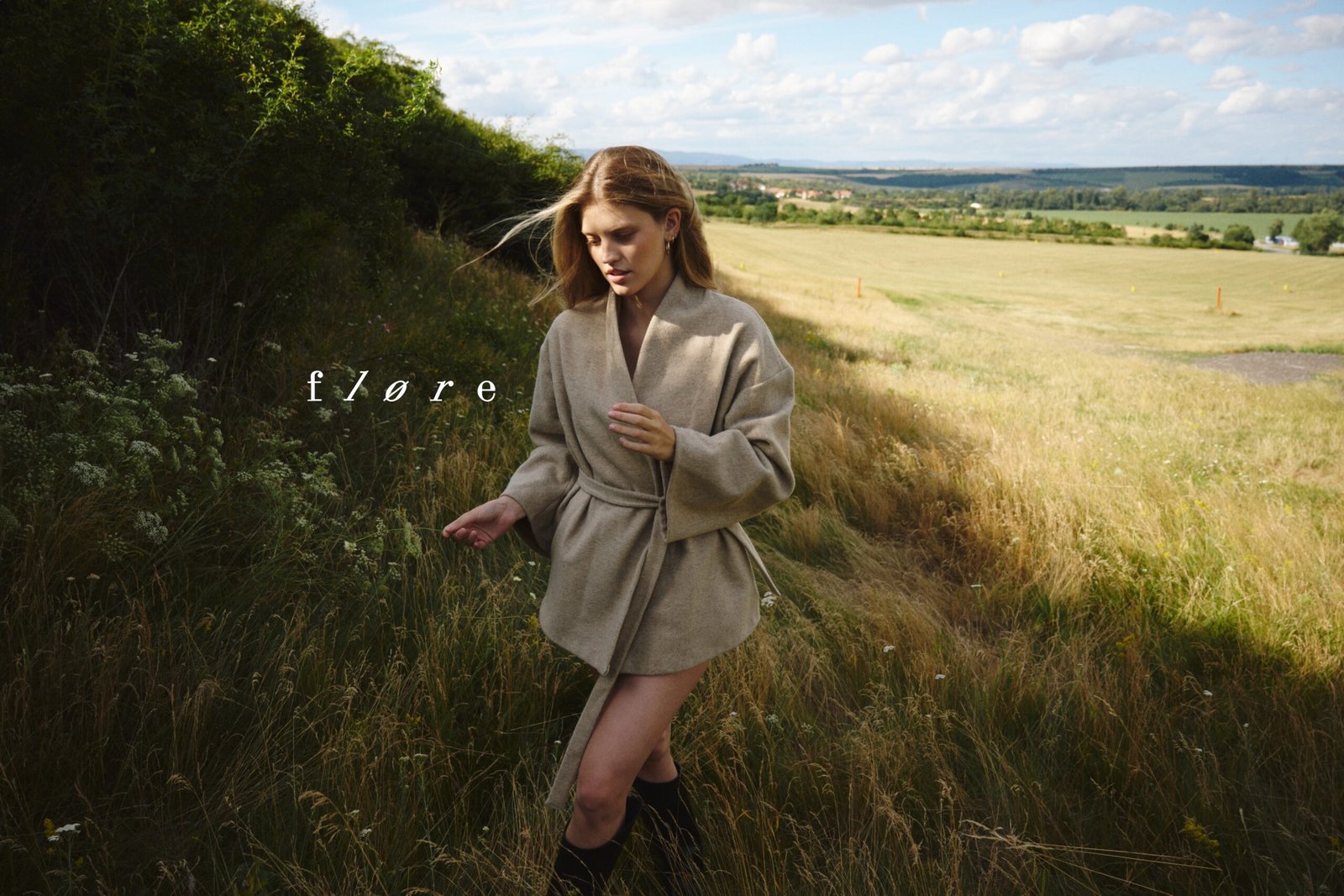
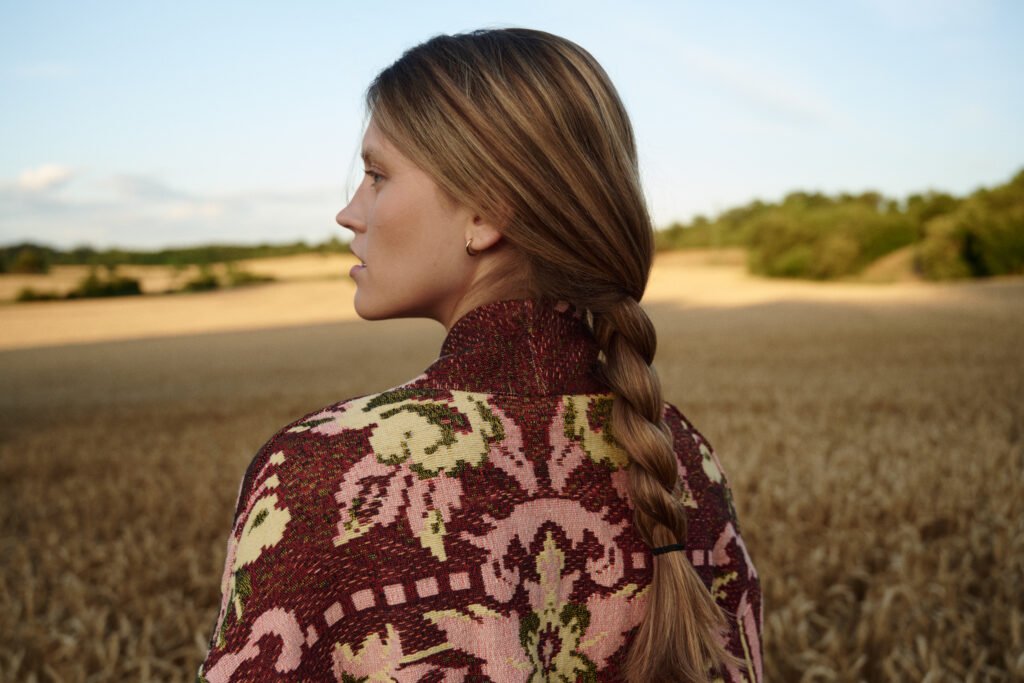
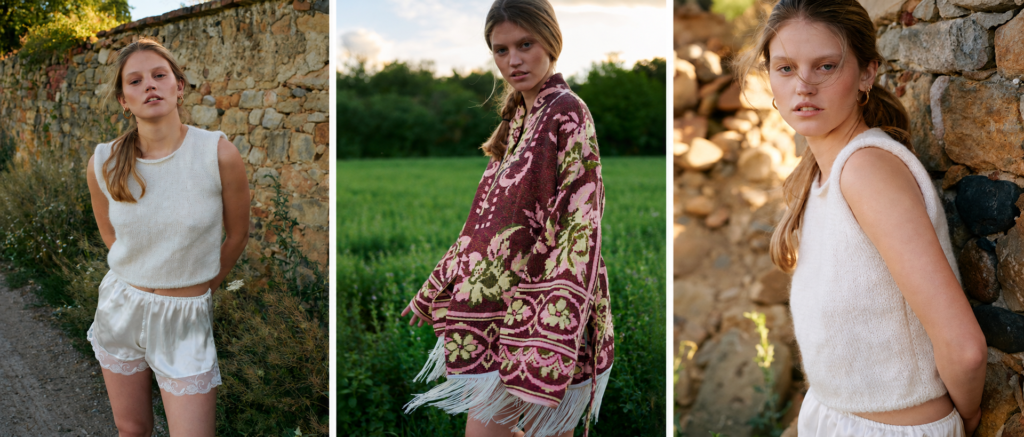
Fløre’s wardrobe includes belted wrap coats, cropped jackets, camisoles, knitwear and bags. Deadstock fabrics sit alongside reclaimed bedspreads, blankets and table linens, made in small quantities and sometimes as one-of-a-kind pieces. Familiar shapes acquire playful details: lace on a bomber collar, a gathered opening, a cropped proportion.
The label began with clothes Trnková made for herself, finding an audience through photographs of summer wardrobes sewn in Tuscany. Following its Prague relaunch in 2025, it has developed into a family business with a more defined creative direction. As its identity becomes clearer, Trnková says, her own taste feels more settled too.
Clothes for an Ordinary Tuesday
Before Fløre became a label, sewing offered Trnková a way to change how it felt to spend a day at home. During lockdown, she began making sleep shorts and shirts. Wearing something she liked mattered even when she had nowhere to go.
Summers in Tuscany gave that practice room to develop. She travelled with her sewing machine, staying in an old castle whose condition, she recalls, was redeemed by its swimming pool. Photographs of the clothes, shared online alongside her poetry, began attracting interest, and she started sewing for her sister and friends.
The Fashion Issue: When did making clothes for yourself become something you wanted to offer other women?
Veronika Trnková: During COVID, I was spending endless days at home in old T-shirts, and honestly, it was getting to me. Making something pretty just to wear around the flat changed how those days felt. After that, every summer I would sew myself a holiday wardrobe. Somewhere along the way, I realised the clothes weren’t really about going anywhere. They were about how I felt in them on an ordinary Tuesday. That was what I wanted to give other women.
Founded in June 2023, Fløre carried traces of Tuscany into its vocabulary. Pieces took names from towns and streets, including Panzano, Certaldo and Voltaia. More fundamentally, Trnková was interested in the relationship between clothes and their surroundings: how dressing could become part of experiencing a place.
What did Tuscany give the clothes, and what happened when you brought them to Prague?
The heat makes you rethink everything you wear: light fabrics, bare shoulders, things that breathe. What I was making for myself fitted into that landscape. Fløre began there almost without my deciding it, as a summer wardrobe that people started noticing.
I have always liked creating a world where the clothes fit the landscape.
I loved watching women in Italy wearing beautiful summer clothes and looking effortlessly chic and alway dressed for the occasion.
Bringing it back to Prague felt like a risk. I wasn’t sure it would land. It turned out there was a real appetite for pink, playfulness and something girly. Tuscany gave Fløre its shape, and Prague showed me it didn’t need the sunshine to make sense.
The Fabric Comes First
The Corredo Bomber began with a plaid table runner. Trnková saw a jacket in it, then added lace taken from an old blanket to the collar, cuffs and pocket. The materials remained recognisable within a new shape.
The piece illustrates a process in which sourcing and designing are closely connected. Trnková responds to a textile before settling on its use. Its previous purpose can remain visible without determining how the finished garment should be worn.
What makes you see clothing in something that belonged in a home?
I have never really seen a household textile as finished. To me, it is fabric. A bedspread already has weight, pattern and history. Somebody chose it, slept under it, kept it. I rarely start with an idea. Almost every piece starts with a fabric I find.
With the Corredo Bomber, I didn’t go looking for a jacket. The runner looked like one to me. I kept the plaid exactly as it was, so you can still tell it once sat under someone’s Sunday lunch. Two household things from two different homes became one piece. What changed was the shape, so the story could continue.
The Panzano wrap coats draw on another source: blankets and bedspreads that families kept for decades, sometimes without using them. After finding her first blanket in a thrift shop, Trnková began noticing recurring designs online. She researched their origins and asked sellers about the people who had owned them.
Many were selling possessions left by a relative. A textile preserved for a “better time” was finally changing hands, its anticipated use still unrealised. Through the coats, those materials enter everyday life in another form.
What interests you about the things people saved but never used?
Many of these blankets are completely unused because people saved everything for a better time, which often never came. When you have lived with a constant sense of lacking something, I think you hold on to things more. My parents and grandparents kept so much. The blankets make me nostalgic for a time I wasn’t alive for, but which left traces behind. I love that people kept them for years and years.
I have always loved things with history.
That attachment informs the village references in her autumn and winter work. Trnková spent her earliest years in a multigenerational home in Slovakia and missed village life after her family moved away. Her affection for its domestic textures is accompanied by an awareness of the restrictions her parents experienced.
“For me, the village symbolises the innocence of my own girlhood,” she explains. “But I don’t want to romanticise it.” The repeated blanket designs carry both familiarity and the limited choice of their period – associations she wants the coats to retain.
A Familiar Shape, a Different Feeling
Fløre’s use of household textiles is grounded in skills learned at home. Trnková’s mother taught her to sew at twelve, initially anxious about letting her use the family machine. She also passed on the habit of keeping materials that might become useful again.
Their approaches to dressing diverge. Trnková remembers her mother putting her children first and rarely buying anything for herself. Fløre makes space for a degree of indulgence: clothes chosen for the pleasure of wearing them.
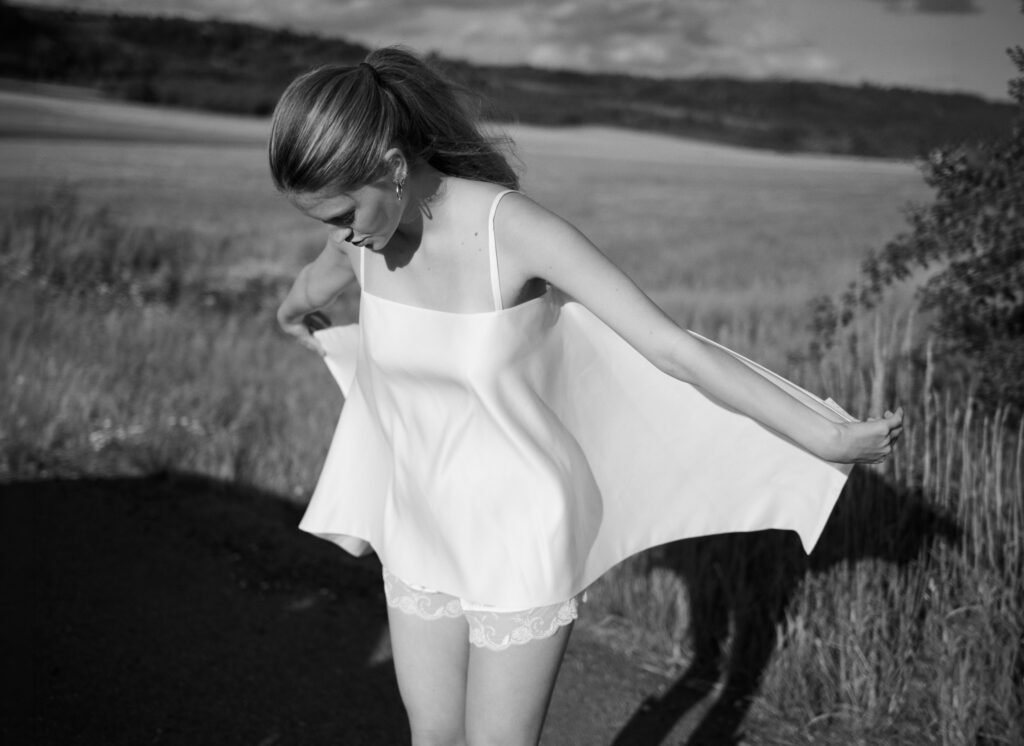
The label’s tagline, “to flirt,” expresses that intention. Lace, colour and proportion give familiar garments a different attitude, while comfort determines whether the design succeeds in everyday use.
How does “to flirt” become a design decision?
Flirting usually implies another person. What I mean is the feeling. What we love about flirting is that it makes us feel seen, wanted, beautiful. I wanted clothes to give you that same feeling without needing anyone else in the room. In design, that means familiar pieces like a shirt, shorts or a jacket, with one detail that makes you feel noticed: a bit of lace, a flash of pink, a crop that shows a little more.
Fløre started with sleep shorts and shirts, so comfort was there from the first stitch. I grew up with my mum’s practicality, so I can’t make something that only works for a photograph. If a piece is pretty but you can’t wait to take it off, it hasn’t done its job.
Trnková’s own ease with dressing developed gradually. She began modelling at thirteen and remembers constant comparison affecting how she saw her body. Oversized clothes offered distance from that scrutiny.
You described dressing to disappear. What first interrupted that habit?
I wore hand-me-downs, huge thrifted sweaters and oversized coats. My mum joked that I looked like I had stolen it from a hunter. I don’t think I was making a style statement. I was putting distance between my body and the world. With modelling, I struggled with whether I was skinny enough or pretty enough.
I would hear that I was good, but not good enough. At fifteen, I didn’t know what “enough” meant.
The first piece that felt different was my grandmother’s old shirt, which I cropped. A little skin, a shape that was actually mine. I have kept it ever since. Fløre comes from that shift. It surprised my mum more than anyone that her daughter in hunter’s coats began making pink clothes.
Defining What Belongs
Pleasure in making did not immediately translate into confidence about running a label. A management role at a Prague fashion boutique provided an income but left little time for Trnková’s own work. Leaving helped her decide to commit to Fløre.
Her husband’s involvement has brought encouragement and structure. He handles the business work that can fall out of view when she spends hours at the sewing machine, while prompting her to articulate the principles behind her choices.
Has defining Fløre helped you understand your own taste?
Definitely. I feel much more settled in what I like, which was something I always wanted. I used to feel inconsistent. My wardrobe would reflect how I felt, and a week later I would think, “This isn’t me.”
Cameron asks, “What does Fløre mean? What makes a piece a Fløre piece?” He makes me think about my design process much more consistently. Before, I could see a beautiful fabric that didn’t go with the collection at all and want to use it. Relaunching Fløre has made it more mature and more stable.
Customers have introduced another perspective. Trnková initially imagined women around her own age wearing the clothes. Encounters with older women revealed that the materials and details could prompt recognition across generations.
What have their responses changed for you?
Older women would stop by, touch the lace and the mesh, and start remembering their own girlhood. I had been thinking of Fløre as clothes for women around my age, and suddenly these pieces were opening something much bigger. It changed how I think about femininity. We tend to tie it to youth, as though it is something you grow out of. Watching them, I realised it is something we always have. It doesn’t leave us; we stop being invited to show it. I would love Fløre to be one of those invitations, at any age.
The Next Pair of Hands
Fløre now depends on a small family team. Trnková designs and sews; her mother contributes knitting and helps with sewing when preparations become demanding. Rose works alongside her on the business.
Expanding production would require another maker to understand both the finish she expects and the demands of working with these materials. The search for an atelier has made growth a practical question of skills, capacity and trust. It also returns Trnková to a hesitation she felt before starting: whether there was a reason to introduce more clothes into a world already full of them.
What persuaded you to proceed, and how does that question influence your next step?
When I was making clothes for myself, it felt fine. But starting a brand made me think, “The world doesn’t need more clothes. Why would I add to that?” A friend told me it was valuable to give people choice. The more independent designers there are, the more people can see other options. That stayed with me. I also try to recognise the nuance. I personally dislike fast fashion, but I don’t judge people who cannot afford anything else.
We are now looking for an atelier that could help us, which has been a struggle. We are thinking about the best way to expand while keeping the way we want to work.
The question of growth returns, eventually, to the ordinary day that prompted her first pieces. The business needs to create room for its makers to experience the pleasure the clothes are intended to offer.
What would you like growth to make possible?
We are always working and rarely take time off. Growing means trusting someone else with the making, and that is the difficult part. I want the seams to match, the shape to hold and the thread to sit exactly where it should.
I am trying to work out how to let Fløre grow without letting it go. I would like the next chapter to give us a little room to breathe. It would be a strange thing to build a brand about feeling good in your everyday life and never stop long enough to feel it ourselves.
Discover more at florethelabel.com and on Instagram at @florethelabel
*Interview has been edited for length and clarity.