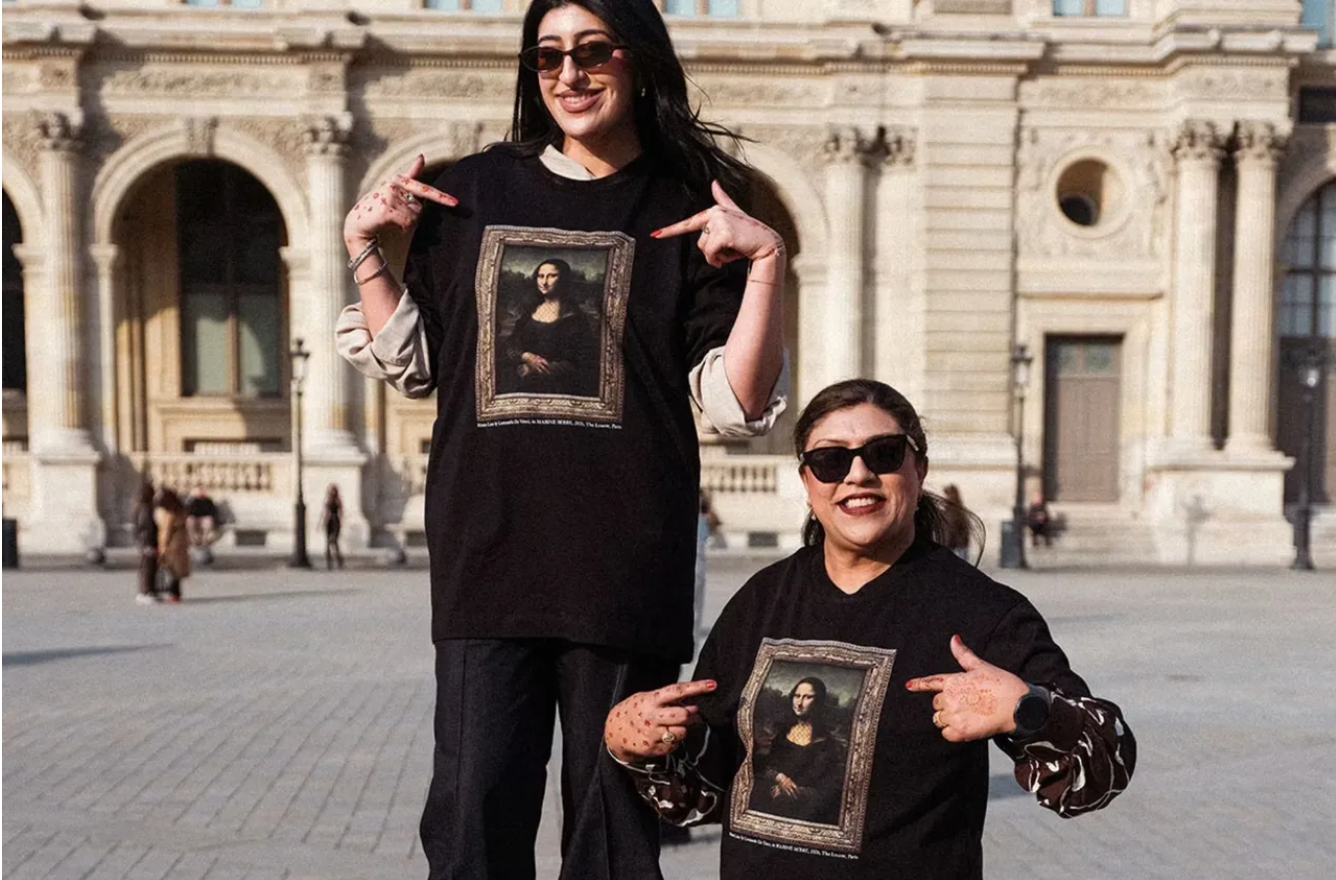
Marine Serre collaborates with the Louvre on a new capsule collection reinterpreting the Mona Lisa through regenerative fashion and sustainable luxury.
Marine Serre has never treated fashion as surface. Her work has consistently moved between past and future, mythology and utility, luxury and responsibility. Now she brings that vision into direct dialogue with one of the world’s most powerful cultural institutions: the Louvre Museum.
For her Fall/Winter 2026 presentation, Serre unveiled couture looks inspired by the museum’s vast archive of symbols, forms and historical narratives. But it is the next step – an exclusive three-piece capsule collection reinterpreting the Mona Lisa – that sharpens the conversation around fashion, heritage and sustainability.
This is not simply nostalgia. It is about continuity.
The Louvre has long functioned as more than a museum. It is a repository of visual memory – an accumulation of myths, archetypes and cultural codes that continue to shape contemporary aesthetics.
For Serre, that archive is not static. It becomes creative material. Her work has long carried echoes of history through sculptural draping, familiar symbols and silhouettes that can feel simultaneously ancient and futuristic. In this context, the Louvre becomes less a reference point than a creative engine.
The decision to reinterpret the Mona Lisa – arguably one of the most reproduced images in the world – is particularly loaded. Rather than approaching it as a symbol of untouchable heritage, Serre brings it back into circulation, translating the painting through the language that has defined her practice: repurposing, regeneration and material transformation.
In a fashion system often driven by constant newness, Serre proposes an alternative: some of the most powerful new ideas can emerge from what already exists.
Beyond Materials: Reworking Meaning
Much of fashion’s sustainability conversation still centres on fabrics, sourcing and supply chains. These questions matter, but they are not the whole story.
The Louvre collaboration introduces another dimension: cultural sustainability. Serre is not only reconsidering materials; she is reconsidering meaning. An image reproduced for more than five centuries is taken out of the museum context and placed into another cycle of interpretation, shifting from something observed to something worn.
It reflects the same principle behind her regenerative and upcycling practice: value does not always need to begin with extraction or the creation of something entirely new. It can come through transformation.
There is also an interesting question of value embedded in the collaboration. Luxury fashion and fine art have historically occupied parallel worlds, both shaped by exclusivity, cultural capital and ideas of permanence. Here, those boundaries begin to collapse. By placing the Mona Lisa onto garments informed by circular thinking, Serre brings together museum and wardrobe, masterpiece and everyday object, preservation and use.
What happens when an untouchable cultural icon becomes something lived in?
The project arrives at a moment when relationships between fashion and cultural institutions are becoming increasingly significant. Yet this collaboration goes beyond borrowing art as decoration. It asks what happens when cultural heritage itself becomes material for contemporary fashion — and whether reinterpretation can offer an alternative to the industry’s relentless pursuit of novelty.
The Fashion Issue Take
Marine Serre does not treat sustainability as a constraint. She treats it as a creative language. Her work with the Louvre suggests that fashion’s future may not depend solely on producing the unprecedented, but on transforming what already surrounds us — materials, symbols, histories and ideas — with greater intelligence.
In a world saturated with images and objects, perhaps one of fashion’s most relevant acts is not simply to create more, but to see differently what already exists. And in that sense, the Mona Lisa has rarely looked more contemporary.